



aACE software blog -  a complete resource for SMBs looking to improve their business processes. Read our articles on all things CRM, Accounting Software, ERP, Inventory Management & more

Stay up-to-date on product releases, company announcements, press coverage, and all things aACE.

aACE software blog -  a complete resource for SMBs looking to improve their business processes. Read our articles on all things CRM, Accounting Software, ERP, Inventory Management & more

Stay up-to-date on product releases, company announcements, press coverage, and all things aACE.

Read more about Want a Boost in Profits? Check Your Returns Policy

Want a Boost in Profits? Check Your Returns Policy

One of the most painful parts of running an eCommerce store is returns. It’s no secret that returns are looked down upon by online retailers in general. After all, don’t returns represent a loss?

What if the reality was that returns were actually the secret to improved sales? They wouldn’t be such a pain any more, would they?

Hand-in-Hand

If we really analyze things, sales and returns aren’t enemies. They’re inseparable best friends; friends in the sense that they actually cooperate and help each other out. We’ll get into details on that later, but for now, let’s consider the importance of returns.

Consumers want to be sure that if their purchase doesn’t work out, they won’t be stuck with a product that doesn’t fit or wasn’t what they were looking for. Who would buy with too much risk? No one. No one wants to be stuck with jeans that they can’t even button up.

Most returns (and one in three items purchased online ARE returned!) happen because the item didn’t fit, the wrong product was shipped out, it wasn’t what the customer was expecting, or it came damaged. Returns are a very normal and necessary part of the online buying experience.

Preventing Unnecessary Pain

Now, that isn’t to say that returns can’t be costing you money if you’re not being careful. But looking at it in a positive light, returns can be a learning experience and an opportunity to increase sales.

Most serious eCommerce retailers have implemented apps and other methods on their sites that help buyers to make an informed decision before they hit ‘‘buy’’. Return rates can be decreased by improving product descriptions as well as upgrading your site with other tools to help buyers make better choices – like multiple images, videos, zoom buttons or even short tutorials for technical products.

The Fine Print

Even after trying to ‘return-proof’ your shop, you won’t be able to prevent all returns. Sometimes it’s just inevitable. Regardless of whether or not you want to set up a returns process, it’s a must. The fantastic shopping experience that online buyers are looking for includes both the purchase and return experience, which means that you probably need to polish up your return process.

And it’s not just the process that needs to be easy. The return policy itself – that legal fine print – is so important to consumers that they actually read it. They’re looking for a smooth, convenient return process, and if that’s not available, they’re likely to buy from someone else. In fact, a UPS study found that there’s nearly an 80% chance that potential customers will leave your site if the return policy is convoluted and appears to make returning an item a lengthy, involved process.

In the long run, if you make even the returns a fantastic experience, customers will come back to you – and not to your competitors. And that means more sales.

What Consumers Want

You can get ahead by making your return policy similar to that of a brick and mortar retailer. The advantage of shopping locally is that you get exactly what you want, you take it home instantly, and you can return it easily.

So, why do people even choose eCommerce stores?

Convenience. They can sit around at home, or on their lunch break, and browse and buy. They are probably in love with your selection or your prices. And, thus, they’ll buy from you – if you have a decent return process and policy.

The risk of buying online is not getting what you were hoping for, and if you can eliminate that, then you can bring in more customers – and more profit.

You should ask yourself if your return policy is as convenient, fee-free, and easy as returns at local stores. If it isn’t, then you may be in trouble. Take a look at your competitor’s policy. Are they giving a better experience to the customer than you are? That’s why they prefer the competition.
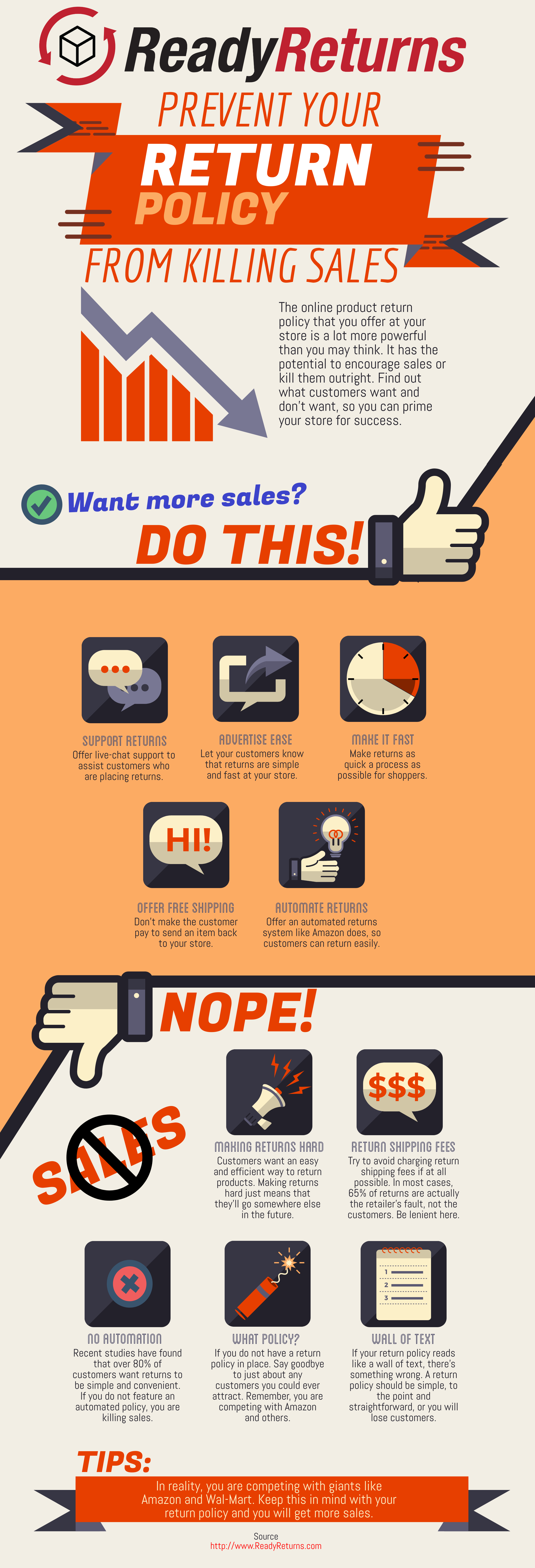
ReadyReturns Infographic

The Reality of it All

According to several sources, the importance of having that smooth-ride policy is something you just can’t keep ignoring if you want to have success in the online shopping world.

Don’t Fear Returns

Stop being afraid of returns. They aren’t your enemies, and they aren’t going to put you under.

It’s really a no brainer. Would you really want to purchase something from your store if:

It didn’t fit?

You didn’t like it?

Or the description was completely off?

Would you lose money when trying to return it? If you wouldn’t have a good experience no one else will either.

Take the time – make the time – to analyze your online store. Check the product descriptions. Go over the return policy. And smooth out the wrinkles so that you’ve got an easy, hassle-free and fee-free return process.

You won’t lose time or money on it. Actually, if you review the facts we’ve just presented, you’ll understand that an easy return policy improves sales, loyalty and long-term retention while reducing cart abandonment rates across the board.

Now that’s something all online retailers can get on board with.

About the Author

Michael Lazar is an Executive at ReadyCloud, an eCommerce CRM software suite that includes premium plugins like ReadyReturns, an automated online product returns solution for e-retailers. As a nationally syndicated author Lazar enjoys covering topics that are related to eCommerce returns.

Learn More


Editor's note: Michael Lazar is an Executive at aACE integration partner ReadyCloud. We're delighted to share his expertise in eCommerce with our audience.One of the most painful parts of running an eCommerce store is returns. It’s no secret that returns are looked down upon by online... Learn More

-->

Editor's note: Michael Lazar is an Executive at aACE integration partner ReadyCloud. We're delighted to share his expertise in eCommerce with our audience.

One of the most painful parts of running an eCommerce store is returns. It’s no secret that returns are looked down upon by online retailers in general. After all, don’t returns represent a loss?

What if the reality was that returns were actually the secret to improved sales? They wouldn’t be such a pain any more, would they?

Hand-in-Hand

If we really analyze things, sales and returns aren’t enemies. They’re inseparable best friends; friends in the sense that they actually cooperate and help each other out. We’ll get into details on that later, but for now, let’s consider the importance of returns.

Consumers want to be sure that if their purchase doesn’t work out, they won’t be stuck with a product that doesn’t fit or wasn’t what they were looking for. Who would buy with too much risk? No one. No one wants to be stuck with jeans that they can’t even button up.

Most returns (and one in three items purchased online ARE returned!) happen because the item didn’t fit, the wrong product was shipped out, it wasn’t what the customer was expecting, or it came damaged. Returns are a very normal and necessary part of the online buying experience.

Preventing Unnecessary Pain

Now, that isn’t to say that returns can’t be costing you money if you’re not being careful. But looking at it in a positive light, returns can be a learning experience and an opportunity to increase sales.

Most serious eCommerce retailers have implemented apps and other methods on their sites that help buyers to make an informed decision before they hit ‘‘buy’’. Return rates can be decreased by improving product descriptions as well as upgrading your site with other tools to help buyers make better choices – like multiple images, videos, zoom buttons or even short tutorials for technical products.

The Fine Print

Even after trying to ‘return-proof’ your shop, you won’t be able to prevent all returns. Sometimes it’s just inevitable. Regardless of whether or not you want to set up a returns process, it’s a must. The fantastic shopping experience that online buyers are looking for includes both the purchase and return experience, which means that you probably need to polish up your return process.

And it’s not just the process that needs to be easy. The return policy itself – that legal fine print – is so important to consumers that they actually read it. They’re looking for a smooth, convenient return process, and if that’s not available, they’re likely to buy from someone else. In fact, a UPS study found that there’s nearly an 80% chance that potential customers will leave your site if the return policy is convoluted and appears to make returning an item a lengthy, involved process.

In the long run, if you make even the returns a fantastic experience, customers will come back to you – and not to your competitors. And that means more sales.

What Consumers Want

You can get ahead by making your return policy similar to that of a brick and mortar retailer. The advantage of shopping locally is that you get exactly what you want, you take it home instantly, and you can return it easily.

So, why do people even choose eCommerce stores?

Convenience. They can sit around at home, or on their lunch break, and browse and buy. They are probably in love with your selection or your prices. And, thus, they’ll buy from you – if you have a decent return process and policy.

The risk of buying online is not getting what you were hoping for, and if you can eliminate that, then you can bring in more customers – and more profit.

You should ask yourself if your return policy is as convenient, fee-free, and easy as returns at local stores. If it isn’t, then you may be in trouble. Take a look at your competitor’s policy. Are they giving a better experience to the customer than you are? That’s why they prefer the competition.

ReadyReturns Infographic

The Reality of it All

According to several sources, the importance of having that smooth-ride policy is something you just can’t keep ignoring if you want to have success in the online shopping world.

Don’t Fear Returns

Stop being afraid of returns. They aren’t your enemies, and they aren’t going to put you under.

It’s really a no brainer. Would you really want to purchase something from your store if:

It didn’t fit?

You didn’t like it?

Or the description was completely off?

Would you lose money when trying to return it? If you wouldn’t have a good experience no one else will either.

Take the time – make the time – to analyze your online store. Check the product descriptions. Go over the return policy. And smooth out the wrinkles so that you’ve got an easy, hassle-free and fee-free return process.

You won’t lose time or money on it. Actually, if you review the facts we’ve just presented, you’ll understand that an easy return policy improves sales, loyalty and long-term retention while reducing cart abandonment rates across the board.

Now that’s something all online retailers can get on board with.

About the Author

Michael Lazar is an Executive at ReadyCloud, an eCommerce CRM software suite that includes premium plugins like ReadyReturns, an automated online product returns solution for e-retailers. As a nationally syndicated author Lazar enjoys covering topics that are related to eCommerce returns.

Learn More

Read more about Upgrading Business Operations Software? Be Aware of These Dangers

Upgrading Business Operations Software? Be Aware of These Dangers

However, the people who will be most affected by the change might have other feelings. As with any change, there can be a lack of interest, misunderstanding about goals, or even resentment over the extra effort required to learn the new tools.

Amid these different reactions, how do you keep your organization unified? How do you organize your company for a successful step forward to increased productivity and growth? To answer questions like these, Bloomberg Tax writer Xing Gao has collected insights from three leaders in business innovation: Michael Baccala of PwC, Harry Bains of NBC Universal, and Robert Giglietti of GE. As a top site for information, news, and insights about business, Bloomberg.com has published the highlights of the webcast interview.

One of the first points established is that your company has to confront the potential problems. Positive attitude and optimism are helpful in any business effort, but if it comes to the point that difficulties are being ignored, then a focus that is positive could create results that are negative. As Baccala says, the challenges are ultimately what your organization needs to consider.

Among the various challenges, one of the most critical is getting your team to understand and accept a new vision of their work. Bringing in new software is essentially rearranging the work environment. And it requires rearranging people's thoughts and feelings. A new work culture needs to prepare the way for the new work environment or you increase the risk of employees fighting change instead of contributing to success.

No one can deny the fact that "The Way We've Always Done Something" is a real mindset with real impacts on the business. Whether it's a tradition of relying on Excel, QuickBooks, NetSuite, or any other software package, the old way of doing things can short-circuit your efforts to establish something better. As Giglietti explains, you must escape the mentality of patching and repairing, creating a new vision of replacing.

Central to your new vision for the business, a communication plan can make a huge difference in the transition. Bains declared simply, "You have to get the message out to the employees." This messaging could be a series of emails focused on how the new technology will make their work obligations easier to fulfill. It might be a town hall-style meeting to discuss how automating basic tasks will open the way for grappling with more complex and valuable issues. However you personalize the content and the format, time spent on conveying these ideas to your team will be time well-spent.

A final recommendation is about preparing ways to measure the benefit of the new technology. The most meaningful gauge might be cost targets or greater time investments in higher-level tasks or something else entirely. But you need to identify these measures before the deployment. Gather some numbers of how things are currently going for a baseline. The measurable improvements after the deployment can help anchor the new tool within the new company culture.

Insightful business owners will recognize the pattern created by this advice from experienced sources. These principles of communication and culture development can help any software deployment be a success, even though your specific application of the principle will be unique.


The transition to new accounting, CRM, or ERP software gets easier the more you can show your team how the tool fits into their best practices. Then the updated software is less of a package dropped on top of the business. it's more of a tool customized to fit your organization's unique niche and value-proposition. aACE 5 is built on FileMaker, which makes it one of the most customizable and most cost-effective business operations products on the market today. It's an ideal match for mid-size companies interested in cross-platform, cloud-based solution, from wholesale distribution to light manufacturing. Learn more about what aACE 5 can do for your business by reading what current aACE clients have to say.

"Instead of simply maintaining our system, they took the time to understand our processes and worked with us to build a customized aACE system suited to our needs. The results exceeded our expectations, saving us several months of man-hours while improving the quality of our products." ~ Tae Koo, Manager of Design and Production, McGraw-Hill
Learn More

Plans to deploy new technology for your company can create both excitement and resistance. Some of your team may look at new software tools like a present or a new challenge. This may be especially true for those most involved with deploying the upgrade. However, the people who will be most... Learn More

-->

Plans to deploy new technology for your company can create both excitement and resistance. Some of your team may look at new software tools like a present or a new challenge. This may be especially true for those most involved with deploying the upgrade.

However, the people who will be most affected by the change might have other feelings. As with any change, there can be a lack of interest, misunderstanding about goals, or even resentment over the extra effort required to learn the new tools.

Amid these different reactions, how do you keep your organization unified? How do you organize your company for a successful step forward to increased productivity and growth? To answer questions like these, Bloomberg Tax writer Xing Gao has collected insights from three leaders in business innovation: Michael Baccala of PwC, Harry Bains of NBC Universal, and Robert Giglietti of GE. As a top site for information, news, and insights about business, Bloomberg.com has published the highlights of the webcast interview.

One of the first points established is that your company has to confront the potential problems. Positive attitude and optimism are helpful in any business effort, but if it comes to the point that difficulties are being ignored, then a focus that is positive could create results that are negative. As Baccala says, the challenges are ultimately what your organization needs to consider.

Among the various challenges, one of the most critical is getting your team to understand and accept a new vision of their work. Bringing in new software is essentially rearranging the work environment. And it requires rearranging people's thoughts and feelings. A new work culture needs to prepare the way for the new work environment or you increase the risk of employees fighting change instead of contributing to success.

No one can deny the fact that "The Way We've Always Done Something" is a real mindset with real impacts on the business. Whether it's a tradition of relying on Excel, QuickBooks, NetSuite, or any other software package, the old way of doing things can short-circuit your efforts to establish something better. As Giglietti explains, you must escape the mentality of patching and repairing, creating a new vision of replacing.

Central to your new vision for the business, a communication plan can make a huge difference in the transition. Bains declared simply, "You have to get the message out to the employees." This messaging could be a series of emails focused on how the new technology will make their work obligations easier to fulfill. It might be a town hall-style meeting to discuss how automating basic tasks will open the way for grappling with more complex and valuable issues. However you personalize the content and the format, time spent on conveying these ideas to your team will be time well-spent.

A final recommendation is about preparing ways to measure the benefit of the new technology. The most meaningful gauge might be cost targets or greater time investments in higher-level tasks or something else entirely. But you need to identify these measures before the deployment. Gather some numbers of how things are currently going for a baseline. The measurable improvements after the deployment can help anchor the new tool within the new company culture.

Insightful business owners will recognize the pattern created by this advice from experienced sources. These principles of communication and culture development can help any software deployment be a success, even though your specific application of the principle will be unique.


The transition to new accounting, CRM, or ERP software gets easier the more you can show your team how the tool fits into their best practices. Then the updated software is less of a package dropped on top of the business. it's more of a tool customized to fit your organization's unique niche and value-proposition. aACE 5 is built on FileMaker, which makes it one of the most customizable and most cost-effective business operations products on the market today. It's an ideal match for mid-size companies interested in cross-platform, cloud-based solution, from wholesale distribution to light manufacturing. Learn more about what aACE 5 can do for your business by reading what current aACE clients have to say.

"Instead of simply maintaining our system, they took the time to understand our processes and worked with us to build a customized aACE system suited to our needs. The results exceeded our expectations, saving us several months of man-hours while improving the quality of our products." ~ Tae Koo, Manager of Design and Production, McGraw-Hill
Learn More

Read more about Nine Tips from Experts to Help You Navigate the eCommerce Tax Revolution

Nine Tips from Experts to Help You Navigate the eCommerce Tax Revolution

The details of this decision are fairly involved. In overview, the journey started in 1992, with Quill Corp. v. North Dakota, regarding the standard for sales taxes and interstate commerce. The final appeal challenges South Dakota’s application of its sales tax to internet retailers who sell into South Dakota, but who have no property or employees in that state. The Court's June decision in favor of South Dakota's legislation was given alongside recommendations for legislators to come up with long-term solutions.

To help you navigate this huge change, Scott Peterson of Avalara has written an article for RetailTouchPoints.com. The central principle he explains is that the recent and ongoing changes in tax legislation require your business to confront tax issues with a thorough, reliable process. Like an ocean, the waves are never steady, so you must establish a system to cope with this ongoing fluctuation.

The nine main features of a well-balanced tax handling process are:

1. Understand each state’s tax laws and know your nexus - Physical presence as the test for nexus has been joined by "extensive virtual presence". Obviously that puts a lot of attention on what the exact meaning of "extensive" is. States are starting to pass more laws basing sales tax obligations on the number of sales or amount of monies.

2. Heed changing filing requirements - States are gradually shifting to e-filing. Make sure that your tax process keeps you updated about current payment options and requirements.

3. Track required prepayments - An increasing number of jurisdictions are turning to PRE-payment for larger tax liabilities and existing pre-payment laws have schedules ranging from 1-4 payments a month. Your process must be flexible and must stay tuned in to the evolving demands.

4. Reconcile your sales tax payable account - The process you adopt must keep the books accurate as well.

5. Regularly confirm filing frequency for each state - Government agencies are more frequently using email and notifications on your tax account to handle communications. But even if a message gets lost en route, you will still be held accountable. In your tax process, include a way to proactively verify your deadlines.

6. Accurately tax new products - This variation to your processes arises directly out of your success. So, well done! But a new product line might entail new complexity for taxation. It's entirely possible that a product is taxable in one state, but exempt in another. As you roll out the new product, make sure its tied into your tax process to verify all the details. Similarly, when you expand sales to a new state, don't assume that the tax obligations will be the same as what you're used to.

7. Stay current with exemption certificates - An easy audit target is tax exemption certificates that are incorrect, misplaced, or expired. In your tax process, be sure that a step is focused on keeping these records watertight.

8. Respond to notices promptly - When a government agency tries to contact you, they take themselves very seriously. Not responding in a timely manner can result in levies, liens, and suspensions. Along with the large-scale changes, your tax handling process must address needs that arise on a day-to-day basis.

9. Use exact location, not ZIP codes - As states continue to refine their taxation requirements, it may be increasingly common for a single postal code to have multiple sales tax rates. Not only does your tax process need to stay up to date on these developments, but your calculations need to be accurate. It's the only way to avoid audits, penalties, and return reconciliations.

As Peterson suggests in conclusion, your protocols for handling tax responsibilities don't need to re-invent the wheel. There are a variety of tools already developed to automate sales tax chores and protect your company from audits. Leverage these technologies to ensure tax compliance and boost your company growth.


Going one step farther in your company progression, after a solid taxation process and high quality tax-handling tools, the pinnacle is to have tax functionality integrated into your business operations software. This is where the benefits of computerized automation shine even brighter. Your tax support keeps your business ship-shape while the accounting, CRM, and ERP software accelerates your business velocity. You can concentrate more of your team's attention on the tasks that boost profits. Learn more today about how the aACE business suite integrates with AvaTax.

"aACE was able to customize a few key components for us very intelligently that now just work. Exactly the way we need them to." ~ Derek Navratil, IT Administrator, Janibell Inc.
Learn More

Running a business can be stressful, like sailing on the open ocean. Waves and winds are constantly changing, forcing you to continually adapt. And one of the largest recent waves across the U.S. market is the Supreme Court decision on South Dakota v. Wayfair. The details of this decision are... Learn More

-->

Running a business can be stressful, like sailing on the open ocean. Waves and winds are constantly changing, forcing you to continually adapt. And one of the largest recent waves across the U.S. market is the Supreme Court decision on South Dakota v. Wayfair.

The details of this decision are fairly involved. In overview, the journey started in 1992, with Quill Corp. v. North Dakota, regarding the standard for sales taxes and interstate commerce. The final appeal challenges South Dakota’s application of its sales tax to internet retailers who sell into South Dakota, but who have no property or employees in that state. The Court's June decision in favor of South Dakota's legislation was given alongside recommendations for legislators to come up with long-term solutions.

To help you navigate this huge change, Scott Peterson of Avalara has written an article for RetailTouchPoints.com. The central principle he explains is that the recent and ongoing changes in tax legislation require your business to confront tax issues with a thorough, reliable process. Like an ocean, the waves are never steady, so you must establish a system to cope with this ongoing fluctuation.

The nine main features of a well-balanced tax handling process are:

1. Understand each state’s tax laws and know your nexus - Physical presence as the test for nexus has been joined by "extensive virtual presence". Obviously that puts a lot of attention on what the exact meaning of "extensive" is. States are starting to pass more laws basing sales tax obligations on the number of sales or amount of monies.

2. Heed changing filing requirements - States are gradually shifting to e-filing. Make sure that your tax process keeps you updated about current payment options and requirements.

3. Track required prepayments - An increasing number of jurisdictions are turning to PRE-payment for larger tax liabilities and existing pre-payment laws have schedules ranging from 1-4 payments a month. Your process must be flexible and must stay tuned in to the evolving demands.

4. Reconcile your sales tax payable account - The process you adopt must keep the books accurate as well.

5. Regularly confirm filing frequency for each state - Government agencies are more frequently using email and notifications on your tax account to handle communications. But even if a message gets lost en route, you will still be held accountable. In your tax process, include a way to proactively verify your deadlines.

6. Accurately tax new products - This variation to your processes arises directly out of your success. So, well done! But a new product line might entail new complexity for taxation. It's entirely possible that a product is taxable in one state, but exempt in another. As you roll out the new product, make sure its tied into your tax process to verify all the details. Similarly, when you expand sales to a new state, don't assume that the tax obligations will be the same as what you're used to.

7. Stay current with exemption certificates - An easy audit target is tax exemption certificates that are incorrect, misplaced, or expired. In your tax process, be sure that a step is focused on keeping these records watertight.

8. Respond to notices promptly - When a government agency tries to contact you, they take themselves very seriously. Not responding in a timely manner can result in levies, liens, and suspensions. Along with the large-scale changes, your tax handling process must address needs that arise on a day-to-day basis.

9. Use exact location, not ZIP codes - As states continue to refine their taxation requirements, it may be increasingly common for a single postal code to have multiple sales tax rates. Not only does your tax process need to stay up to date on these developments, but your calculations need to be accurate. It's the only way to avoid audits, penalties, and return reconciliations.

As Peterson suggests in conclusion, your protocols for handling tax responsibilities don't need to re-invent the wheel. There are a variety of tools already developed to automate sales tax chores and protect your company from audits. Leverage these technologies to ensure tax compliance and boost your company growth.


Going one step farther in your company progression, after a solid taxation process and high quality tax-handling tools, the pinnacle is to have tax functionality integrated into your business operations software. This is where the benefits of computerized automation shine even brighter. Your tax support keeps your business ship-shape while the accounting, CRM, and ERP software accelerates your business velocity. You can concentrate more of your team's attention on the tasks that boost profits. Learn more today about how the aACE business suite integrates with AvaTax.

"aACE was able to customize a few key components for us very intelligently that now just work. Exactly the way we need them to." ~ Derek Navratil, IT Administrator, Janibell Inc.
Learn More

Read more about 5 Guidelines to Ensure Success for Your CRM Implementation

5 Guidelines to Ensure Success for Your CRM Implementation

A 50% failure rate on CRM system implementations is a worrisome statistic, to say the least. That companies continue to attempt these software deployments is a testament to the value of CRM software and to each company's insight. The rewards that can come from a well-functioning customer relationship management system is worth the risk.

To help you hedge your bets, Richard Young has published an article on Bullhorn.com, pointing out the five most common tripwires for CRM implementations:

1. Too Little Leadership

The senior personnel who fully understand the business need to be involved in the software selection. It's fine to have junior staff do the legwork and prepare a list of options. But senior managers are the ones who know the company's niche and what the CRM system needs to do to help the company progress.

These leaders need to be active in reviewing the software option, including sending the research group back to the drawing board. They need to participate in focused discussions to ensure the best business operations program is identified. This will also set an example to the rest of the company about the importance of making the software deployment a success. These company leaders will be able to talk easily, clearly, and persuasively about the benefits that lay in store on the other side of the transition.

2. Too Few Clearly Defined Goals

When it isn't clear what exactly the CRM system will do, it becomes much harder to achieve success. This is why establishing specific goals is vital. The broad initiative of 'improving the customer experience' is an important direction, but doesn't give much for measurable progress. This improvement needs to be defined in more detail.

Rather than a single, over-arching finish line for the project, more goals can bring better results. As the first objectives are successfully accomplished, it can raise team morale and build momentum for the upcoming efforts. In essence, when you outline your goals, you can create a self-fulfilling prophecy of your project's success.

3. Too Much IT Involvement

This point is not to say the IT group (or expert) on your team should not be part of the CRM deployment. Instead, the role of IT personnel needs to be clearly defined. Usually these team members won't have the necessary understanding of the sales process and service levels to help with deciding which software to select. Once the sales and marketing leaders identify a short-list of CRM packages, the IT staff can offer input on technical details that may make one option a clear winner. And of course IT will be essential for the actual deployment after the best solution has been selected.

4. Too Much Inflexibility

Getting the software installed is only part of the project. After that point, the challenge is to get your team to use the application and integrate it into their daily activities. Ideally the initial discussions about the best software solution will address these vital concerns and the tool you select will support the ways your staff work. The worst case scenario however is to buy software that doesn't mesh with your team's current processes and then to force them to change what they do because the money has already been spent.

In contrast, when the end-user's workflows are part of the initial discussions, it can be easier to discuss how slight changes to the process can bring valuable dividends. And a quality business operations product will even allow individuals to accomplish their work in the ways that make the most sense to them.

5. Too Little Storage

This can be a trick question during the sales process, so be sure to exercise due diligence and find out all the constraints on each software package. You do not want to finish the deployment and then have a follow-up conversation about extra costs for additional data storage.

While storage space isn't a particularly sexy feature, it can be crucial. If data limits mean that some information is going to regularly be deleted from the system, it will be a hard choice to decide what to throw out. The information that sales people need will drive revenue, while the info that senior management needs will drive growth. Which can you do without?

The underlying principle from Young's article is that no company can afford to rush into a CRM integration. Success hinges on mindful preparation and follow-through.

The general process for purchasing business operations software — whether it is an accounting system, a CRM tool, or an ERP solution — is relatively the same. Each type of software is a critical investment in your company's development. Learn more about how aACE can revolutionize a business by reading our success stories.

"aACE is a fabulously refined program that is very easy to use. Been using aACE for the last 8 years and it's been wonderful working with them." ~ Bumkee Kim, Janibell Inc.

Learn More

Will your software upgrade be successful? According to some sources, you can tell by the flip of a coin — heads you win, tails you lose.A 50% failure rate on CRM system implementations is a worrisome statistic, to say the least. That companies continue to attempt these software deployments is a... Learn More

-->

Will your software upgrade be successful? According to some sources, you can tell by the flip of a coin — heads you win, tails you lose.

A 50% failure rate on CRM system implementations is a worrisome statistic, to say the least. That companies continue to attempt these software deployments is a testament to the value of CRM software and to each company's insight. The rewards that can come from a well-functioning customer relationship management system is worth the risk.

To help you hedge your bets, Richard Young has published an article on Bullhorn.com, pointing out the five most common tripwires for CRM implementations:

1. Too Little Leadership

The senior personnel who fully understand the business need to be involved in the software selection. It's fine to have junior staff do the legwork and prepare a list of options. But senior managers are the ones who know the company's niche and what the CRM system needs to do to help the company progress.

These leaders need to be active in reviewing the software option, including sending the research group back to the drawing board. They need to participate in focused discussions to ensure the best business operations program is identified. This will also set an example to the rest of the company about the importance of making the software deployment a success. These company leaders will be able to talk easily, clearly, and persuasively about the benefits that lay in store on the other side of the transition.

2. Too Few Clearly Defined Goals

When it isn't clear what exactly the CRM system will do, it becomes much harder to achieve success. This is why establishing specific goals is vital. The broad initiative of 'improving the customer experience' is an important direction, but doesn't give much for measurable progress. This improvement needs to be defined in more detail.

Rather than a single, over-arching finish line for the project, more goals can bring better results. As the first objectives are successfully accomplished, it can raise team morale and build momentum for the upcoming efforts. In essence, when you outline your goals, you can create a self-fulfilling prophecy of your project's success.

3. Too Much IT Involvement

This point is not to say the IT group (or expert) on your team should not be part of the CRM deployment. Instead, the role of IT personnel needs to be clearly defined. Usually these team members won't have the necessary understanding of the sales process and service levels to help with deciding which software to select. Once the sales and marketing leaders identify a short-list of CRM packages, the IT staff can offer input on technical details that may make one option a clear winner. And of course IT will be essential for the actual deployment after the best solution has been selected.

4. Too Much Inflexibility

Getting the software installed is only part of the project. After that point, the challenge is to get your team to use the application and integrate it into their daily activities. Ideally the initial discussions about the best software solution will address these vital concerns and the tool you select will support the ways your staff work. The worst case scenario however is to buy software that doesn't mesh with your team's current processes and then to force them to change what they do because the money has already been spent.

In contrast, when the end-user's workflows are part of the initial discussions, it can be easier to discuss how slight changes to the process can bring valuable dividends. And a quality business operations product will even allow individuals to accomplish their work in the ways that make the most sense to them.

5. Too Little Storage

This can be a trick question during the sales process, so be sure to exercise due diligence and find out all the constraints on each software package. You do not want to finish the deployment and then have a follow-up conversation about extra costs for additional data storage.

While storage space isn't a particularly sexy feature, it can be crucial. If data limits mean that some information is going to regularly be deleted from the system, it will be a hard choice to decide what to throw out. The information that sales people need will drive revenue, while the info that senior management needs will drive growth. Which can you do without?

The underlying principle from Young's article is that no company can afford to rush into a CRM integration. Success hinges on mindful preparation and follow-through.

The general process for purchasing business operations software — whether it is an accounting system, a CRM tool, or an ERP solution — is relatively the same. Each type of software is a critical investment in your company's development. Learn more about how aACE can revolutionize a business by reading our success stories.

"aACE is a fabulously refined program that is very easy to use. Been using aACE for the last 8 years and it's been wonderful working with them." ~ Bumkee Kim, Janibell Inc.

Learn More

Read more about Successfully Diversify Your eCommerce Products Using 3 Simple Steps

Successfully Diversify Your eCommerce Products Using 3 Simple Steps

The next challenge, now that smart entrepreneurs recognize eCommerce as a valuable avenue, is to differentiate yourself among online sellers. The number of eCommerce stores for your industry and your product will only increase as time goes on. You need to be thinking now about what you can do to make your brand stand out from that crowd.

The single-most important distinguishing feature for your business is rapidly becoming the customer experience you provide. But an important factor in that experience is diversification, as highlighted in a guest-contributed article for Entrepreneur.com, "3 Key Ways to Diversify Your Ecommerce Store".

Diversification may seem contrary to advice about specializing and being unique on the market. However, expanding the selection of products you offer can benefit your business by "increasing sales to existing customers or opening avenues to entirely new demographics." This can actually be part of your distinct customer experience, where your shoppers can find the supporting products they want right on your eCommerce site.

To successfully diversify, use these three guidelines:

1. Identify Your Niche

Where we're balancing between the two recommendations to specialize and to diversify, the key is research. A random jumble of products on your eCommerce shelf isn't going to help much. And while there is a wealth of general advice about picking a niche for your business, the focus of your research needs to be your customers.

What additional items or supporting products do they find useful? After they purchase from you, what else do they need? For example, a company that manufactures water filters could also provide cups and water bottles.

To help gather and analyze this information, you should leverage your CRM system, which can make information collected by sales staff and follow-up contacts available to your decision-makers.

2. Test Your Products

When you select the diversified products for your eCommerce store, be sure that you know what you're selling. If something doesn't work right on the water bottles our example company provides, they want to know about it before their customers encounter it. In your long-term goal of building relationships and clients who are also fans of your company, a poorly made supporting product isn't worth the trouble it could cause. Your reputation is worth ordering sample products and checking things out.

After you feel comfortable with these items though, you don't have to double your inventory in order to have the items ready for sale. Leverage drop-shipping to purchase items on-demand for your customers and ship directly from the third-party merchant.

3. Double-down on Branding

Your business identity is yours to shape. And having the most popular supporting products can be a strong addition to your reputation. Publicize your efforts to create the absolute best customer experience on your eCommerce site. Let people know that this is integral to your brand. New questionnaires and new additions to the line-up can each be material for social media efforts, blog posts, or newsletters.

As noted before, throwing dollars around for any available option is not the effective approach — instead you should concentrate on the channels that your current clients favor. Create the identity and display it where it will be seen by the people who need to know who you are. Although the ways brand value is measured can differ, there is little debate over the fact that your brand identity is crucial.


Whether your industry is in professional services, wholesale distribution, or even light manufacturing, you can take advantage of product diversification in order to boost your customer experience. Start with learning more from your loyal customers, then make sure what you'll be offering is a quality addition, and then make sure people know what you're doing and why. Diversification can help you craft exactly the right identity that resonates with your customer base.

And with robust yet affordable CRM tools, aACE 5 can help you coordinate information from your customers so you can make the strategic decisions that will foster your company growth. From mobile apps to cross-platform support, the functionality you need is available now. Learn more today.

"aACE will be a valuable asset for us for many years to come." ~ Kevin Richardson, Director of Operations and Finance, On Hold Co.
Learn More

eCommerce has quickly become a vital part of a modern company's sales approach. From the first sale across the ARPANET in the 1970's (an exchange of cannabis between students at Stanford and MIT) until today, when eCommerce sales in the U.S. alone exceed $300 million, the growth of this platform... Learn More

-->

eCommerce has quickly become a vital part of a modern company's sales approach. From the first sale across the ARPANET in the 1970's (an exchange of cannabis between students at Stanford and MIT) until today, when eCommerce sales in the U.S. alone exceed $300 million, the growth of this platform hasn't always been smooth. Its presence, however, is undeniable.

The next challenge, now that smart entrepreneurs recognize eCommerce as a valuable avenue, is to differentiate yourself among online sellers. The number of eCommerce stores for your industry and your product will only increase as time goes on. You need to be thinking now about what you can do to make your brand stand out from that crowd.

The single-most important distinguishing feature for your business is rapidly becoming the customer experience you provide. But an important factor in that experience is diversification, as highlighted in a guest-contributed article for Entrepreneur.com, "3 Key Ways to Diversify Your Ecommerce Store".

Diversification may seem contrary to advice about specializing and being unique on the market. However, expanding the selection of products you offer can benefit your business by "increasing sales to existing customers or opening avenues to entirely new demographics." This can actually be part of your distinct customer experience, where your shoppers can find the supporting products they want right on your eCommerce site.

To successfully diversify, use these three guidelines:

1. Identify Your Niche

Where we're balancing between the two recommendations to specialize and to diversify, the key is research. A random jumble of products on your eCommerce shelf isn't going to help much. And while there is a wealth of general advice about picking a niche for your business, the focus of your research needs to be your customers.

What additional items or supporting products do they find useful? After they purchase from you, what else do they need? For example, a company that manufactures water filters could also provide cups and water bottles.

To help gather and analyze this information, you should leverage your CRM system, which can make information collected by sales staff and follow-up contacts available to your decision-makers.

2. Test Your Products

When you select the diversified products for your eCommerce store, be sure that you know what you're selling. If something doesn't work right on the water bottles our example company provides, they want to know about it before their customers encounter it. In your long-term goal of building relationships and clients who are also fans of your company, a poorly made supporting product isn't worth the trouble it could cause. Your reputation is worth ordering sample products and checking things out.

After you feel comfortable with these items though, you don't have to double your inventory in order to have the items ready for sale. Leverage drop-shipping to purchase items on-demand for your customers and ship directly from the third-party merchant.

3. Double-down on Branding

Your business identity is yours to shape. And having the most popular supporting products can be a strong addition to your reputation. Publicize your efforts to create the absolute best customer experience on your eCommerce site. Let people know that this is integral to your brand. New questionnaires and new additions to the line-up can each be material for social media efforts, blog posts, or newsletters.

As noted before, throwing dollars around for any available option is not the effective approach — instead you should concentrate on the channels that your current clients favor. Create the identity and display it where it will be seen by the people who need to know who you are. Although the ways brand value is measured can differ, there is little debate over the fact that your brand identity is crucial.


Whether your industry is in professional services, wholesale distribution, or even light manufacturing, you can take advantage of product diversification in order to boost your customer experience. Start with learning more from your loyal customers, then make sure what you'll be offering is a quality addition, and then make sure people know what you're doing and why. Diversification can help you craft exactly the right identity that resonates with your customer base.

And with robust yet affordable CRM tools, aACE 5 can help you coordinate information from your customers so you can make the strategic decisions that will foster your company growth. From mobile apps to cross-platform support, the functionality you need is available now. Learn more today.

"aACE will be a valuable asset for us for many years to come." ~ Kevin Richardson, Director of Operations and Finance, On Hold Co.
Learn More

Read more about Avoiding Tax Audits Using Research-based Recommendations

Avoiding Tax Audits Using Research-based Recommendations

The research was conducted by Avalara and Peisner Johnson & Company. They requested information from both Texas and California state governments. The Texas Department of Revenue provided data on sales and use tax audits from 1989—2016 (approximately 64,000 audits). The California State Board of Equalization Annual Report (2013—2014) provided details on the state’s sales and use tax audit revenue and supporting demographics.

An analysis of this data showed several important patterns:

  • State auditors tend to focus attention on industries where past audits have shown tax discrepancies.
  • The most commonly audited industries are retail, manufacturing, construction, wholesale/distribution, and food services.
  • A third of the audits conducted focused on companies with headquarters outside of the state where the audit took place.
  • One of the most common noncompliance issues that triggers an audit hinges on untaxed purchases from out-of-state vendors.
  • Audit assessments from use tax not being paid came to an average total cost of more than $100,000.

Clearly, taking a little time to prevent an audit can be very valuable. And a good first step may be to get more information from the free white paper.

One of the most useful insights that Avalara offers on this issue is that the state government and the actual auditors are not the enemy. The real threat is risk. By targeting the business processes and procedures that could bring your business to an audit, you can prevent that audit. The regulations for sales tax are complex and variable though, so it may be worthwhile to gather support from experts.


To further secure your organization, you can integrate sales tax automation with your business operations software. aACE 5 offers the surety of a strong connection to AvaTax. The precision of GPS coordinates and the vigilance of continuously updated tax regulations can put your mind at ease. Learn more today.

"As a company, we had been through 3 previous versions of FileMaker software and we were looking for a system that was able to grow and change with us instead of just scraping an old system and starting fresh every few years. aACE is that system for us. As new challenges and demands arise, Michael and his team are able to adapt and customize our system to meet those needs." ~ Brittany Ulrich, Vice President, ASAP Event Advertising
Learn More

The threat of a tax audit might lurk in the mind of any sensible business owner. With states looking to address budget needs with more aggressive auditing, this possibility is becoming more and more likely. But help for avoiding this hazard is available in a free white paper. The research was... Learn More

-->

The threat of a tax audit might lurk in the mind of any sensible business owner. With states looking to address budget needs with more aggressive auditing, this possibility is becoming more and more likely. But help for avoiding this hazard is available in a free white paper.

The research was conducted by Avalara and Peisner Johnson & Company. They requested information from both Texas and California state governments. The Texas Department of Revenue provided data on sales and use tax audits from 1989—2016 (approximately 64,000 audits). The California State Board of Equalization Annual Report (2013—2014) provided details on the state’s sales and use tax audit revenue and supporting demographics.

An analysis of this data showed several important patterns:

  • State auditors tend to focus attention on industries where past audits have shown tax discrepancies.
  • The most commonly audited industries are retail, manufacturing, construction, wholesale/distribution, and food services.
  • A third of the audits conducted focused on companies with headquarters outside of the state where the audit took place.
  • One of the most common noncompliance issues that triggers an audit hinges on untaxed purchases from out-of-state vendors.
  • Audit assessments from use tax not being paid came to an average total cost of more than $100,000.

Clearly, taking a little time to prevent an audit can be very valuable. And a good first step may be to get more information from the free white paper.

One of the most useful insights that Avalara offers on this issue is that the state government and the actual auditors are not the enemy. The real threat is risk. By targeting the business processes and procedures that could bring your business to an audit, you can prevent that audit. The regulations for sales tax are complex and variable though, so it may be worthwhile to gather support from experts.


To further secure your organization, you can integrate sales tax automation with your business operations software. aACE 5 offers the surety of a strong connection to AvaTax. The precision of GPS coordinates and the vigilance of continuously updated tax regulations can put your mind at ease. Learn more today.

"As a company, we had been through 3 previous versions of FileMaker software and we were looking for a system that was able to grow and change with us instead of just scraping an old system and starting fresh every few years. aACE is that system for us. As new challenges and demands arise, Michael and his team are able to adapt and customize our system to meet those needs." ~ Brittany Ulrich, Vice President, ASAP Event Advertising
Learn More

Read more about Manage Risk Towards Success with 10 ERP Implementation Best Practices

Manage Risk Towards Success with 10 ERP Implementation Best Practices

They point out how an Enterprise Resource Planning system, whether its a new solution or the evolution of your current solution, needs to revolve around the parts of your business that are growing most rapidly. This helps ensure the system will be situated to support profitable growth. That may be as you are extending a current product line, rolling out a new product, or pivoting to pursue a business model that takes advantage of new opportunities. Bob and Steve recommend viewing your ERP solution as a platform for delivering value to new and existing customers.

Describing things from that viewpoint, they recommend that any organization preparing to implement an ERP system must have an intentional focus. This includes clarity on the plan, the accountability, and the ownership. When you prepare the stage with a focused business objective, implementation expertise, and a fluent knowledge of your unique niche and other technologies, you can feel confident that your ERP deployment will be successful.

To help you prepare for an ERP implementation, Bob and Steve share these ten best practices that you can apply in your company:

  1. List business goals supported by metrics - These productivity numbers map out how beneficial the ERP solution can be. They're vital for helping the people in your company understand the need and the opportunity at hand.
  2. Describe current operations - A clear knowledge of your processes today will help you get the most value from the configuration options in the new system tomorrow.
  3. Stage-gate process to manage customization requests - You should plan on some customization for your new ERP solution; however, success demands that you have person clearly assigned to as a filter to separate vital adaptations from the nice-to-have changes that can be tweaked after the initial roll-out is complete.
  4. Leverage experienced partners - Each of the people on your team is an expert on part of your business; getting support from an expert on software deployment can pay back dividends later.
  5. Track communications and change management - Change always stirs up some resistance, but sharing information about what is going to happen and why it will be valuable to the company can help pave the way for a smooth transition.
  6. Promote power users as a resource - Identifying the people already on your team who can be a resource for others also helps integrate the new tool into the company. Maximize the benefit here with a reward or recognition program for those who are adding this additional value.
  7. Celebrate successes - Highlighting the good work people are doing and the progressive benefits of the new system will sustain the energy needed for the changeover.
  8. Plan for project evolution - Continuous improvement is the keyword here. From the stage-gate owner mentioned above, at the conclusion of the initial deployment you will likely have a list of additional functionality that can enhance your business operations further.
  9. Focus your operations software - To balance out Best Practice #8, be sure to keep focused on the most valuable upgrades, based on the metrics you've gathered and the new numbers your ERP system will be able to provide.
  10. Stay informed about new technologies - Industry 4.0, IIoT, and MES can all benefit a company, but they come with a cost of expense and complexity. Stay alert for opportunities to leverage these ongoing technology evolutions.

Bob and Steve wrap up by reiterating the idea that an ERP solution cannot be seen as a project that just ends one day. The ERP data will feed back into your processes and your refined processes will make certain data more valuable. This needs to be the long-term picture you paint for the implementation team, the executives, and the people on the shop floor. When your entire organization is on the same page of continuous improvement, you're well on your way to avoiding the pitfalls and securing the ROI that a new ERP system can bring.

With a robust yet affordable ERP solution, aACE 5 can also support your accounting and CRM needs. Beyond this vital core functionality, aACE 5 is integrated with inventory tracking, order management, production processes, and shipping/receiving. Our goal is to give you 360-degree visibility on your operations plus time-saving automation. We help companies focus on the high-value strategic aspects that lead to accelerated business velocity and growth.

"I had the pleasure of working with aACE Software in developing and implementing a customized FileMaker system for my company — a mid-size, creative services agency. We needed a strong project management system with the capability of measuring costs in real-time, which could replace our old, fragmented database system without losing any of the valuable data that was stored there. Before we even started, the aACE team spent a lot of time with our agency leaders: from IT, to project management teams, to financial services, to the company principle — making sure all agency functions would be fully supported by the new aACE system. What came out of this involved consultation was not only a great system, but also vast improvements to streamline our process." ~ Richelle Rothermich, Vice President & Managing Director, The O Group
Learn More

Consultants can be a great source of business information. They work with multiple companies and see lots of projects go from start to completion. Drawing on this kind of background, Bob Blanchette and Steve Bieszczat have published a helpful article on the Manufacturing Business Technology website... Learn More

-->

Consultants can be a great source of business information. They work with multiple companies and see lots of projects go from start to completion. Drawing on this kind of background, Bob Blanchette and Steve Bieszczat have published a helpful article on the Manufacturing Business Technology website detailing the top 10 best practices for manufacturers to follow when implementing an ERP solution.

They point out how an Enterprise Resource Planning system, whether its a new solution or the evolution of your current solution, needs to revolve around the parts of your business that are growing most rapidly. This helps ensure the system will be situated to support profitable growth. That may be as you are extending a current product line, rolling out a new product, or pivoting to pursue a business model that takes advantage of new opportunities. Bob and Steve recommend viewing your ERP solution as a platform for delivering value to new and existing customers.

Describing things from that viewpoint, they recommend that any organization preparing to implement an ERP system must have an intentional focus. This includes clarity on the plan, the accountability, and the ownership. When you prepare the stage with a focused business objective, implementation expertise, and a fluent knowledge of your unique niche and other technologies, you can feel confident that your ERP deployment will be successful.

To help you prepare for an ERP implementation, Bob and Steve share these ten best practices that you can apply in your company:

  1. List business goals supported by metrics - These productivity numbers map out how beneficial the ERP solution can be. They're vital for helping the people in your company understand the need and the opportunity at hand.
  2. Describe current operations - A clear knowledge of your processes today will help you get the most value from the configuration options in the new system tomorrow.
  3. Stage-gate process to manage customization requests - You should plan on some customization for your new ERP solution; however, success demands that you have person clearly assigned to as a filter to separate vital adaptations from the nice-to-have changes that can be tweaked after the initial roll-out is complete.
  4. Leverage experienced partners - Each of the people on your team is an expert on part of your business; getting support from an expert on software deployment can pay back dividends later.
  5. Track communications and change management - Change always stirs up some resistance, but sharing information about what is going to happen and why it will be valuable to the company can help pave the way for a smooth transition.
  6. Promote power users as a resource - Identifying the people already on your team who can be a resource for others also helps integrate the new tool into the company. Maximize the benefit here with a reward or recognition program for those who are adding this additional value.
  7. Celebrate successes - Highlighting the good work people are doing and the progressive benefits of the new system will sustain the energy needed for the changeover.
  8. Plan for project evolution - Continuous improvement is the keyword here. From the stage-gate owner mentioned above, at the conclusion of the initial deployment you will likely have a list of additional functionality that can enhance your business operations further.
  9. Focus your operations software - To balance out Best Practice #8, be sure to keep focused on the most valuable upgrades, based on the metrics you've gathered and the new numbers your ERP system will be able to provide.
  10. Stay informed about new technologies - Industry 4.0, IIoT, and MES can all benefit a company, but they come with a cost of expense and complexity. Stay alert for opportunities to leverage these ongoing technology evolutions.

Bob and Steve wrap up by reiterating the idea that an ERP solution cannot be seen as a project that just ends one day. The ERP data will feed back into your processes and your refined processes will make certain data more valuable. This needs to be the long-term picture you paint for the implementation team, the executives, and the people on the shop floor. When your entire organization is on the same page of continuous improvement, you're well on your way to avoiding the pitfalls and securing the ROI that a new ERP system can bring.

With a robust yet affordable ERP solution, aACE 5 can also support your accounting and CRM needs. Beyond this vital core functionality, aACE 5 is integrated with inventory tracking, order management, production processes, and shipping/receiving. Our goal is to give you 360-degree visibility on your operations plus time-saving automation. We help companies focus on the high-value strategic aspects that lead to accelerated business velocity and growth.

"I had the pleasure of working with aACE Software in developing and implementing a customized FileMaker system for my company — a mid-size, creative services agency. We needed a strong project management system with the capability of measuring costs in real-time, which could replace our old, fragmented database system without losing any of the valuable data that was stored there. Before we even started, the aACE team spent a lot of time with our agency leaders: from IT, to project management teams, to financial services, to the company principle — making sure all agency functions would be fully supported by the new aACE system. What came out of this involved consultation was not only a great system, but also vast improvements to streamline our process." ~ Richelle Rothermich, Vice President & Managing Director, The O Group
Learn More

Read more about 3 Approaches to Using CRM for Better Customer Experience

3 Approaches to Using CRM for Better Customer Experience

The key factor: customer experience.

What does that mean? According to Customer Experience Futurist Blake Morgan, it means that your customer's perception of your brand IS the reality of your brand. If they feel you offer everything they need, then you ARE the best company.

Daniel Newman provides even more support in his article on Forbes.com — Want Better Customer Experience? Combine CRM and Customer Feedback:

  • 86% of buyers value a high-quality experience
  • Finding new clients costs 6 times more than retaining current clients

So how do you get to the point of pleasing and retaining these customers? The short answer is customer feedback. Establish a company culture where listening to your clients happens continuously. Then get the information your staff gather to the people who need it.

For this aspect of the solution, your CRM system is the go-to resource. It's already designed to store and distribute and act on customer interactions. The bulk of Newman's article focuses on reasons why you should maximize use of your CRM in order to improve customer experience.

First, he touches on how data organization is a core feature of CRM tools. Each client record is an ideal gathering point for the insight that client shares with you. And additions to each growing relationship record can be routed to the right group in your organization. Whether it's a support issue, a comment on recent marketing efforts, or input about your website, the information can be directed to the people who can respond best.

Next, Newman discusses the trends and patterns that will help you make strategic choices for your business. It's hard for regular folks to process the amounts of data that will highlight these openings. But with some computer assistance, your staff can recognize where customers are leaning into your brand and where they're tilted away from you. Numbers are the easiest to crunch of course, but the spoken and written feedback can be just as important for a more clear understanding of why your customers are doing what they're doing.

Finally, the article concludes with a warning to not underestimate any client feedback. This goes back to the customer-centered culture you need to establish. Part of this mindset needs to be that even if the person who receives the feedback doesn't see the value, they still record it in the CRM system. Going farther, even if no one sees the value right now, the feedback might be useful to identify new projects or initiatives. In essence, clients who will tell you what they think are an invested think-tank for your company's long-term growth.

Whether you have an expensive CRM package, a home-grown solution, or if you're considering the best routes to upgrade your CRM tech, there's always a way to capture customer feedback. Taking advantage of that knowledge will help you improve customer experience and rise above your competition.

aACE 5 takes customer feedback seriously. Not only was our product developed based on this kind of user input, but it also features robust functionality for recording customer interactions — from anywhere in the system. Likewise, emails and attachments can be automatically linked to the relevant records. Your sales team can access these materials, as well as the goal setting, schedule planning, and quote preparation tools. All the facets of your complex relationships can be tracked in the aACE 5 CRM module. Learn more today.

"aACE Software helped us visualize our information in a way that we did not have available to us with our prior ERP/CRM system." ~ Daniel Peleg, Exec. VP of Operations and Business Development, Consumers' Choice Awards

Learn More

By 2020, some predictions claim, the most important factor for standing out from the competition will not be your high quality product. It won't be advertising budget. It won't be low prices. The key factor: customer experience.What does that mean? According to Customer Experience... Learn More

-->

By 2020, some predictions claim, the most important factor for standing out from the competition will not be your high quality product. It won't be advertising budget. It won't be low prices.

The key factor: customer experience.

What does that mean? According to Customer Experience Futurist Blake Morgan, it means that your customer's perception of your brand IS the reality of your brand. If they feel you offer everything they need, then you ARE the best company.

Daniel Newman provides even more support in his article on Forbes.com — Want Better Customer Experience? Combine CRM and Customer Feedback:

  • 86% of buyers value a high-quality experience
  • Finding new clients costs 6 times more than retaining current clients

So how do you get to the point of pleasing and retaining these customers? The short answer is customer feedback. Establish a company culture where listening to your clients happens continuously. Then get the information your staff gather to the people who need it.

For this aspect of the solution, your CRM system is the go-to resource. It's already designed to store and distribute and act on customer interactions. The bulk of Newman's article focuses on reasons why you should maximize use of your CRM in order to improve customer experience.

First, he touches on how data organization is a core feature of CRM tools. Each client record is an ideal gathering point for the insight that client shares with you. And additions to each growing relationship record can be routed to the right group in your organization. Whether it's a support issue, a comment on recent marketing efforts, or input about your website, the information can be directed to the people who can respond best.

Next, Newman discusses the trends and patterns that will help you make strategic choices for your business. It's hard for regular folks to process the amounts of data that will highlight these openings. But with some computer assistance, your staff can recognize where customers are leaning into your brand and where they're tilted away from you. Numbers are the easiest to crunch of course, but the spoken and written feedback can be just as important for a more clear understanding of why your customers are doing what they're doing.

Finally, the article concludes with a warning to not underestimate any client feedback. This goes back to the customer-centered culture you need to establish. Part of this mindset needs to be that even if the person who receives the feedback doesn't see the value, they still record it in the CRM system. Going farther, even if no one sees the value right now, the feedback might be useful to identify new projects or initiatives. In essence, clients who will tell you what they think are an invested think-tank for your company's long-term growth.

Whether you have an expensive CRM package, a home-grown solution, or if you're considering the best routes to upgrade your CRM tech, there's always a way to capture customer feedback. Taking advantage of that knowledge will help you improve customer experience and rise above your competition.

aACE 5 takes customer feedback seriously. Not only was our product developed based on this kind of user input, but it also features robust functionality for recording customer interactions — from anywhere in the system. Likewise, emails and attachments can be automatically linked to the relevant records. Your sales team can access these materials, as well as the goal setting, schedule planning, and quote preparation tools. All the facets of your complex relationships can be tracked in the aACE 5 CRM module. Learn more today.

"aACE Software helped us visualize our information in a way that we did not have available to us with our prior ERP/CRM system." ~ Daniel Peleg, Exec. VP of Operations and Business Development, Consumers' Choice Awards

Learn More

Read more about Three Recommendations to Ensure Your Tech Helps Your Team

Three Recommendations to Ensure Your Tech Helps Your Team

Sometimes, though, that's a big "if".

The people who make software and hardware don't always pay as much attention as possible to the needs of people who use it. And they rarely know your company's specific processes, let alone base their development decisions on them. So unless you've got a citizen developer on your team, it can be hit-or-miss as to whether a given upgrade is actually an improvement.

In fact, some new and/or improved technology tools may actually make it harder for your team to get work done. It might be as small as a redesign that moves important features to new places on the GUI. Or it could be as large as an expensive purchase that included all the bells and whistles, but doesn't have functionality vital for your staff.

Martha Bird, writing for Entrepreneur.com, discusses this dilemma. She identifies three vantage points you can use to help evaluate technology options. Use them to make sure your team and your company get the best benefit from each purchase.

1. Does the technology blend in with the way your people work?

Some tools complicate processes in an attempt to stand out from the crowd. But an interface that stands out isn't necessarily a selling point. Instead, the people who use the tools get the most advantage when the tools fade into the background. When software makes things so easy that you don't even notice it's happening, that's a well-made system. Whether the underlying code is simple or complex doesn't matter. The key point is whether it helps your team get things done.

2. Does the tech help your team focus on human-work?

One of the primary purposes of technology is to make things easier, not for the sake of easiness, but in order to address more valuable needs. Automation can handle some tasks better than people, freeing those people to do work that computer tools cannot accomplish. Look for software that can be customized to work the logic-based, repetitive aspects of your company. As a business grows, smart entrepreneurs always notice better and better ways to do things. The technology should support this kind of growth. And this lets you redirect your team's attention onto strategic, creative, and relationship-centered assignments.

3. Does it help your staff collaborate in their work?

Part of that human-centered work your team can do will be working together. Not only does this lead to better results, but it brings the fringe benefit of strengthening the team. Powerful technology will enable these kinds of interaction, promoting awareness, cooperation, and cross-pollination between different groups in the company. This synergy can be enhanced when you find tools that make it natural for people to combine efforts.

Insightful business people will recognize the exchange here — time invested in evaluating tools will pay dividends when you actually purchase. Like the old fable, a deliberate pace will help you progress better than quickly jumping at every new technology release.


Among business operations software, aACE 5 stands out as one of the few systems designed based on the end users. Our development was driven by feedback from initial users, and now you have the opportunity to benefit from their recommendations. Our ongoing effort to meet each client's needs is one reason why simple and effective customizations are mentioned so frequently in testimonials about our product. Contact us today to learn how aACE 5 can integrate, automate, and accelerate your business processes.

"Michael and his team have customized their aACE FileMaker system to fit the needs of our business model. Because we work in the alcohol industry, government regulations are very strict and mandate how we must track and record data; they also require us to file numerous operation-related reports on a monthly or semi-monthly basis. Because of the peculiarities of our business, no stock program would have done the work that we needed it to do, nor helped us to reach our goal of reducing manual recording/reporting on a repetitive basis." ~ Jasmine Crandall, Midwest Custom Bottling LLC
Learn More

Success in your business is a balance between people and tools. Smart, hard-working staff make a huge difference. And if you have technology in place that supports them, it will amplify their efforts. Sometimes, though, that's a big "if". The people who make software and hardware don't always pay... Learn More

-->

Success in your business is a balance between people and tools. Smart, hard-working staff make a huge difference. And if you have technology in place that supports them, it will amplify their efforts.

Sometimes, though, that's a big "if".

The people who make software and hardware don't always pay as much attention as possible to the needs of people who use it. And they rarely know your company's specific processes, let alone base their development decisions on them. So unless you've got a citizen developer on your team, it can be hit-or-miss as to whether a given upgrade is actually an improvement.

In fact, some new and/or improved technology tools may actually make it harder for your team to get work done. It might be as small as a redesign that moves important features to new places on the GUI. Or it could be as large as an expensive purchase that included all the bells and whistles, but doesn't have functionality vital for your staff.

Martha Bird, writing for Entrepreneur.com, discusses this dilemma. She identifies three vantage points you can use to help evaluate technology options. Use them to make sure your team and your company get the best benefit from each purchase.

1. Does the technology blend in with the way your people work?

Some tools complicate processes in an attempt to stand out from the crowd. But an interface that stands out isn't necessarily a selling point. Instead, the people who use the tools get the most advantage when the tools fade into the background. When software makes things so easy that you don't even notice it's happening, that's a well-made system. Whether the underlying code is simple or complex doesn't matter. The key point is whether it helps your team get things done.

2. Does the tech help your team focus on human-work?

One of the primary purposes of technology is to make things easier, not for the sake of easiness, but in order to address more valuable needs. Automation can handle some tasks better than people, freeing those people to do work that computer tools cannot accomplish. Look for software that can be customized to work the logic-based, repetitive aspects of your company. As a business grows, smart entrepreneurs always notice better and better ways to do things. The technology should support this kind of growth. And this lets you redirect your team's attention onto strategic, creative, and relationship-centered assignments.

3. Does it help your staff collaborate in their work?

Part of that human-centered work your team can do will be working together. Not only does this lead to better results, but it brings the fringe benefit of strengthening the team. Powerful technology will enable these kinds of interaction, promoting awareness, cooperation, and cross-pollination between different groups in the company. This synergy can be enhanced when you find tools that make it natural for people to combine efforts.

Insightful business people will recognize the exchange here — time invested in evaluating tools will pay dividends when you actually purchase. Like the old fable, a deliberate pace will help you progress better than quickly jumping at every new technology release.


Among business operations software, aACE 5 stands out as one of the few systems designed based on the end users. Our development was driven by feedback from initial users, and now you have the opportunity to benefit from their recommendations. Our ongoing effort to meet each client's needs is one reason why simple and effective customizations are mentioned so frequently in testimonials about our product. Contact us today to learn how aACE 5 can integrate, automate, and accelerate your business processes.

"Michael and his team have customized their aACE FileMaker system to fit the needs of our business model. Because we work in the alcohol industry, government regulations are very strict and mandate how we must track and record data; they also require us to file numerous operation-related reports on a monthly or semi-monthly basis. Because of the peculiarities of our business, no stock program would have done the work that we needed it to do, nor helped us to reach our goal of reducing manual recording/reporting on a repetitive basis." ~ Jasmine Crandall, Midwest Custom Bottling LLC
Learn More

Scroll to Top