Business Process Improvement Through Software

Dive into the details to discover how aACE can help your business.

aACE software blog -  a complete resource for SMBs looking to improve their business processes. Read our articles on all things CRM, Accounting Software, ERP, Inventory Management & more

Business Process Improvement Through Software!

All things CRM, Accounting Software, ERP, Inventory Management & more

Read more about Utilize aACE Notices to Improve Your Employee Communication

Utilize aACE Notices to Improve Your Employee Communication

Maintaining good communication between employees is what makes a business successful. Without effective internal communication, operations would be inefficient and processes would take forever to complete. In the modern age, there are a variety of communication channels for employees. But what if one of those was found within your ERP solution?Learn More

Read more about Use aACE Tax Profiles to Manage Your Sales Tax

Use aACE Tax Profiles to Manage Your Sales Tax

Sales tax calculations can become messy when your business ships packages to multiple tax jurisdictions. Taxes are already complicated enough. Wouldn’t it be nice to have a solution that could simplify your sales tax calculation process? aACE’s out-of-the-box tax management infrastructure allows you to manage taxes for each jurisdiction in which you do business.Learn More

Read more about Inter-Office A/P and A/R Transactions in aACE

Inter-Office A/P and A/R Transactions in aACE

Intercompany accounting is one of many complex challenges a financial department may have. Tracking revenue for multiple businesses when they’re intertwined, lack of tools to manage settlements, and time consuming processes are just a few issues that can hold down your businesses from growing. You need something that helps solve these problems, and aACE is here to help.Learn More

Read more about Easily and Accurately Collect Sales Taxes with aACE+ Avalara AvaTax

Easily and Accurately Collect Sales Taxes with aACE+ Avalara AvaTax

To learn more about how aACE makes sales tax management easy, let’s look at how our sample company, aACME Education Solutions, uses these features in their day-to-day operations.

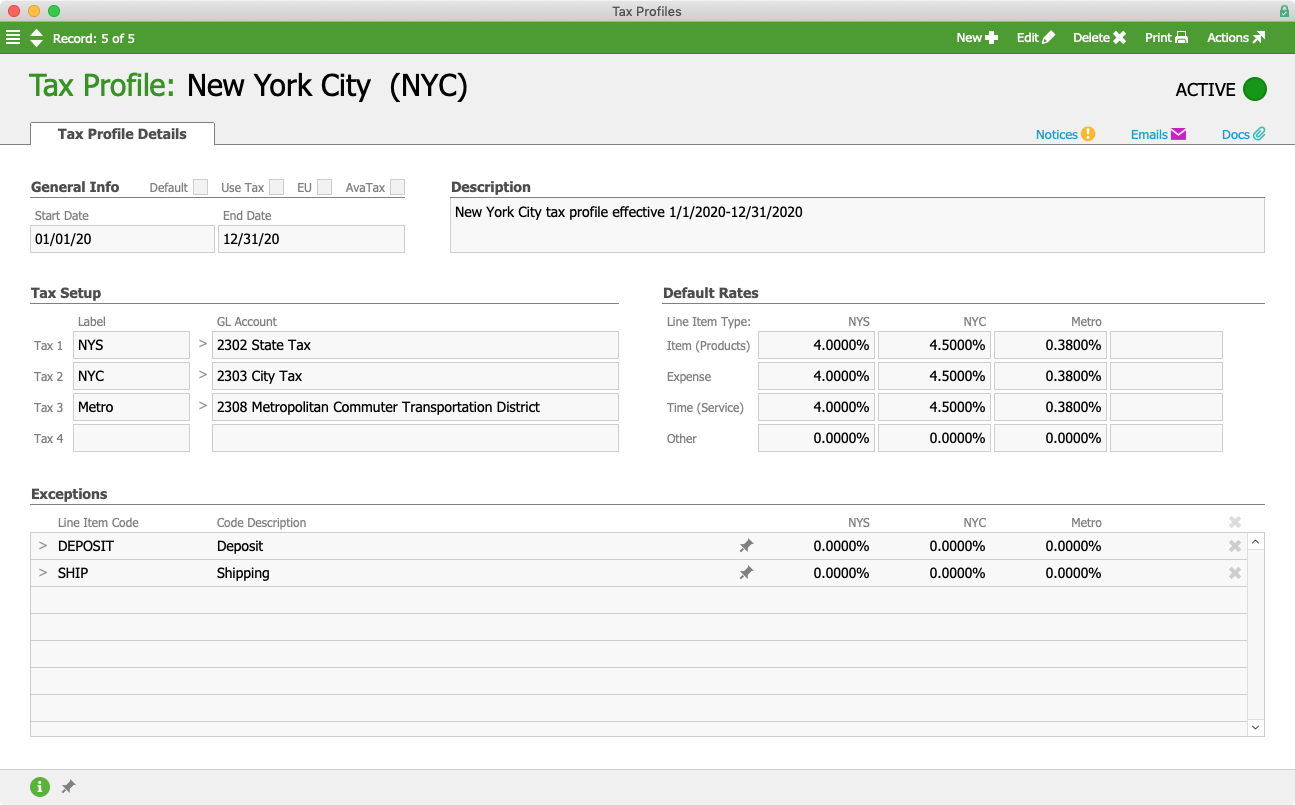
aACME sales rep Jamie Gianelli receives an order from P.S. 118 in the Bronx for 35 science textbooks and 5 hours of curriculum development. When Jamie creates the order, aACE automatically pulls in the NYC tax profile based on the postal code in P.S. 118’s shipping address. This tax profile is configured with each of the tax rates applicable in New York City as well as any items that are exempt from the local sales tax.

NYC Tax Profile

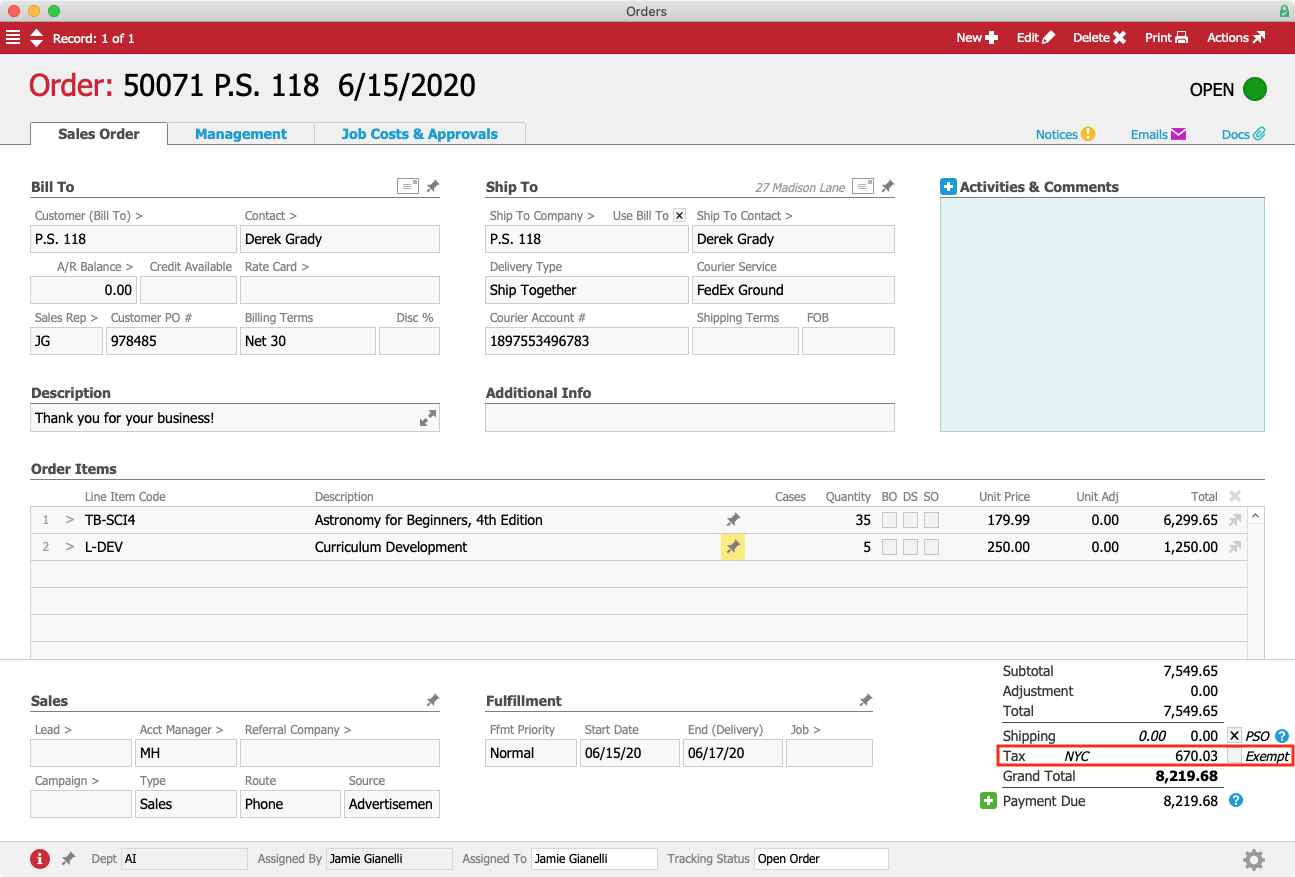
When Jamie processes the order, aACE calculates the sales tax and includes it in the grand total.

PS 118 Order Annotated

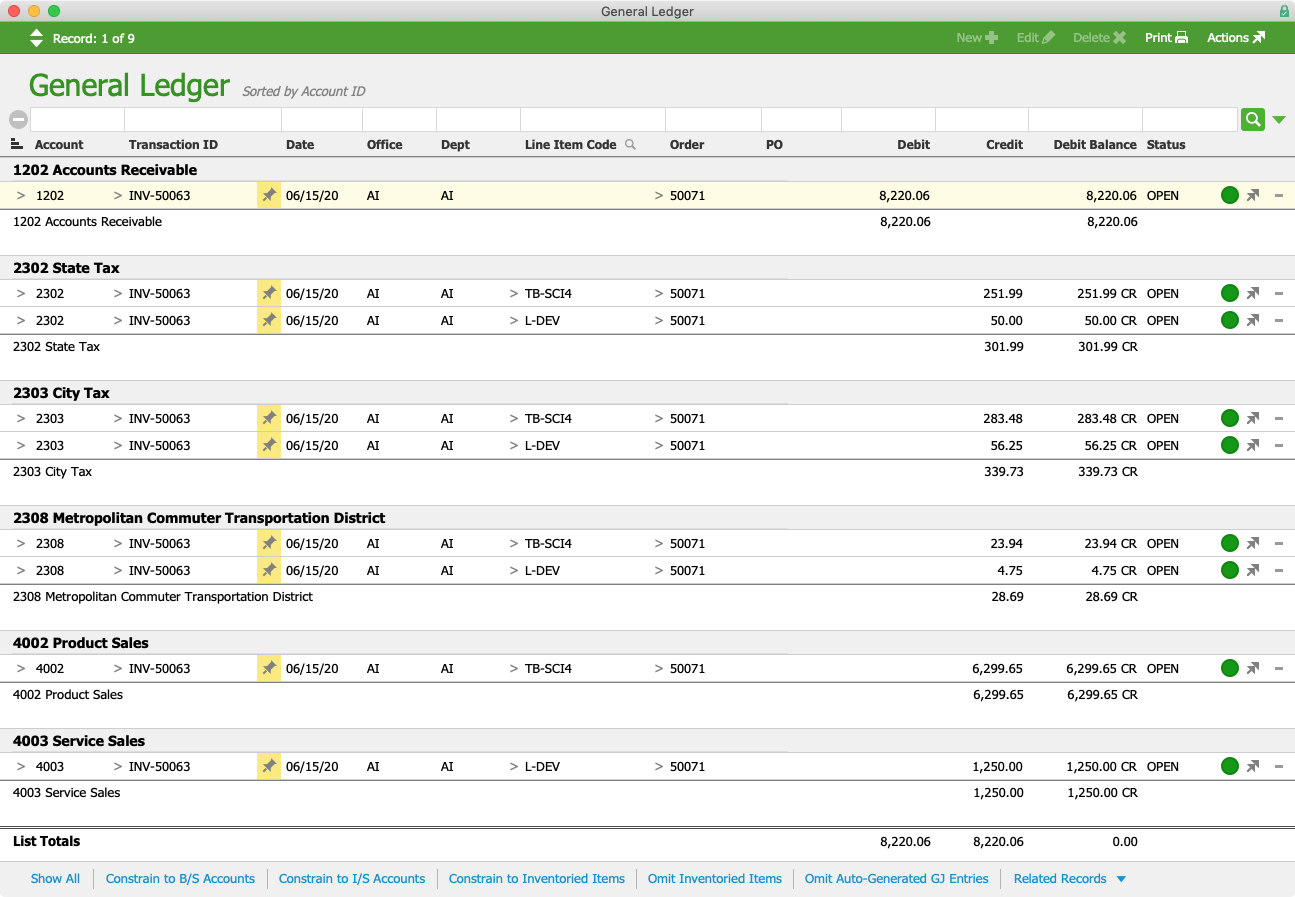
Once the order is shipped, Alexis Kohn in the Accounts Receivable department receives a notice that the related invoice has been generated. While inspecting the invoice to make sure everything looks accurate, Alexis wants to know how the sales tax was calculated. By navigating to the related general ledger transactions, she can see how much of the tax went to the GL accounts for the New York State, New York City, and Metropolitan Commuter District taxes, respectively.

This will become important when it comes time to remit these collected taxes to the government. Alexis will be able to easily see the balance owed to each tax agency and cut a check for those amounts.

PS 118 GL Entries

But what happens when an order comes in from a state where aACME is not required to collect sales taxes?

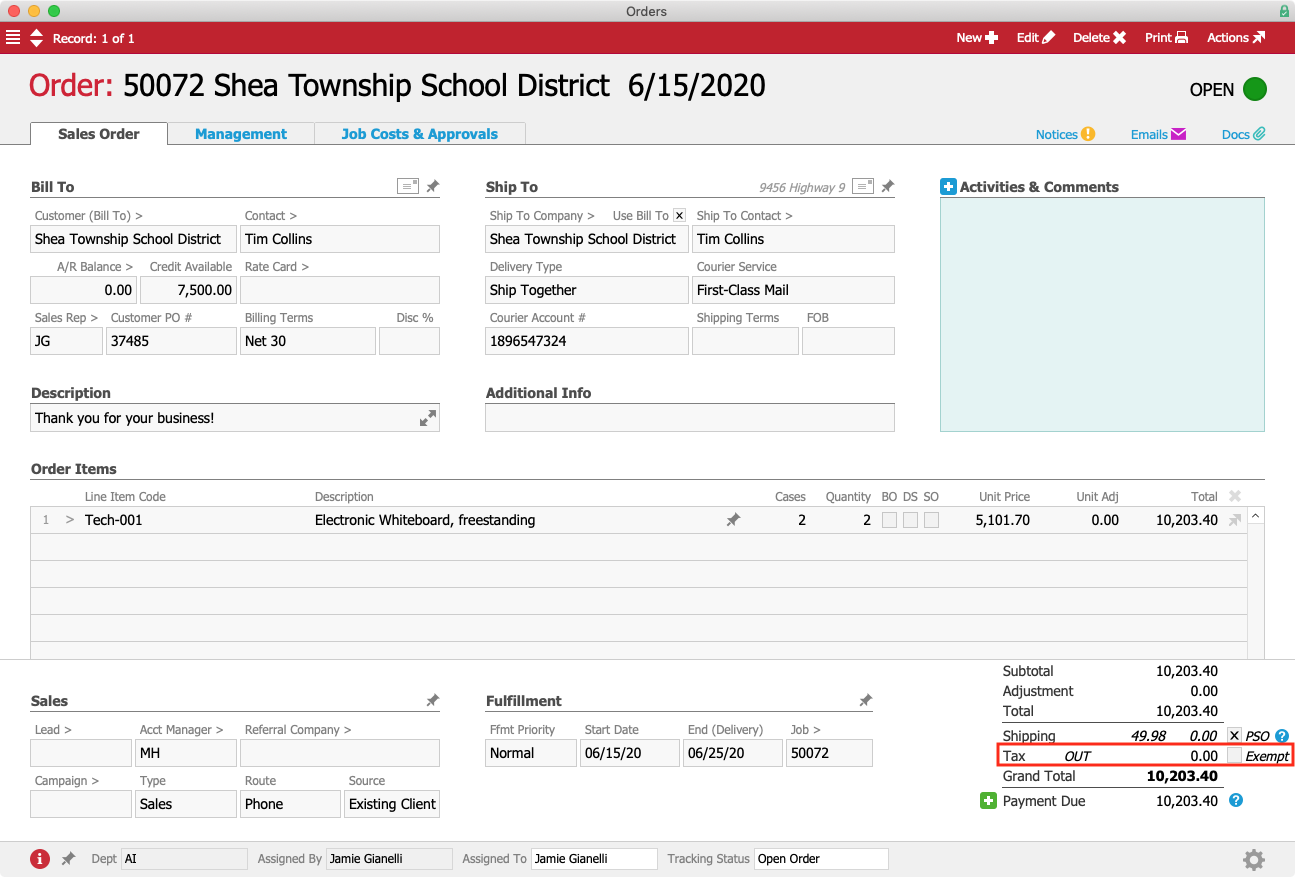
Jamie receives an order from the Shea Township School District for two new electronic whiteboards. Shea Township is located in Ohio, where aACME does not have a presence and is therefore not required to collect sales taxes. When Jamie enters the order, aACE automatically pulls in the Out-of-State tax profile based on the customer’s ship-to postal code. This tax profile is configured not to collect taxes, so when the order is processed, the sales tax comes to $0.

STSD Order Annotated

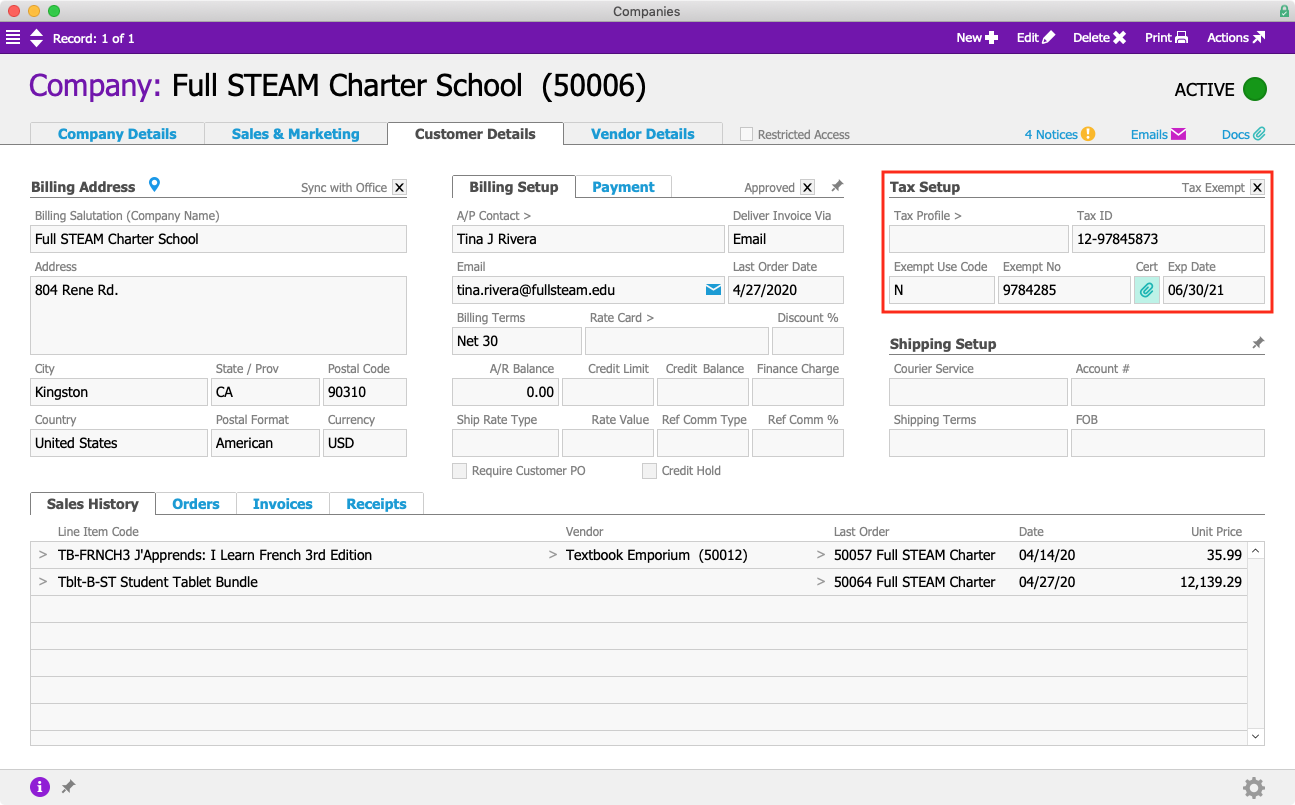
Similarly, aACE also includes tools for supporting tax-exempt customers. For example, longtime aACME client Full STEAM Charter School is a nonprofit and exempt from paying sales taxes. In Full STEAM’s Company record, they are flagged as tax exempt and their exemption certificate is kept on file.

Full STEAM Company Record Annotated

Now you may be asking, what happens when a customer located in one tax jurisdiction places an order to be picked up in another jurisdiction? aACE can handle that, too.

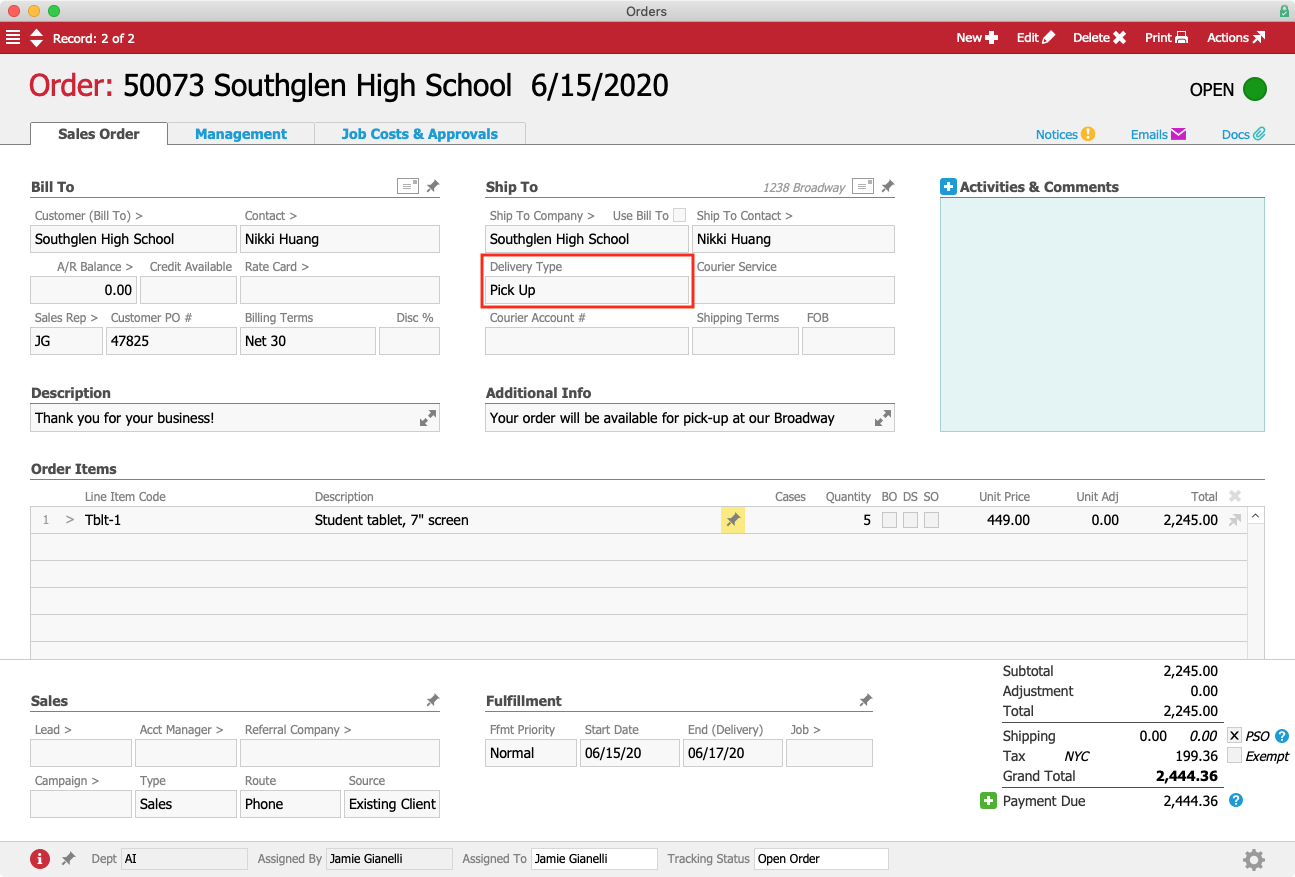
Jamie receives an order for 5 new student tablets from Nikki Huang at Southglen High School. SHS is located in Pemberton, NJ, but Nikki is going into the city for a conference and plans to pick up the tablets in person from aACME’s Manhattan location. When Jamie enters the order, she selects “Pick Up” as the type of delivery.

Southglen Order Pick Up

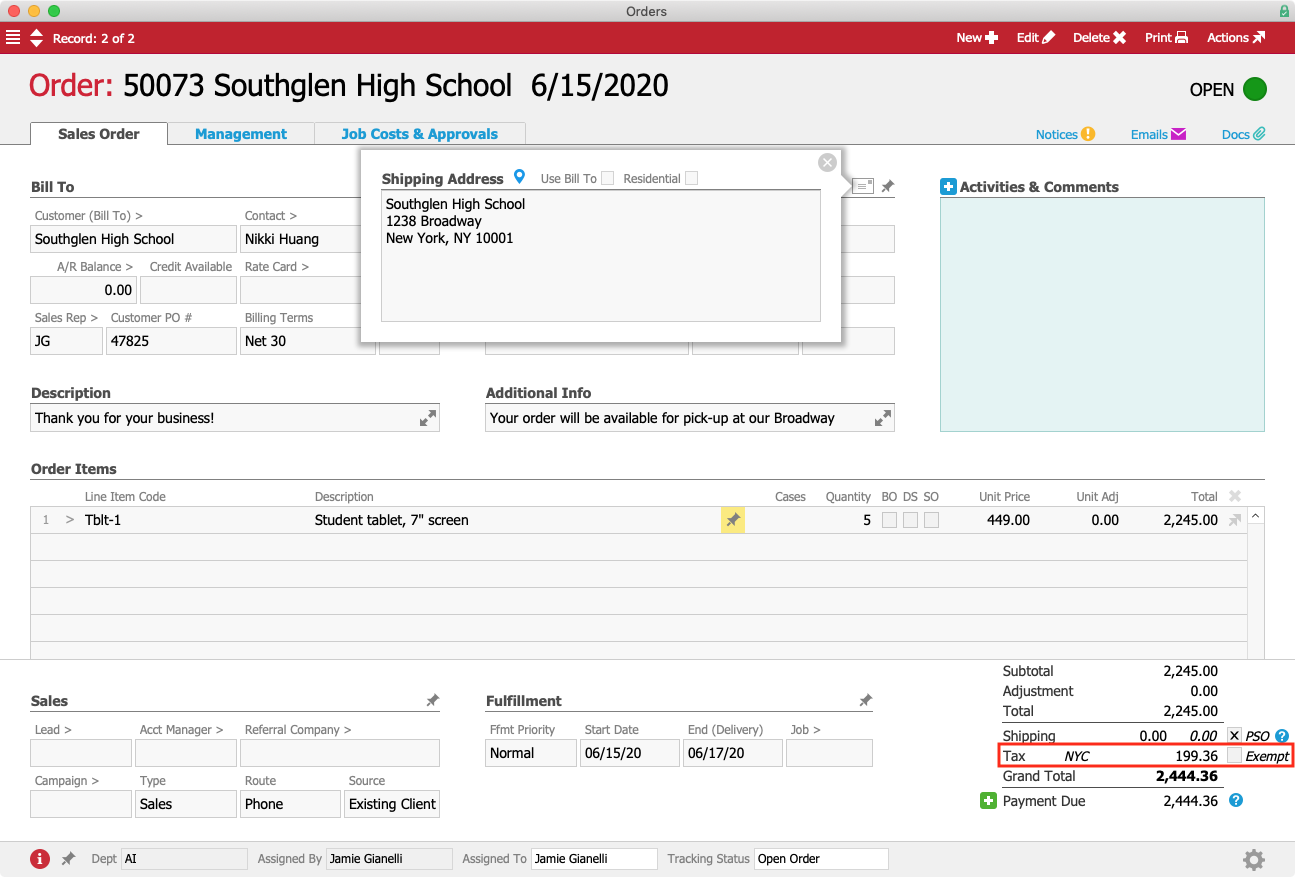
This automatically changes the shipping address from Southglen’s Pemberton campus to aACME’s New York office. aACE also pulls in the NYC tax profile based on the new postal code associated with the order.

Southglen Shipping Address Annotated

As you can see, aACE’s out-of-the-box tax functionality makes it simple to collect and remit sales taxes. But if you have a presence in a large number of tax jurisdictions, you may not want to manually update dozens of profiles every time there’s a change in tax rates — and some tax jurisdictions don’t align perfectly with local zip codes, complicating matters even further. Then there are jurisdictions that tax certain items on a tiered basis — meaning the first $5,000 in sales, for example, is taxed at one rate while the next $5,000 is taxed at a different rate and so on — not to mention jurisdictions that tax items differently depending on the circumstances, like a raw chicken from the grocery store’s meat department vs. that same chicken sold after having been roasted at the deli counter. Wouldn’t it be great if you could automate sales tax collection with even more precision?

That’s where aACE+ Avalara AvaTax comes in.

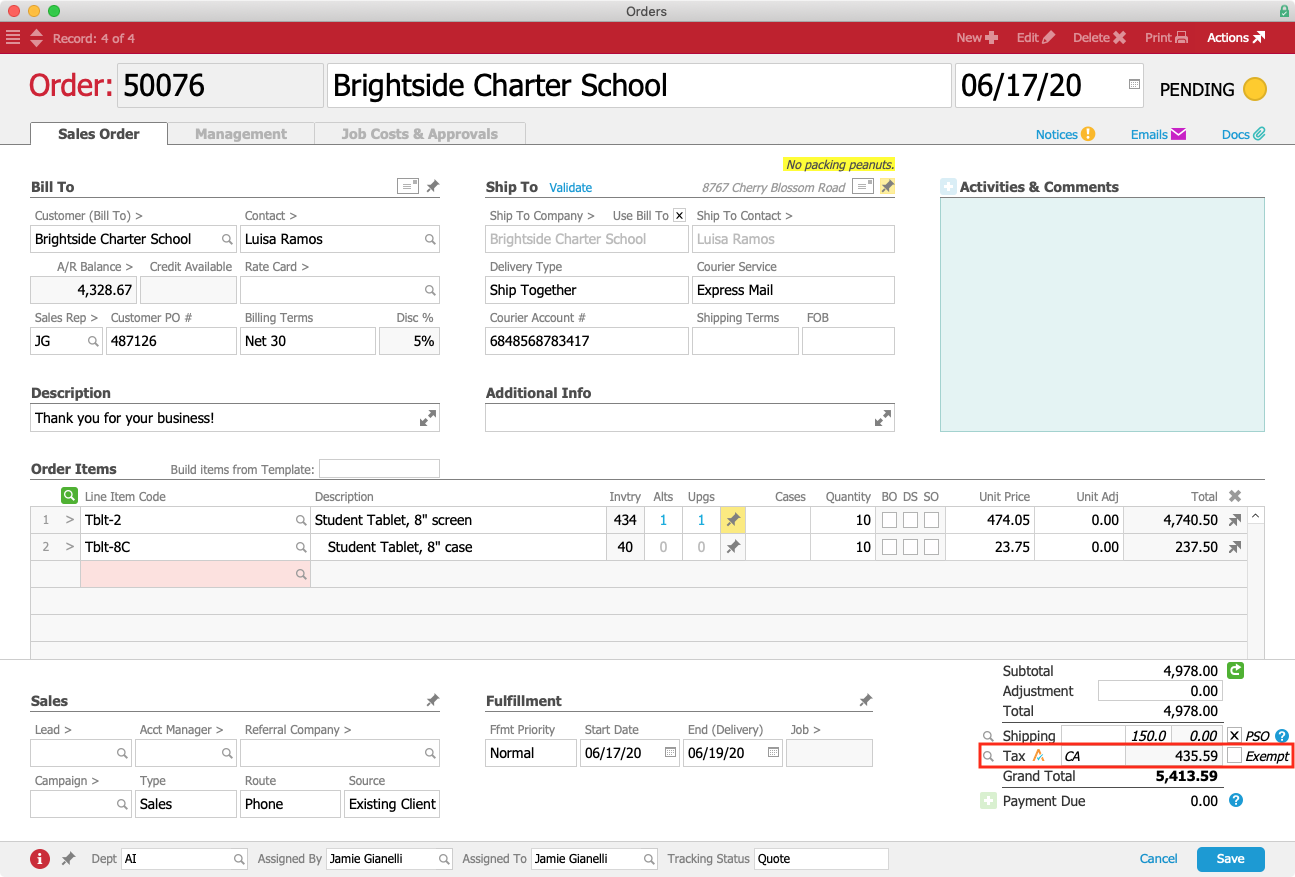
Jamie receives an order from the Brightside Charter School for 10 new student tablets and 10 cases — but now, aACME has implemented the aACE+ AvaTax integration. Like the previous examples, aACE auto-selects the tax profile associated with Brightside’s postal code. This time, however, the tax profile has AvaTax enabled as shown by the AvaTax Icon icon, which tells aACE to bypass its internal tax infrastructure and use the Avalara integration instead.

BCS Order Annotated

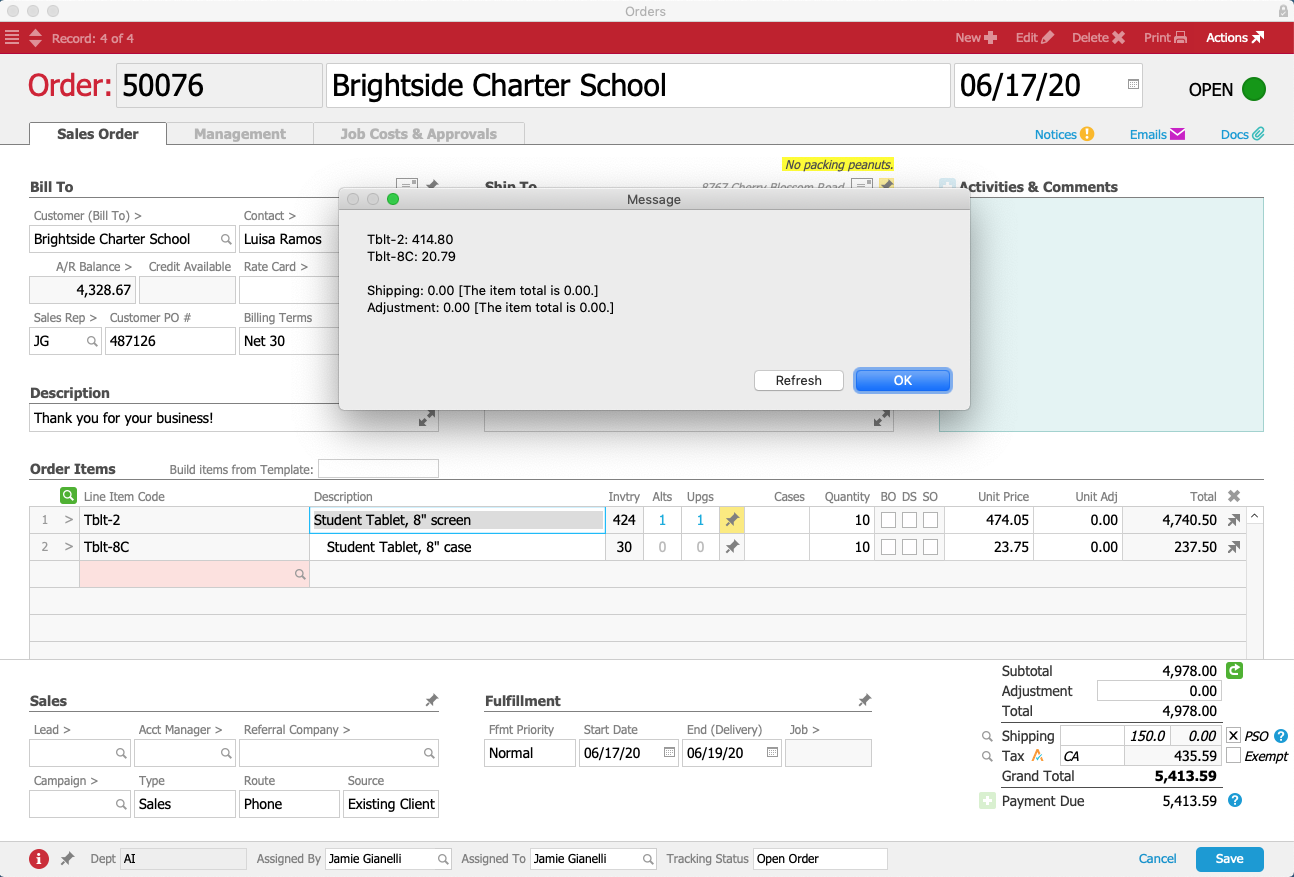
AvaTax calculates the order’s sales tax in seconds using the precise location of Brightside’s shipping address. Without leaving aACE, Jamie can see top-level details from AvaTax such as the amount of the order, the total taxable amount minus any discounts or exemptions, and the total sales tax.

BCS Order AvaTax Dialog

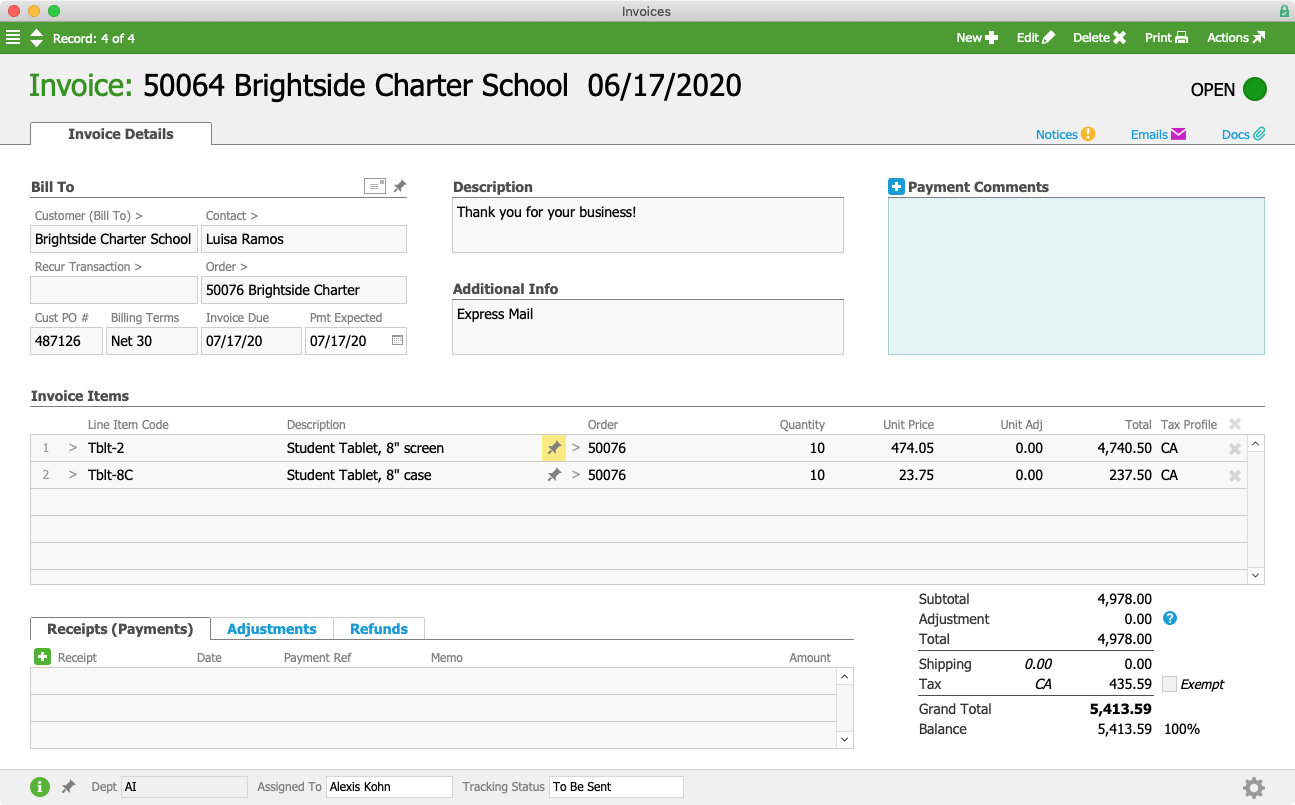
Once the order has been shipped, aACE again automatically generates an invoice. Over in the A/R department, Alexis logs in and reviews the invoice to make sure it’s correct before sending it to the customer.

BCS Invoice

If Alexis ever needs to double-check the tax calculations for this invoice, she can simply log into aACME’s Avalara AvaTax account. She finds invoice #50064 in the Transactions portal and opens up the detail view. Alexis can see the sales tax for the invoice broken down by line item, including the taxable amount of each line item, any discounts, the taxes or fees associated with each item, and the cost of each item with taxes included.

For more details, Alexis can click on the line item for the tablets. Here she can see each individual tax jurisdiction that this item was subject to as well as the tax rates and total tax amount for each one. When tax time rolls around, Alexis will use Avalara’s robust reporting and filing tools to remit any accrued taxes to the appropriate jurisdictions all over the country.

aACE tax profiles and the aACE+ Avalara AvaTax integration can help take the headache out of tax time. To learn more about aACE+ AvaTax, check out our landing page on Avalara’s website. And to discover how aACE can help streamline your business’s operations, register for a webinar today.

Learn More

Managing sales taxes isn’t anyone’s idea of a good time — but it doesn’t have to be a chore, either. aACE’s out-of-the-box tax management infrastructure makes it easy for you to set and update tax profiles for each jurisdiction in which you do business. And for even more peace of mind,... Learn More

-->

Managing sales taxes isn’t anyone’s idea of a good time — but it doesn’t have to be a chore, either. aACE’s out-of-the-box tax management infrastructure makes it easy for you to set and update tax profiles for each jurisdiction in which you do business. And for even more peace of mind, the aACE+ Avalara AvaTax integration uses geolocation to provide precise, up-to-date tax rates every time you make a sale.

To learn more about how aACE makes sales tax management easy, let’s look at how our sample company, aACME Education Solutions, uses these features in their day-to-day operations.

aACME sales rep Jamie Gianelli receives an order from P.S. 118 in the Bronx for 35 science textbooks and 5 hours of curriculum development. When Jamie creates the order, aACE automatically pulls in the NYC tax profile based on the postal code in P.S. 118’s shipping address. This tax profile is configured with each of the tax rates applicable in New York City as well as any items that are exempt from the local sales tax.

NYC Tax Profile

When Jamie processes the order, aACE calculates the sales tax and includes it in the grand total.

PS 118 Order Annotated

Once the order is shipped, Alexis Kohn in the Accounts Receivable department receives a notice that the related invoice has been generated. While inspecting the invoice to make sure everything looks accurate, Alexis wants to know how the sales tax was calculated. By navigating to the related general ledger transactions, she can see how much of the tax went to the GL accounts for the New York State, New York City, and Metropolitan Commuter District taxes, respectively.

This will become important when it comes time to remit these collected taxes to the government. Alexis will be able to easily see the balance owed to each tax agency and cut a check for those amounts.

PS 118 GL Entries

But what happens when an order comes in from a state where aACME is not required to collect sales taxes?

Jamie receives an order from the Shea Township School District for two new electronic whiteboards. Shea Township is located in Ohio, where aACME does not have a presence and is therefore not required to collect sales taxes. When Jamie enters the order, aACE automatically pulls in the Out-of-State tax profile based on the customer’s ship-to postal code. This tax profile is configured not to collect taxes, so when the order is processed, the sales tax comes to $0.

STSD Order Annotated

Similarly, aACE also includes tools for supporting tax-exempt customers. For example, longtime aACME client Full STEAM Charter School is a nonprofit and exempt from paying sales taxes. In Full STEAM’s Company record, they are flagged as tax exempt and their exemption certificate is kept on file.

Full STEAM Company Record Annotated

Now you may be asking, what happens when a customer located in one tax jurisdiction places an order to be picked up in another jurisdiction? aACE can handle that, too.

Jamie receives an order for 5 new student tablets from Nikki Huang at Southglen High School. SHS is located in Pemberton, NJ, but Nikki is going into the city for a conference and plans to pick up the tablets in person from aACME’s Manhattan location. When Jamie enters the order, she selects “Pick Up” as the type of delivery.

Southglen Order Pick Up

This automatically changes the shipping address from Southglen’s Pemberton campus to aACME’s New York office. aACE also pulls in the NYC tax profile based on the new postal code associated with the order.

Southglen Shipping Address Annotated

As you can see, aACE’s out-of-the-box tax functionality makes it simple to collect and remit sales taxes. But if you have a presence in a large number of tax jurisdictions, you may not want to manually update dozens of profiles every time there’s a change in tax rates — and some tax jurisdictions don’t align perfectly with local zip codes, complicating matters even further. Then there are jurisdictions that tax certain items on a tiered basis — meaning the first $5,000 in sales, for example, is taxed at one rate while the next $5,000 is taxed at a different rate and so on — not to mention jurisdictions that tax items differently depending on the circumstances, like a raw chicken from the grocery store’s meat department vs. that same chicken sold after having been roasted at the deli counter. Wouldn’t it be great if you could automate sales tax collection with even more precision?

That’s where aACE+ Avalara AvaTax comes in.

Jamie receives an order from the Brightside Charter School for 10 new student tablets and 10 cases — but now, aACME has implemented the aACE+ AvaTax integration. Like the previous examples, aACE auto-selects the tax profile associated with Brightside’s postal code. This time, however, the tax profile has AvaTax enabled as shown by the AvaTax Icon icon, which tells aACE to bypass its internal tax infrastructure and use the Avalara integration instead.

BCS Order Annotated

AvaTax calculates the order’s sales tax in seconds using the precise location of Brightside’s shipping address. Without leaving aACE, Jamie can see top-level details from AvaTax such as the amount of the order, the total taxable amount minus any discounts or exemptions, and the total sales tax.

BCS Order AvaTax Dialog

Once the order has been shipped, aACE again automatically generates an invoice. Over in the A/R department, Alexis logs in and reviews the invoice to make sure it’s correct before sending it to the customer.

BCS Invoice

If Alexis ever needs to double-check the tax calculations for this invoice, she can simply log into aACME’s Avalara AvaTax account. She finds invoice #50064 in the Transactions portal and opens up the detail view. Alexis can see the sales tax for the invoice broken down by line item, including the taxable amount of each line item, any discounts, the taxes or fees associated with each item, and the cost of each item with taxes included.

For more details, Alexis can click on the line item for the tablets. Here she can see each individual tax jurisdiction that this item was subject to as well as the tax rates and total tax amount for each one. When tax time rolls around, Alexis will use Avalara’s robust reporting and filing tools to remit any accrued taxes to the appropriate jurisdictions all over the country.

aACE tax profiles and the aACE+ Avalara AvaTax integration can help take the headache out of tax time. To learn more about aACE+ AvaTax, check out our landing page on Avalara’s website. And to discover how aACE can help streamline your business’s operations, register for a webinar today.

Learn More

Read more about Seamlessly, Securely Process Customer Payments with aACE+ Payments

Seamlessly, Securely Process Customer Payments with aACE+ Payments

With aACE+ Payments, you can.

A growing list of leading payment processing services integrate seamlessly with your aACE solution, ensuring that you’re able to quickly and securely process credit card, debit card, and ACH check payments. Eliminate the hassle of manually entering payment information into multiple solutions; with aACE+ Payments, you can enter payment information directly into a payment processor’s secure servers from aACE. Securely applying payment is a breeze, saving you time and minimizing the potential for errors. To learn more, let’s take a look at how our sample company, aACME Education Solutions, uses this feature in their day-to-day operations.

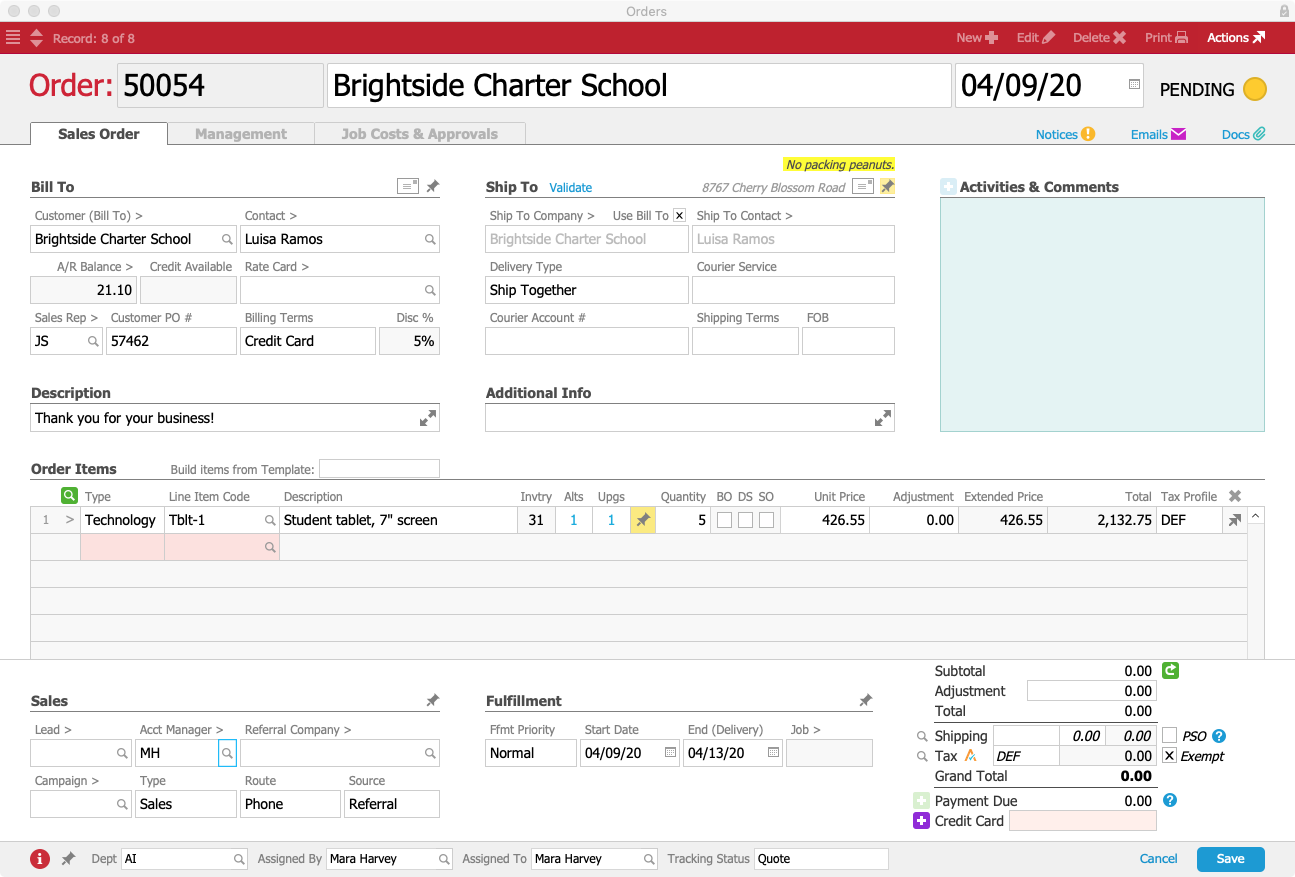
Mara Harvey receives a call from Luisa Ramos at the Brightside Charter School. Luisa would like to place an order for 5 student tablets and put it on her company card. Mara creates the order in aACE, specifying Credit Card as the billing terms.

BCS Order

When Mara selects Credit Card as the billing terms, a Credit Card field appears underneath the order’s total. Because Luisa doesn’t have a credit card on file yet, Mara will need to enter one so that it’s available when the product ships.

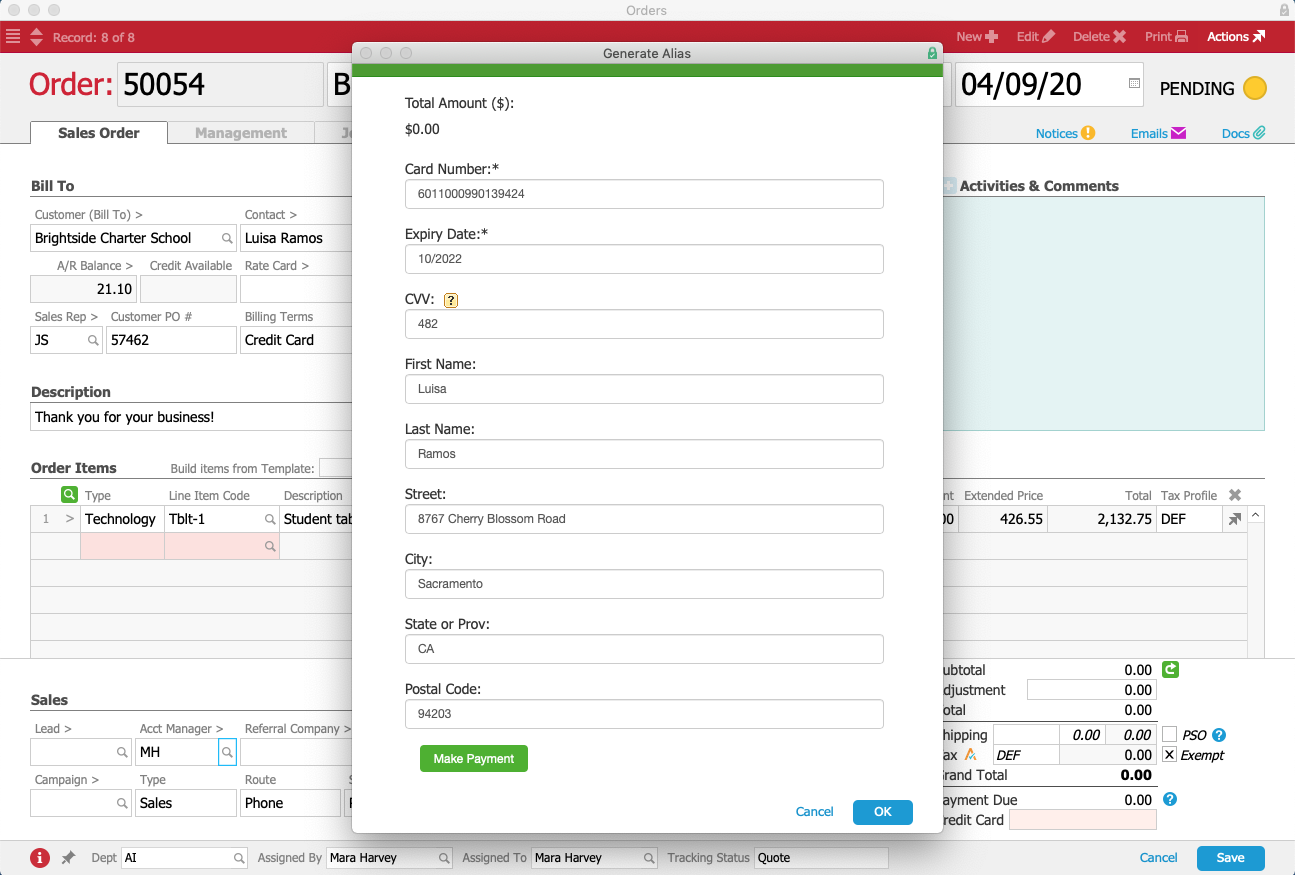
To add Luisa’s credit card, Mara clicks on the Purple Plus Icon button to the left of the Credit Card field. A form pops up where Mara can enter Luisa’s credit card details without leaving the order. The form automatically pulls in address information from Brightside Charter School’s company record, and Mara fills in the card number, expiration date, security code, and cardholder name.

BCS Generate Alias Form

Although this form was launched by a button in aACE, the form itself isn’t part of aACE — instead it’s a portal into the payment processor’s server that has been integrated seamlessly into aACME’s aACE solution. This ensures that when Mara enters Luisa’s sensitive credit card information, that data is never stored locally where it may be at risk, but rather is stored only on the payment processor’s secure servers.

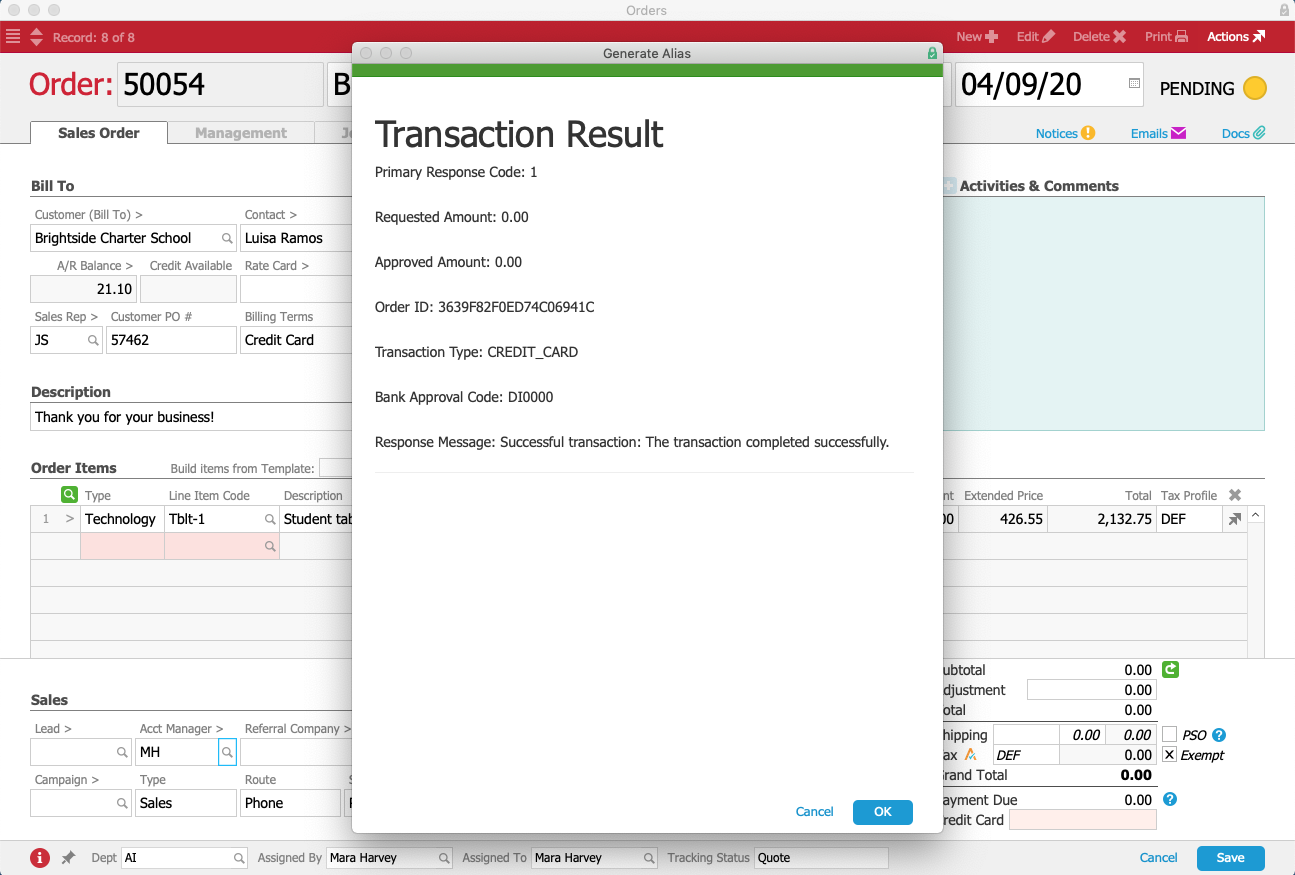
Once the Mara submits the form, the payment processor generates a token for Luisa’s credit card that is stored in aACE. This makes it easier for the aACME sales team to process future orders, while still maintaining PCI compliance. In seconds, Mara receives a message that the transaction went through successfully. The card is now ready to be used.

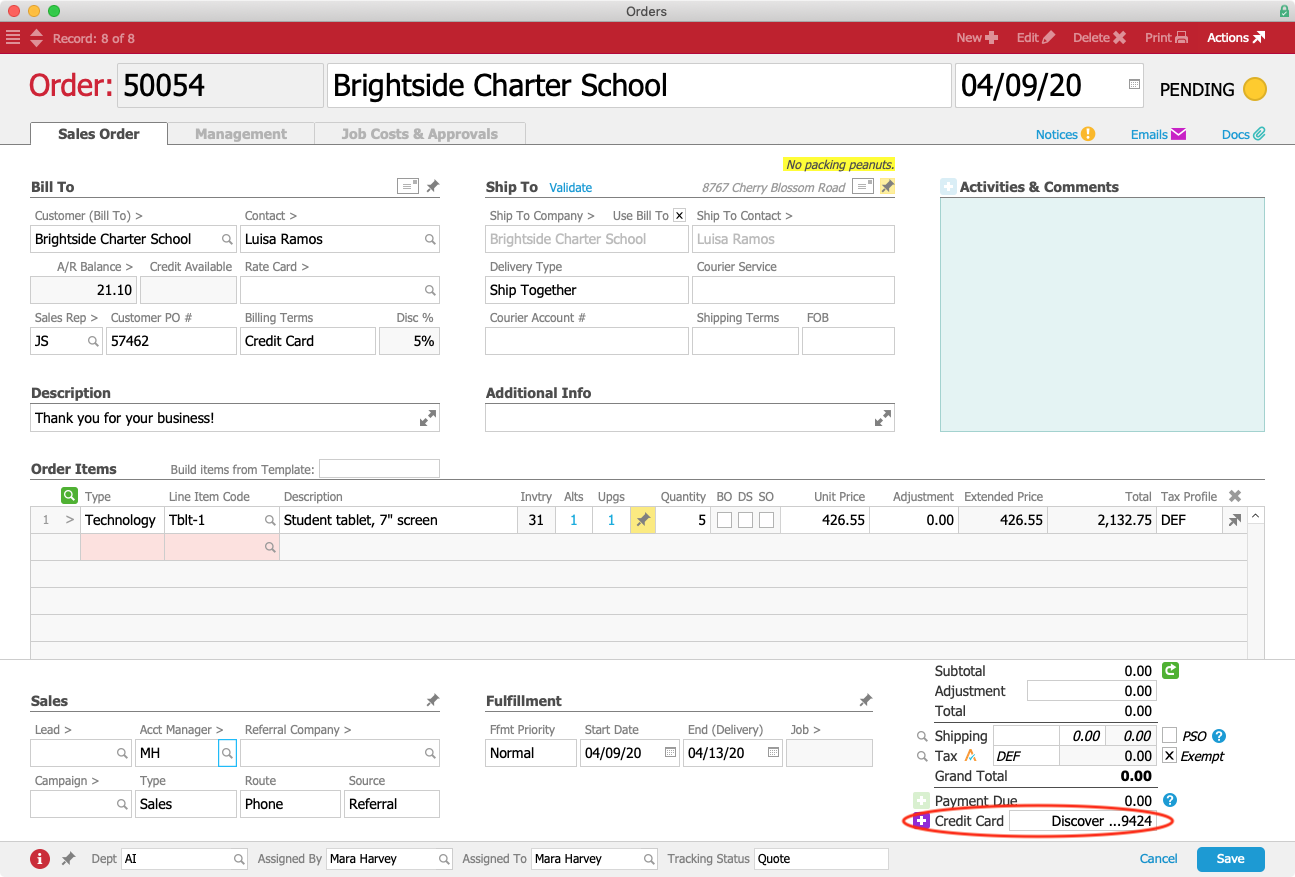
Mara closes the form, and aACE automatically pulls the card’s alias into the Credit Card field. Only the card brand, last four digits, and expiration date are displayed. A hidden field contains the token; remember, at no point does aACE itself or Mara’s workstation have access to the full credit card number.

BCS Transaction Result

Mara saves and processes Luisa’s order, which prompts aACE to automatically generate a shipment for the tablets. In aACME’s warehouse, Ned Walker picks the tablets using the aACE Pick App. When he’s finished, aACE automatically transmits the shipment to aACME’s shipping solution.

Over in the Shipping Department, Kristie Hernandez logs into the shipping solution and schedules Luisa’s package for delivery. The shipment information is automatically pulled back into aACE, where the shipment record’s status is updated to Shipped.

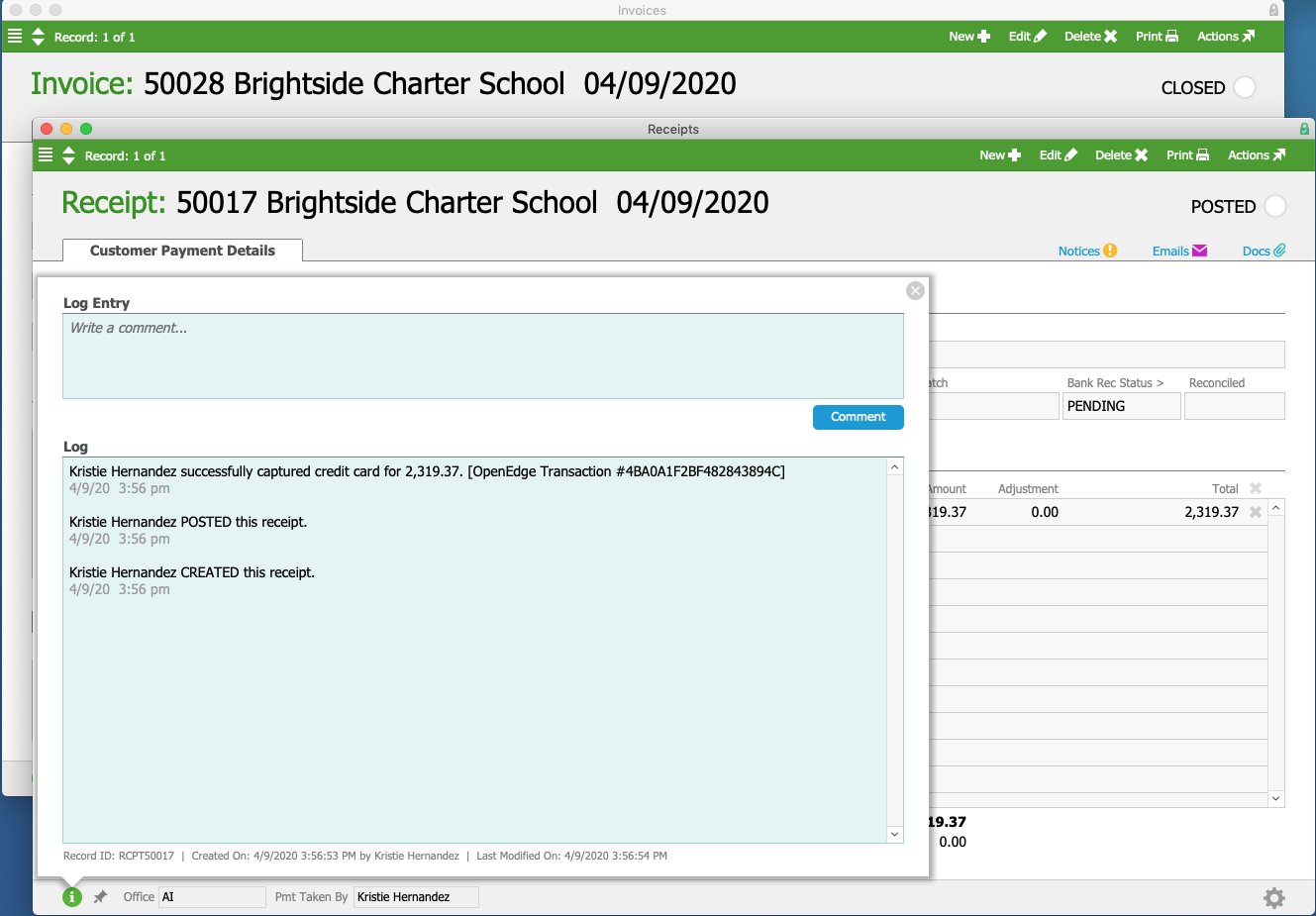
At this point, aACE automatically generates an invoice for the order. Because the order is configured to charge the card on file, Luisa’s card is automatically charged for the balance, resulting in a posted receipt and closed invoice.

BCS Order with CC

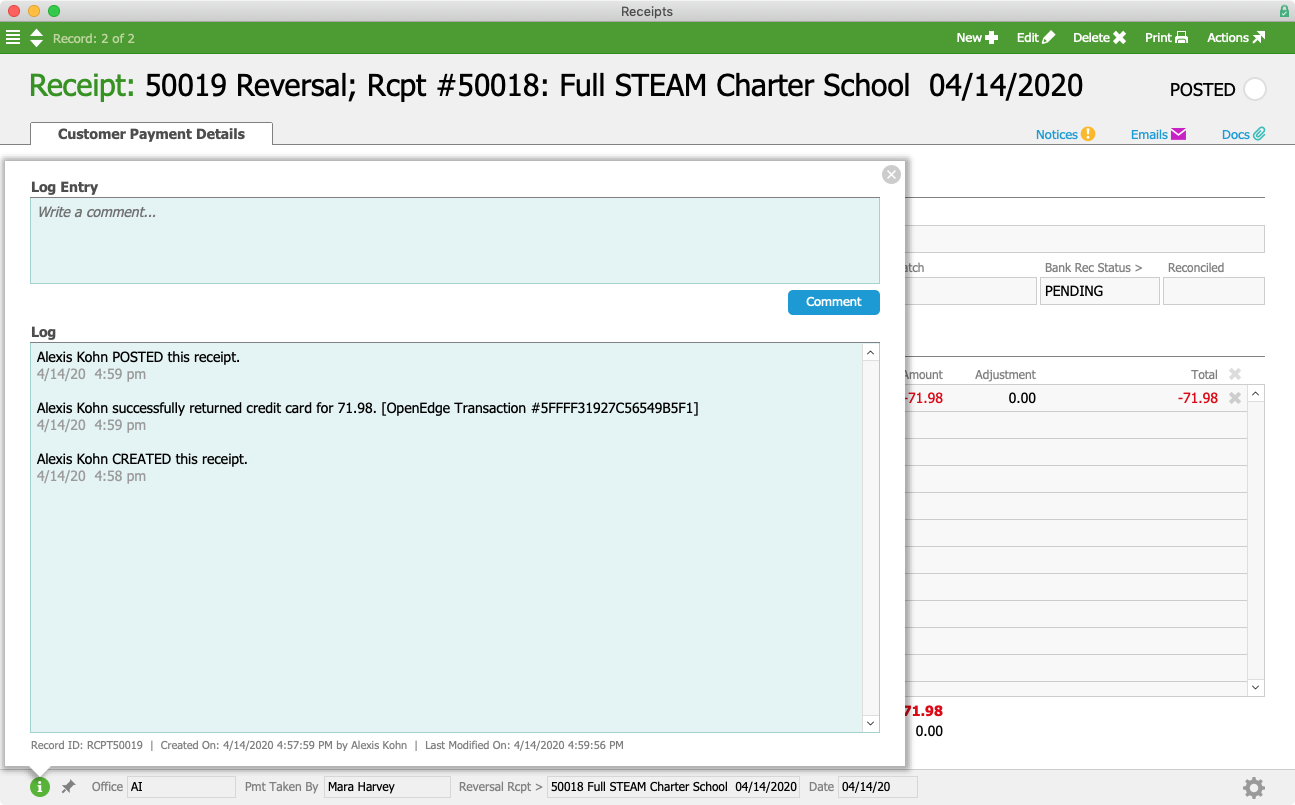
In the receipt’s log, we can see that the credit card was successfully charged.

BCS Invoice and Receipt

But what happens when there’s a problem with the credit card and the payment fails to go through? aACE notifies the relevant parties immediately, enabling you to prevent products from going out the door without having been paid for. Let’s take a look at how that works.

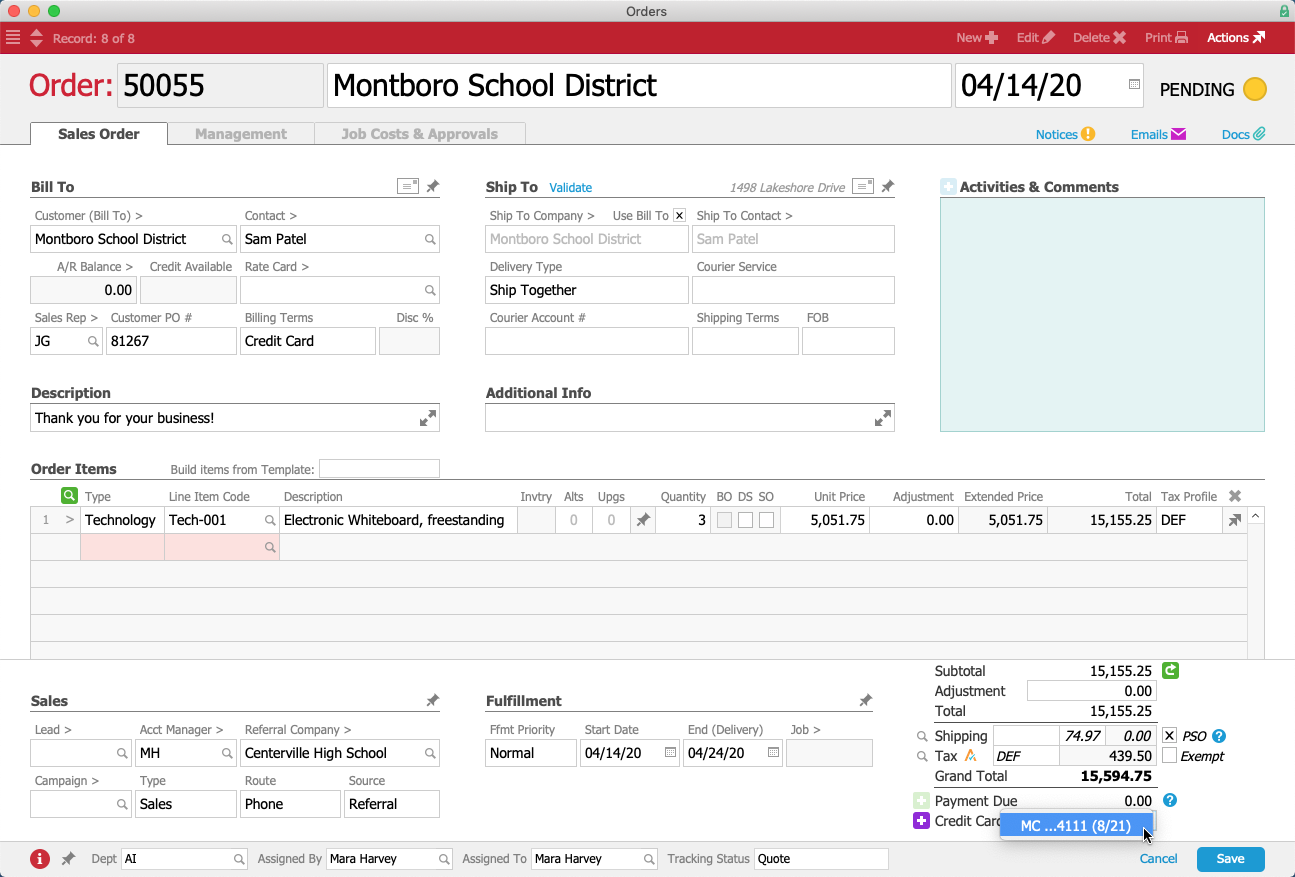
Mara receives another order, this time for 3 electronic whiteboards from the Montboro School District. Sam Patel, the Assistant Superintendent placing the order, would like to pay with a credit card he has used previously with aACME. As before, Mara selects Credit Card as the billing terms and the Credit Card field appears under the order’s total. This time, instead of entering new credit card details, Mara can simply choose the card Sam wants to use from the drop-down list.

MSD Order

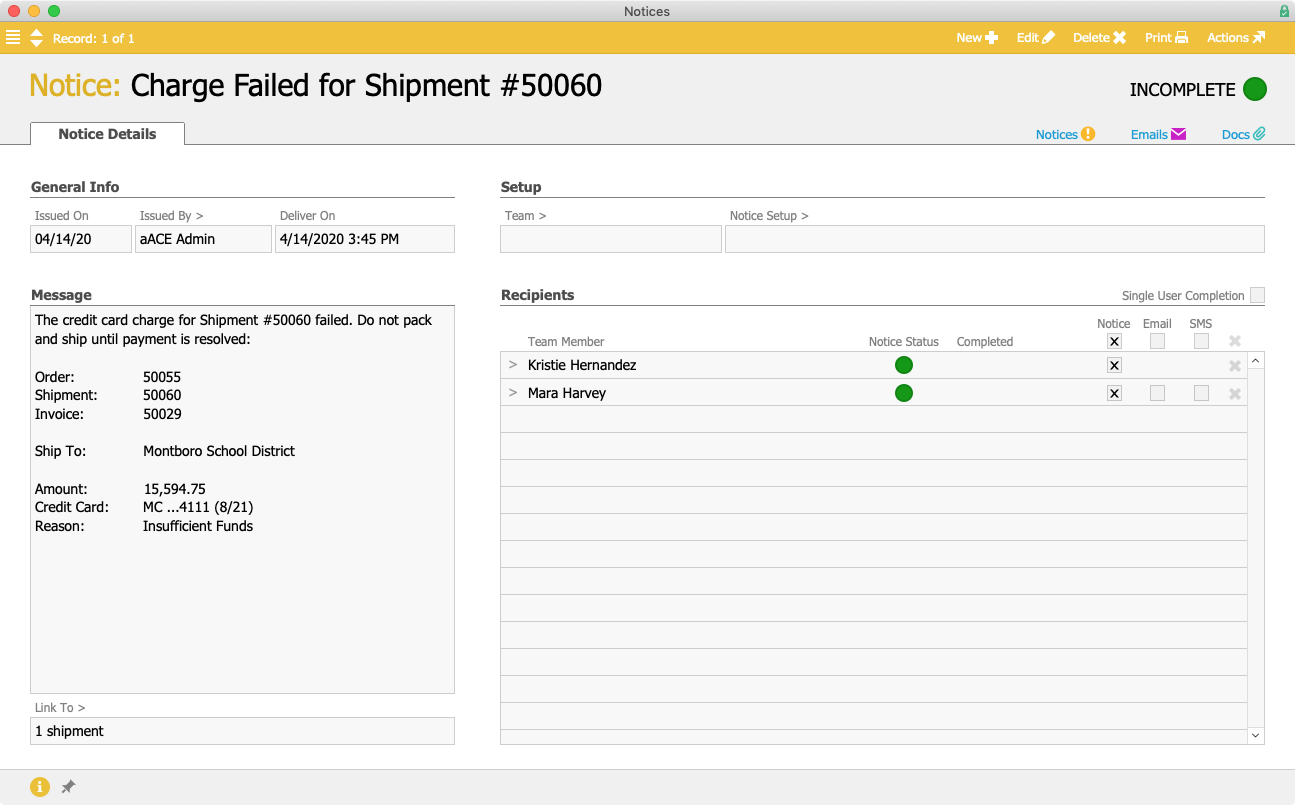
The order proceeds to the warehouse, where it’s picked, packed, and prepared to be shipped. When Kristie schedules the shipment, aACE again automatically generates an invoice and charges the credit card on file – but this time, the card is declined.

Immediately, aACE sends a text message to Kristie’s mobile phone. She cancels the shipment and stops the package from leaving before payment is received. Mara also receives a notification, allowing her to quickly follow up with Sam to get a new credit card for the order.

MSD Notice

Now we’ve seen how aACE+ Payments makes it easy to take credit card payments, but what happens if a customer requests a refund or exchange?

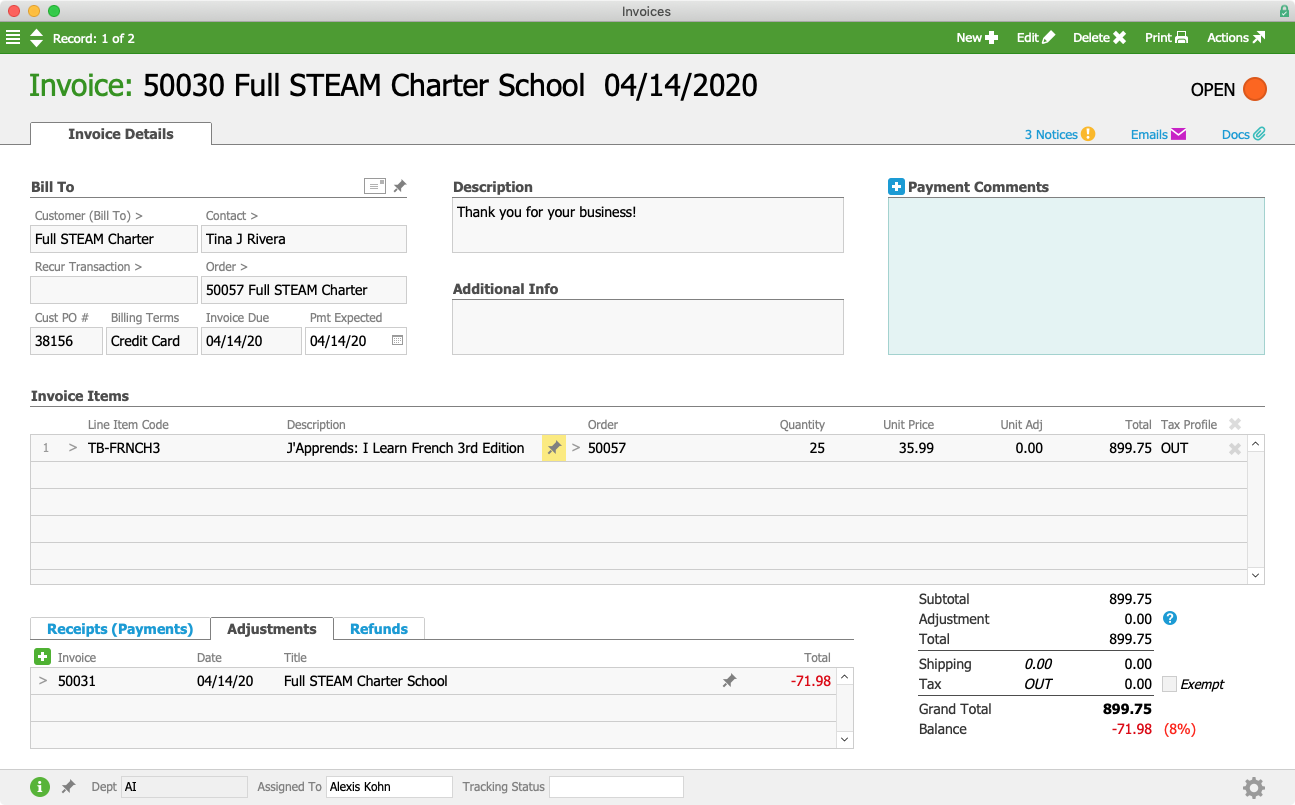
The Full STEAM Academy Charter School ordered 25 French textbooks, but when they arrive, two of the books are damaged. Tina Rivera, the school principal, contacts aACME to initiate the refund process and send the damaged books back.

When the package from Full STEAM arrives in aACME’s warehouse, Alexis Kohn in the Billing department receives a notice alerting her that an adjustment invoice has been generated. She determines that everything looks correct and processes it, which reverses the amount of the two textbooks from the original invoice.

Full STEAM Invoice with Adjustment

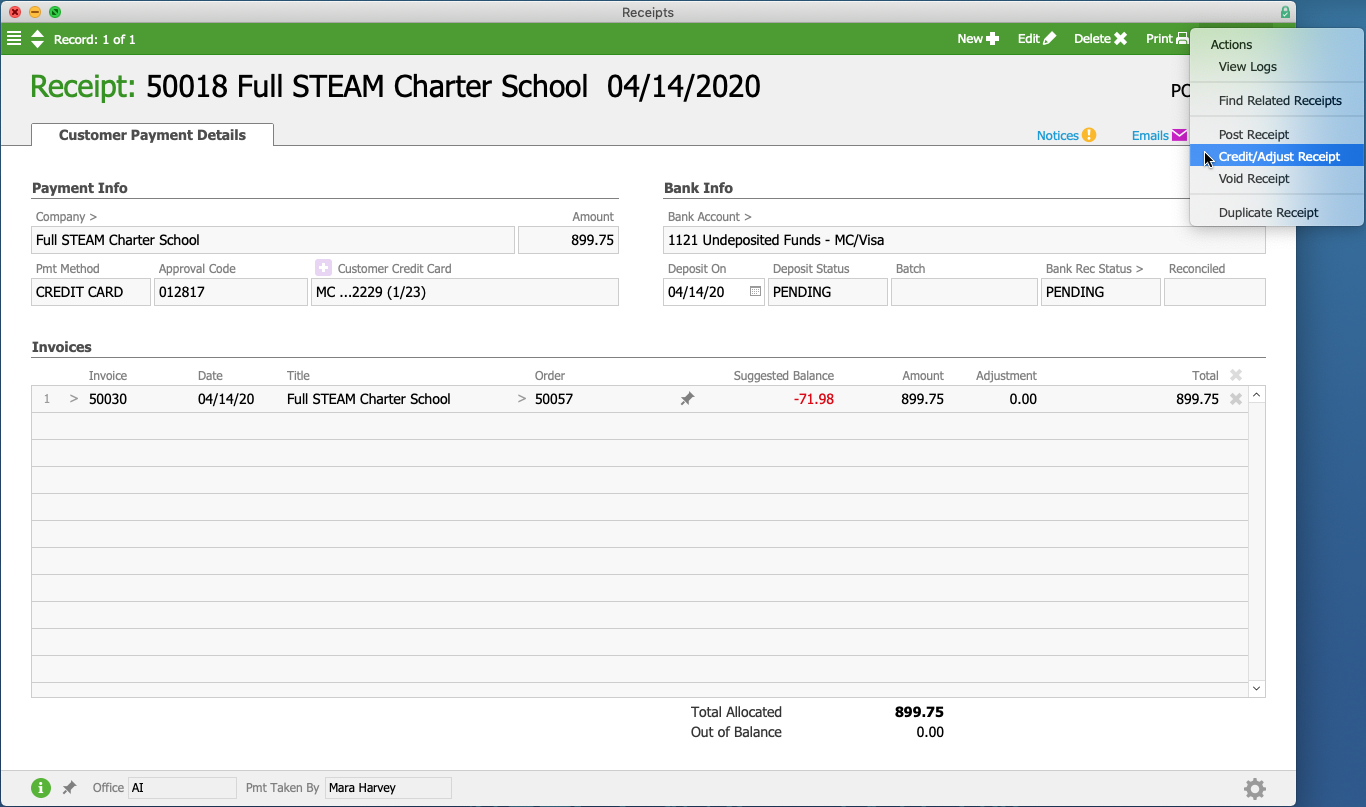
Next, Alexis needs to issue a partial refund for the two damaged books. To do that, she pulls up the original receipt and selects Credit/Adjust Receipt from the Actions menu.

Full STEAM Receipt

aACE automatically pulls in the customer, method of payment, invoice, order, and a suggested amount for the refund. After double-checking that the information is correct, Alexis posts the receipt. Tina’s credit card is then refunded when the credit card batch settles overnight.

Full STEAM Receipt Log

What if a sales rep makes a mistake and accidentally overcharges the customer? Fortunately, aACE+ Payments makes it easy to correct those errors — and as long as the mistake is fixed on the same day, the erroneous charge won’t even make it to the customer’s credit card statement.

Jamie Gianelli, a sales rep at aACME, receives an order from Southglen High School for new textbooks to replace the outdated ones the school has been using. Nikki Huang, the Vice Principal at Southglen, gives Jamie a long list of books and their quantities, including 45 natural science textbooks. Jamie accidentally mistypes this number as 54, and due to the many items in the order, neither she nor Nikki realize that the total is higher than it should be. It’s only after Jamie has opened the order and taken the payment that she realizes the mistake.
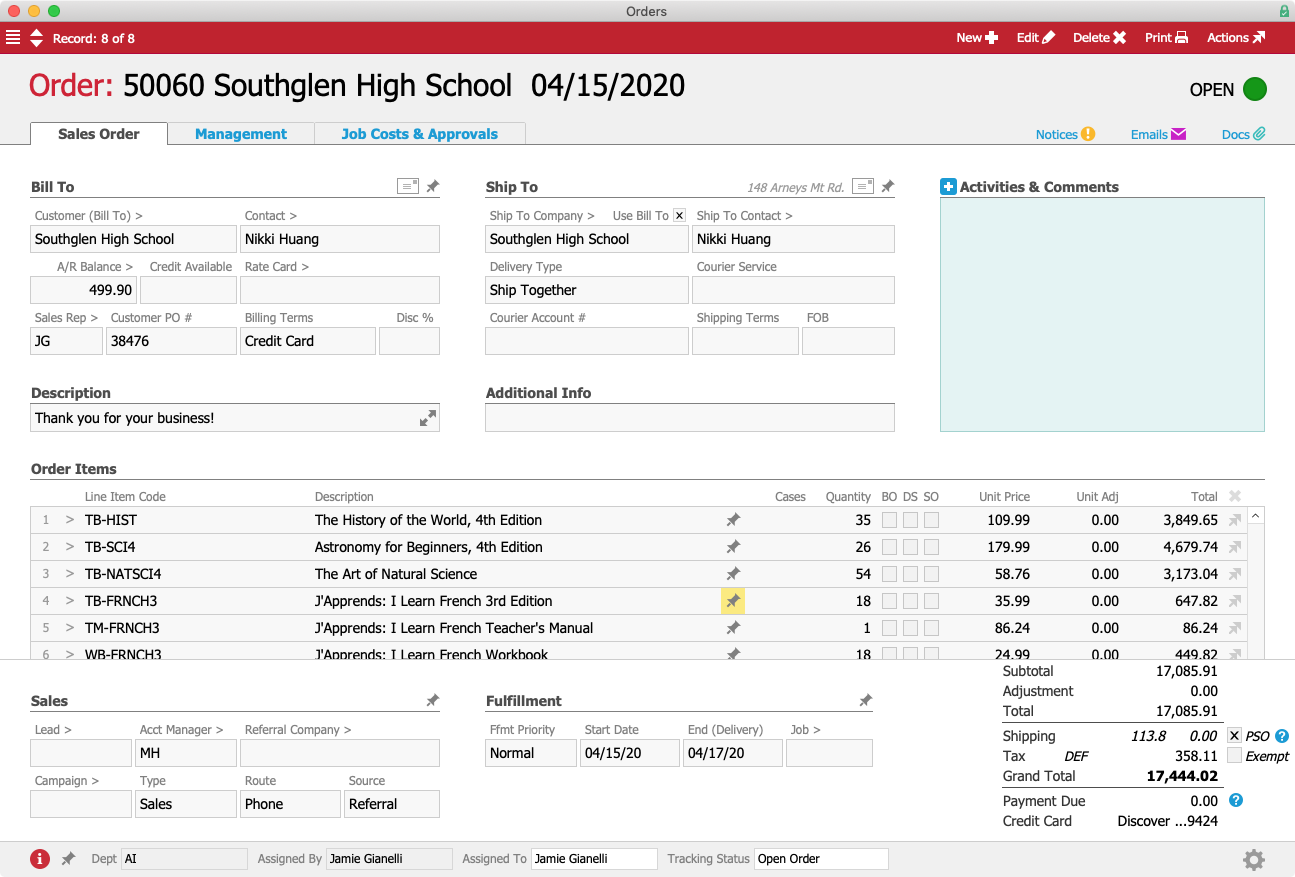
Southglen Order

Fortunately, because Jamie caught the error on the same day that the payment was processed, she can fix it before the incorrect charge hits Nikki’s credit card. She pulls up the order and changes the quantity of the science books from 54 to 45, then voids the receipt that was originally created, which voids the pending charge and removes it from Nikki’s credit card statement. With the updated order Jamie can charge the correct amount without Nikki ever seeing the mistake.

And if a customer wants to pay by ACH? aACE+ Payments supports that too.

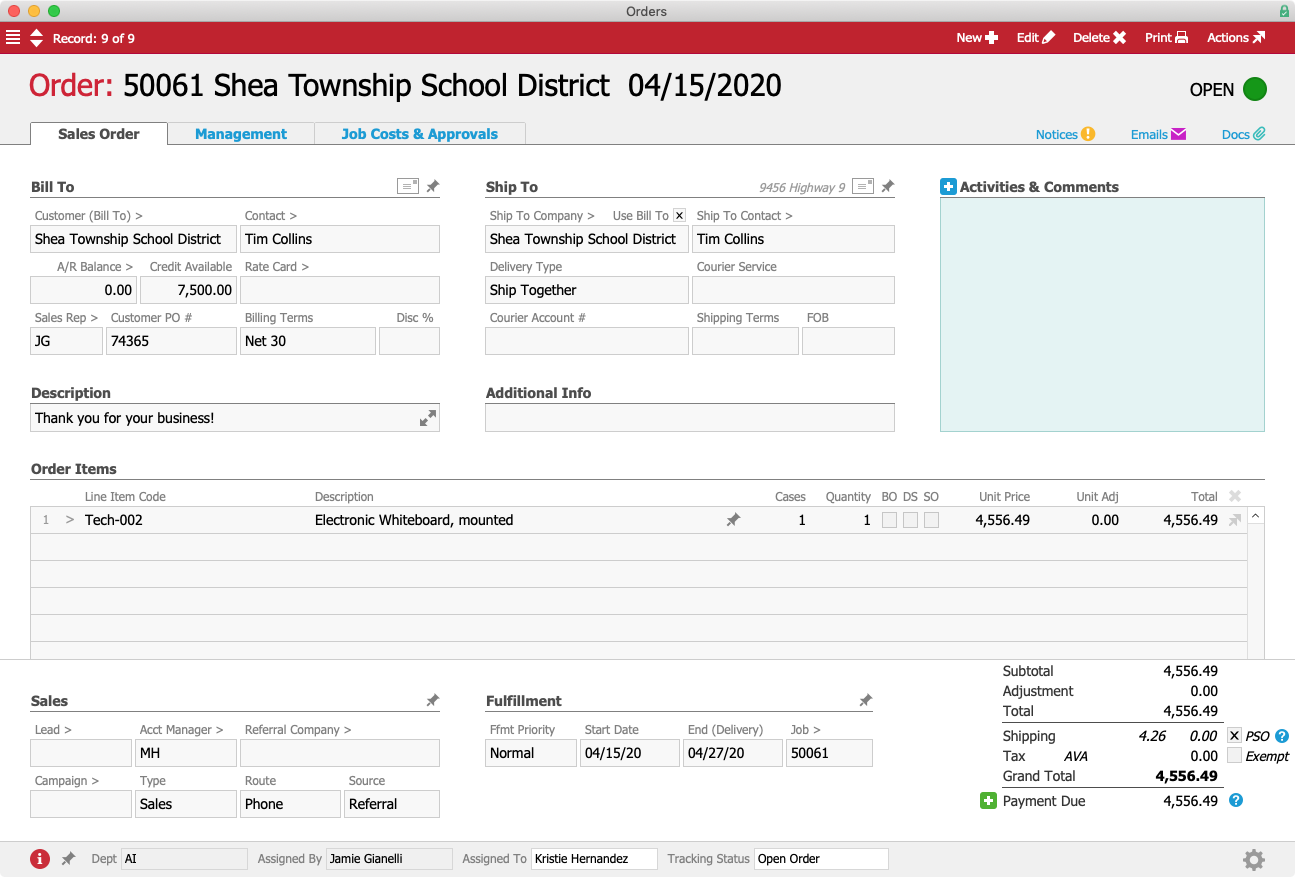
Jamie receives an order from the Shea Township School District for a new mounted electronic whiteboard. Tim Collins, the Administrative Assistant at Shea Township, would like to place a 50% deposit on the order using ACH.

STSD Order

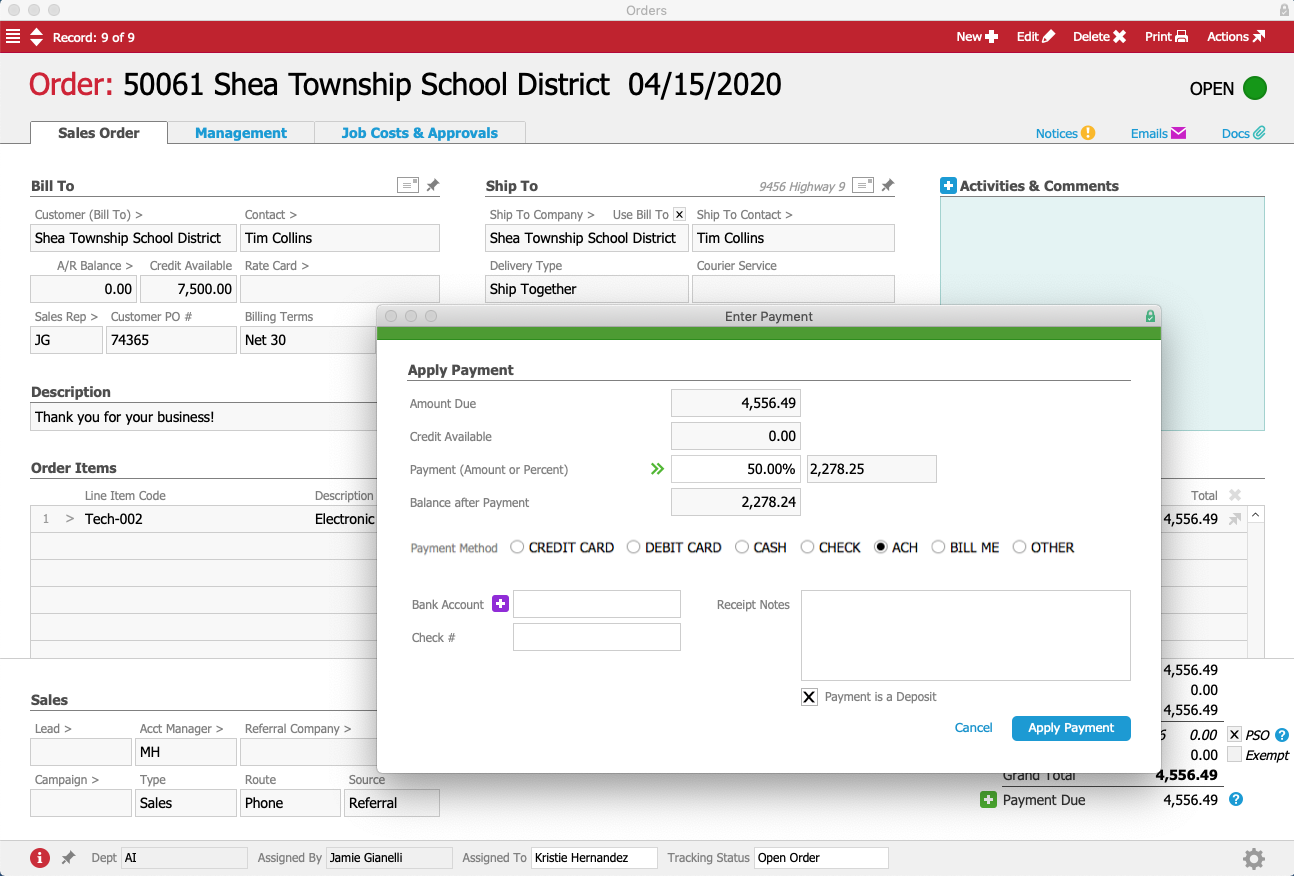
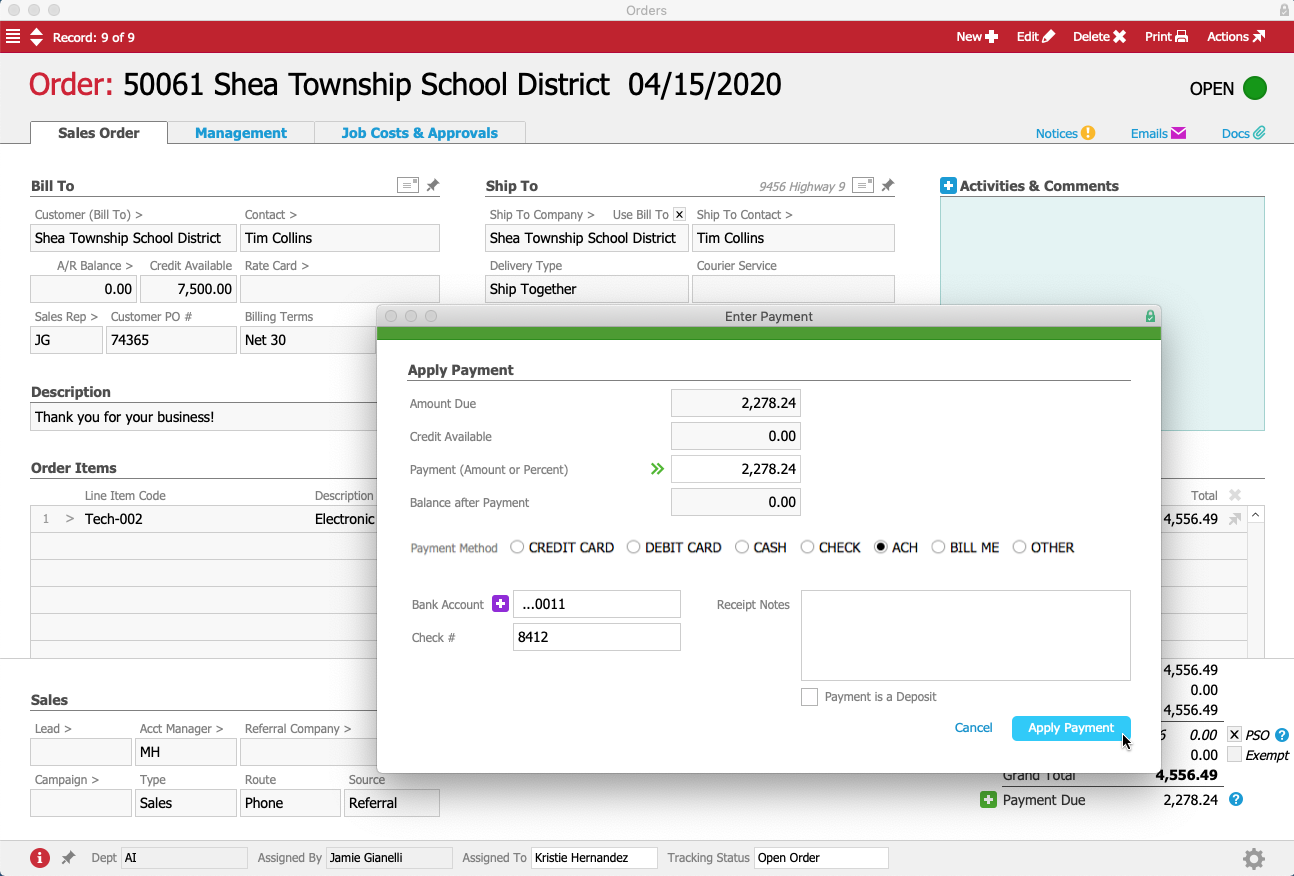
To process the deposit right away, Jamie clicks on the Green Plus Icon icon next to the Payment Due field, which opens up a payment dialog. Jamie enters “50%” in the Payment field and marks the “Payment is a Deposit” flag at the bottom of the screen. She selects “ACH” as the payment method.

STSD Enter Payment

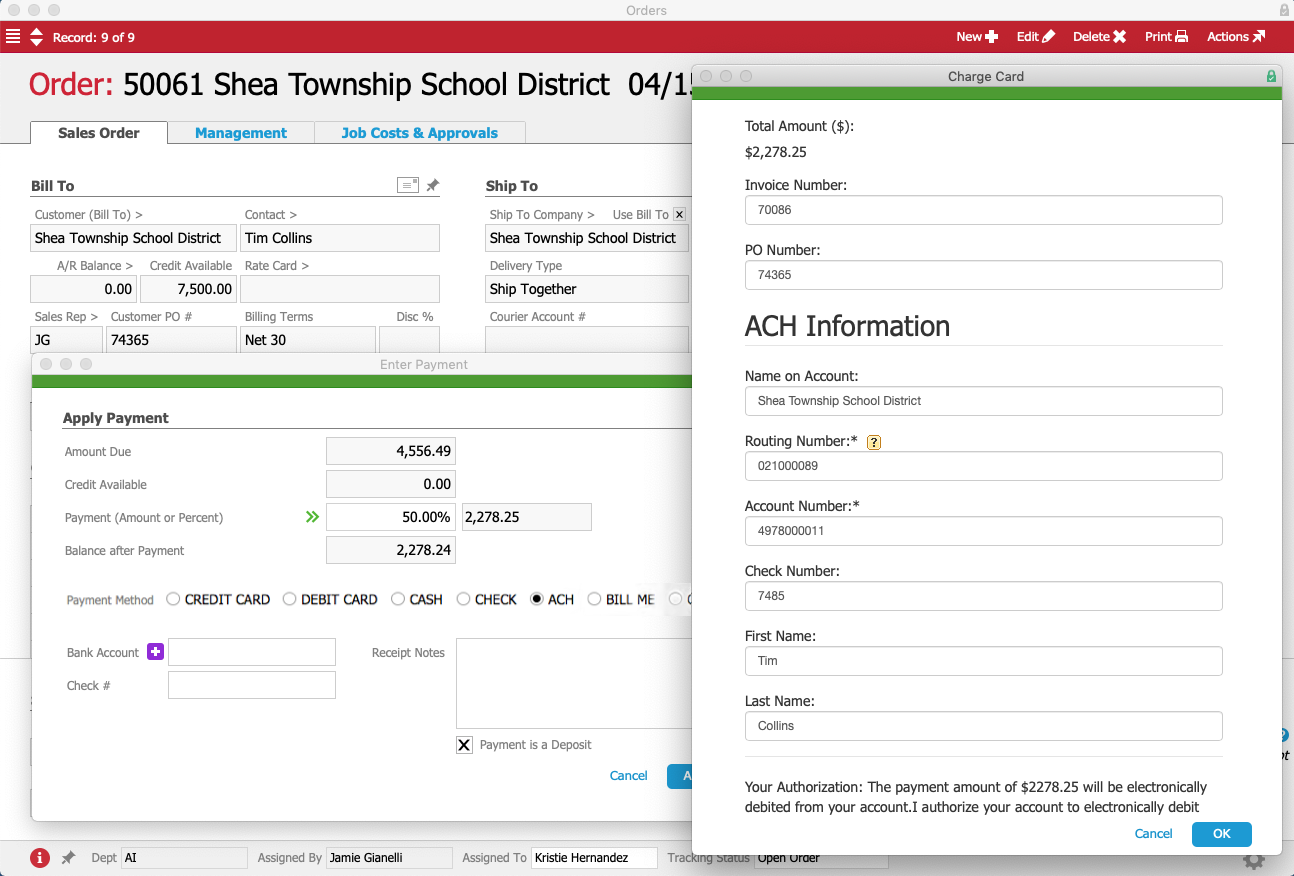
Jamie clicks on the Purple Plus Icon icon next to the Bank Account field, and a form for entering the bank account details pops up. Like we saw in the first example, this form is not part of aACE — rather, it’s an integrated portal to aACME’s payment processor.

STSD Charge Card Screen

Jamie enters Tim’s bank information in the form to authorize the payment processor to take the deposit directly from Tim’s checking account — all without his sensitive banking information ever entering aACE.

Jamie closes the form and returns to the payment dialog in aACE. As above, the bank account has been “tokenized” so it can be used for future payments. The only thing left for Jamie to do is click on the Apply Payment button to record the deposit in aACE.

Days later, Jamie receives a notification that the order has been shipped and it’s time to process the final payment. She returns to the order record and again clicks on the Green Plus Icon icon next to the Payment Due field.

As before, she selects “ACH” as the payment method. She has already entered Tim’s banking information in aACME’s payment processor, so a token representing the account appears in a drop-down menu when Jamie clicks into the Bank Account field. Jamie selects the account and clicks the Apply Payment button to process the payment.

STSD Final Payment

As these examples show, aACE+ Payments enables your business to take credit card and ACH payments swiftly and securely, removing the opportunity for errors introduced by duplicate data entry. To learn more about what aACE can do for you, register for a webinar today.

"We wouldn’t be able to do what we do without what aACE does for us. We used to spend hours entering each piece of data by hand — aACE automates ALL of it, freeing up our employees to handle our increasing volume of orders. We can do a lot more now thanks to aACE’s near-limitless functionality." - Cory Elliot, Founder and President, Troy Filters Ltd.

Learn More

You’ve nurtured a lead through the buyer’s journey, matched them with a product that’s sure to fit their needs, and now it’s time to take their payment. If you’re still using outdated manual methods and terminals that don’t communicate with your ERP, this may be time-consuming,... Learn More

-->

You’ve nurtured a lead through the buyer’s journey, matched them with a product that’s sure to fit their needs, and now it’s time to take their payment. If you’re still using outdated manual methods and terminals that don’t communicate with your ERP, this may be time-consuming, error-prone, and unsecured. Wouldn’t it be great if you could process payments quickly and securely all from within your order management solution?

With aACE+ Payments, you can.

A growing list of leading payment processing services integrate seamlessly with your aACE solution, ensuring that you’re able to quickly and securely process credit card, debit card, and ACH check payments. Eliminate the hassle of manually entering payment information into multiple solutions; with aACE+ Payments, you can enter payment information directly into a payment processor’s secure servers from aACE. Securely applying payment is a breeze, saving you time and minimizing the potential for errors. To learn more, let’s take a look at how our sample company, aACME Education Solutions, uses this feature in their day-to-day operations.

Mara Harvey receives a call from Luisa Ramos at the Brightside Charter School. Luisa would like to place an order for 5 student tablets and put it on her company card. Mara creates the order in aACE, specifying Credit Card as the billing terms.

BCS Order

When Mara selects Credit Card as the billing terms, a Credit Card field appears underneath the order’s total. Because Luisa doesn’t have a credit card on file yet, Mara will need to enter one so that it’s available when the product ships.

To add Luisa’s credit card, Mara clicks on the Purple Plus Icon button to the left of the Credit Card field. A form pops up where Mara can enter Luisa’s credit card details without leaving the order. The form automatically pulls in address information from Brightside Charter School’s company record, and Mara fills in the card number, expiration date, security code, and cardholder name.

BCS Generate Alias Form

Although this form was launched by a button in aACE, the form itself isn’t part of aACE — instead it’s a portal into the payment processor’s server that has been integrated seamlessly into aACME’s aACE solution. This ensures that when Mara enters Luisa’s sensitive credit card information, that data is never stored locally where it may be at risk, but rather is stored only on the payment processor’s secure servers.

Once the Mara submits the form, the payment processor generates a token for Luisa’s credit card that is stored in aACE. This makes it easier for the aACME sales team to process future orders, while still maintaining PCI compliance. In seconds, Mara receives a message that the transaction went through successfully. The card is now ready to be used.

Mara closes the form, and aACE automatically pulls the card’s alias into the Credit Card field. Only the card brand, last four digits, and expiration date are displayed. A hidden field contains the token; remember, at no point does aACE itself or Mara’s workstation have access to the full credit card number.

BCS Transaction Result

Mara saves and processes Luisa’s order, which prompts aACE to automatically generate a shipment for the tablets. In aACME’s warehouse, Ned Walker picks the tablets using the aACE Pick App. When he’s finished, aACE automatically transmits the shipment to aACME’s shipping solution.

Over in the Shipping Department, Kristie Hernandez logs into the shipping solution and schedules Luisa’s package for delivery. The shipment information is automatically pulled back into aACE, where the shipment record’s status is updated to Shipped.

At this point, aACE automatically generates an invoice for the order. Because the order is configured to charge the card on file, Luisa’s card is automatically charged for the balance, resulting in a posted receipt and closed invoice.

BCS Order with CC

In the receipt’s log, we can see that the credit card was successfully charged.

BCS Invoice and Receipt

But what happens when there’s a problem with the credit card and the payment fails to go through? aACE notifies the relevant parties immediately, enabling you to prevent products from going out the door without having been paid for. Let’s take a look at how that works.

Mara receives another order, this time for 3 electronic whiteboards from the Montboro School District. Sam Patel, the Assistant Superintendent placing the order, would like to pay with a credit card he has used previously with aACME. As before, Mara selects Credit Card as the billing terms and the Credit Card field appears under the order’s total. This time, instead of entering new credit card details, Mara can simply choose the card Sam wants to use from the drop-down list.

MSD Order

The order proceeds to the warehouse, where it’s picked, packed, and prepared to be shipped. When Kristie schedules the shipment, aACE again automatically generates an invoice and charges the credit card on file – but this time, the card is declined.

Immediately, aACE sends a text message to Kristie’s mobile phone. She cancels the shipment and stops the package from leaving before payment is received. Mara also receives a notification, allowing her to quickly follow up with Sam to get a new credit card for the order.

MSD Notice

Now we’ve seen how aACE+ Payments makes it easy to take credit card payments, but what happens if a customer requests a refund or exchange?

The Full STEAM Academy Charter School ordered 25 French textbooks, but when they arrive, two of the books are damaged. Tina Rivera, the school principal, contacts aACME to initiate the refund process and send the damaged books back.

When the package from Full STEAM arrives in aACME’s warehouse, Alexis Kohn in the Billing department receives a notice alerting her that an adjustment invoice has been generated. She determines that everything looks correct and processes it, which reverses the amount of the two textbooks from the original invoice.

Full STEAM Invoice with Adjustment

Next, Alexis needs to issue a partial refund for the two damaged books. To do that, she pulls up the original receipt and selects Credit/Adjust Receipt from the Actions menu.

Full STEAM Receipt

aACE automatically pulls in the customer, method of payment, invoice, order, and a suggested amount for the refund. After double-checking that the information is correct, Alexis posts the receipt. Tina’s credit card is then refunded when the credit card batch settles overnight.

Full STEAM Receipt Log

What if a sales rep makes a mistake and accidentally overcharges the customer? Fortunately, aACE+ Payments makes it easy to correct those errors — and as long as the mistake is fixed on the same day, the erroneous charge won’t even make it to the customer’s credit card statement.

Jamie Gianelli, a sales rep at aACME, receives an order from Southglen High School for new textbooks to replace the outdated ones the school has been using. Nikki Huang, the Vice Principal at Southglen, gives Jamie a long list of books and their quantities, including 45 natural science textbooks. Jamie accidentally mistypes this number as 54, and due to the many items in the order, neither she nor Nikki realize that the total is higher than it should be. It’s only after Jamie has opened the order and taken the payment that she realizes the mistake.

Southglen Order

Fortunately, because Jamie caught the error on the same day that the payment was processed, she can fix it before the incorrect charge hits Nikki’s credit card. She pulls up the order and changes the quantity of the science books from 54 to 45, then voids the receipt that was originally created, which voids the pending charge and removes it from Nikki’s credit card statement. With the updated order Jamie can charge the correct amount without Nikki ever seeing the mistake.

And if a customer wants to pay by ACH? aACE+ Payments supports that too.

Jamie receives an order from the Shea Township School District for a new mounted electronic whiteboard. Tim Collins, the Administrative Assistant at Shea Township, would like to place a 50% deposit on the order using ACH.

STSD Order

To process the deposit right away, Jamie clicks on the Green Plus Icon icon next to the Payment Due field, which opens up a payment dialog. Jamie enters “50%” in the Payment field and marks the “Payment is a Deposit” flag at the bottom of the screen. She selects “ACH” as the payment method.

STSD Enter Payment

Jamie clicks on the Purple Plus Icon icon next to the Bank Account field, and a form for entering the bank account details pops up. Like we saw in the first example, this form is not part of aACE — rather, it’s an integrated portal to aACME’s payment processor.

STSD Charge Card Screen

Jamie enters Tim’s bank information in the form to authorize the payment processor to take the deposit directly from Tim’s checking account — all without his sensitive banking information ever entering aACE.

Jamie closes the form and returns to the payment dialog in aACE. As above, the bank account has been “tokenized” so it can be used for future payments. The only thing left for Jamie to do is click on the Apply Payment button to record the deposit in aACE.

Days later, Jamie receives a notification that the order has been shipped and it’s time to process the final payment. She returns to the order record and again clicks on the Green Plus Icon icon next to the Payment Due field.

As before, she selects “ACH” as the payment method. She has already entered Tim’s banking information in aACME’s payment processor, so a token representing the account appears in a drop-down menu when Jamie clicks into the Bank Account field. Jamie selects the account and clicks the Apply Payment button to process the payment.

STSD Final Payment

As these examples show, aACE+ Payments enables your business to take credit card and ACH payments swiftly and securely, removing the opportunity for errors introduced by duplicate data entry. To learn more about what aACE can do for you, register for a webinar today.

"We wouldn’t be able to do what we do without what aACE does for us. We used to spend hours entering each piece of data by hand — aACE automates ALL of it, freeing up our employees to handle our increasing volume of orders. We can do a lot more now thanks to aACE’s near-limitless functionality." - Cory Elliot, Founder and President, Troy Filters Ltd.

Learn More

Read more about Automate Recurring Transactions with aACE

Automate Recurring Transactions with aACE

With aACE, you can.

aACE’s automated Recurring Transactions module allows you to set and forget your regular transactions. To see this feature in action, let’s take a look at just a few examples of how our fictional company, aACME Education Solutions, uses it in their day-to-day operations.

Receipts

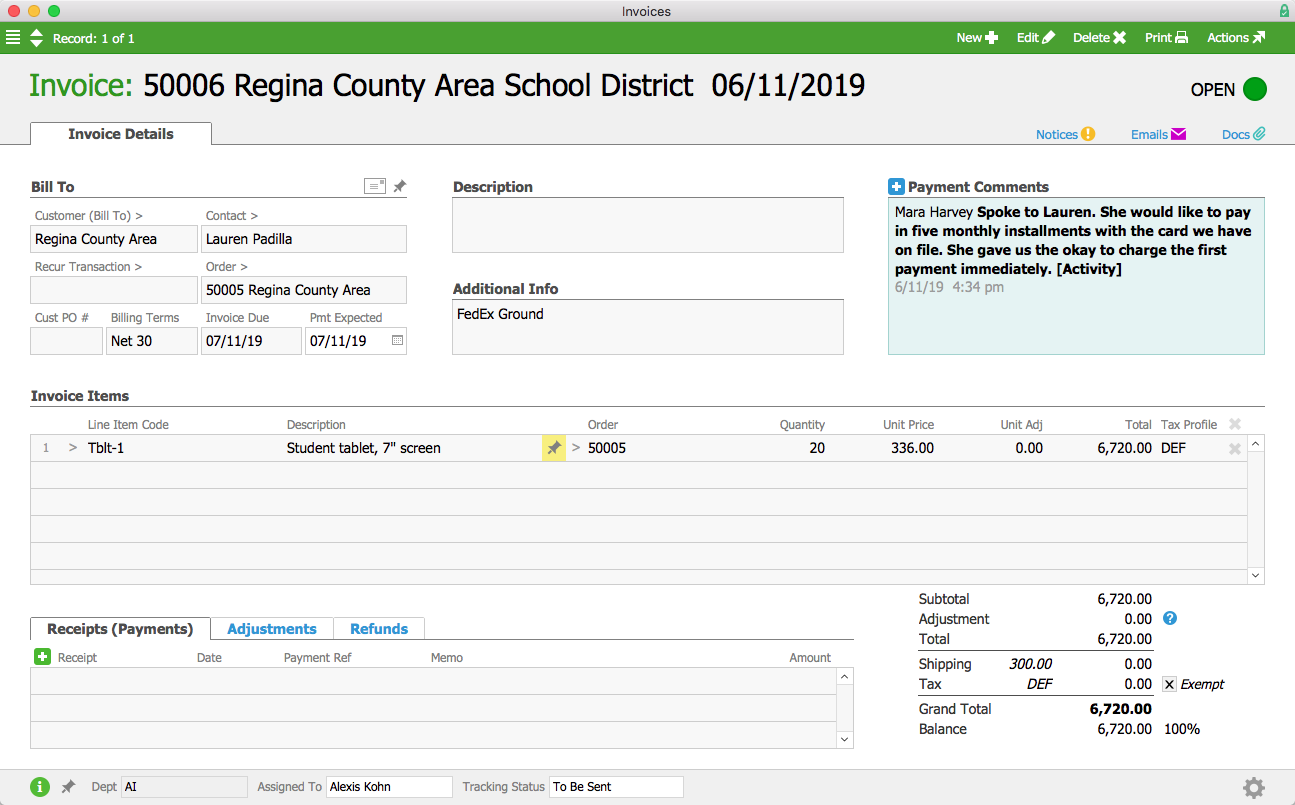
The Regina County Area School District places an order for 20 tablet computers for their students. Account Manager Mara Harvey receives a call from Lauren Padilla at the school district, asking if they could pay for the tablets in five installments. When aACE auto-generates the order’s invoice, Mara makes a note of the agreement in the Payment Comments field.
Invoice

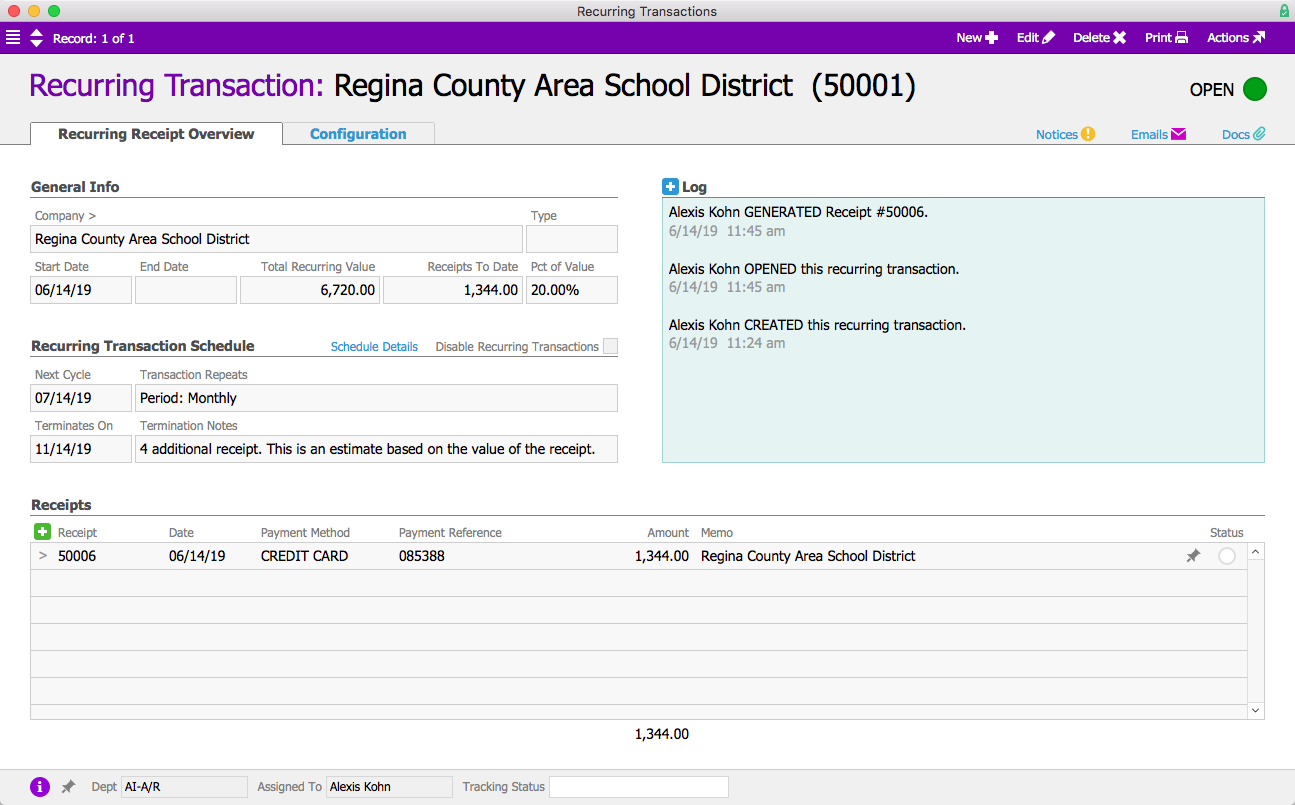
When Alexis Kohn in the Accounts Receivable department sees this note, she creates a new customer payment receipt in the Recurring Transactions module. Lauren has agreed to pay each installment via a credit card that’s kept on file, so Alexis configures the transaction to automatically charge that card and post the resulting receipt each month until the invoice has been paid off. Lauren had asked for the payment plan to begin immediately, so Alexis manually runs the first cycle. aACE generates the first receipt and updates the transaction’s schedule so it will run automatically next month.
Recurring Receipt

Purchases

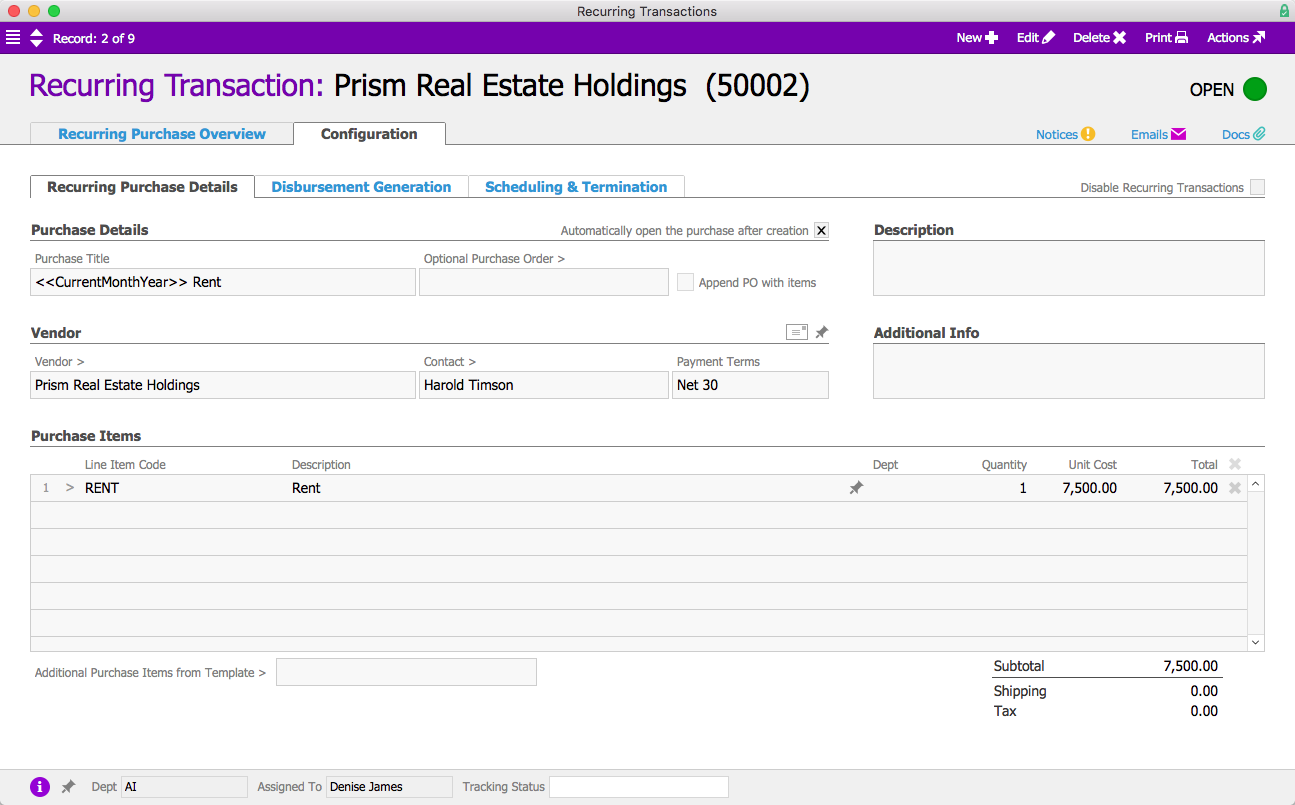
aACME Education Solutions has just signed a lease on a new office space, and Denise James in the Accounts Payable department needs to set up a recurring transaction for the monthly rent. To do that, she creates a new purchase in the Recurring Transactions module.

Using merge fields, she sets up the title of each purchase to reflect the then-current month and year. Then she configures the record to automatically generate a purchase and disbursement on the first of each month. The disbursement will be left pending, and a member of the A/P team will be notified when it is time to process it and cut the monthly rent check.

Recurring Purchase

General Journal Entries

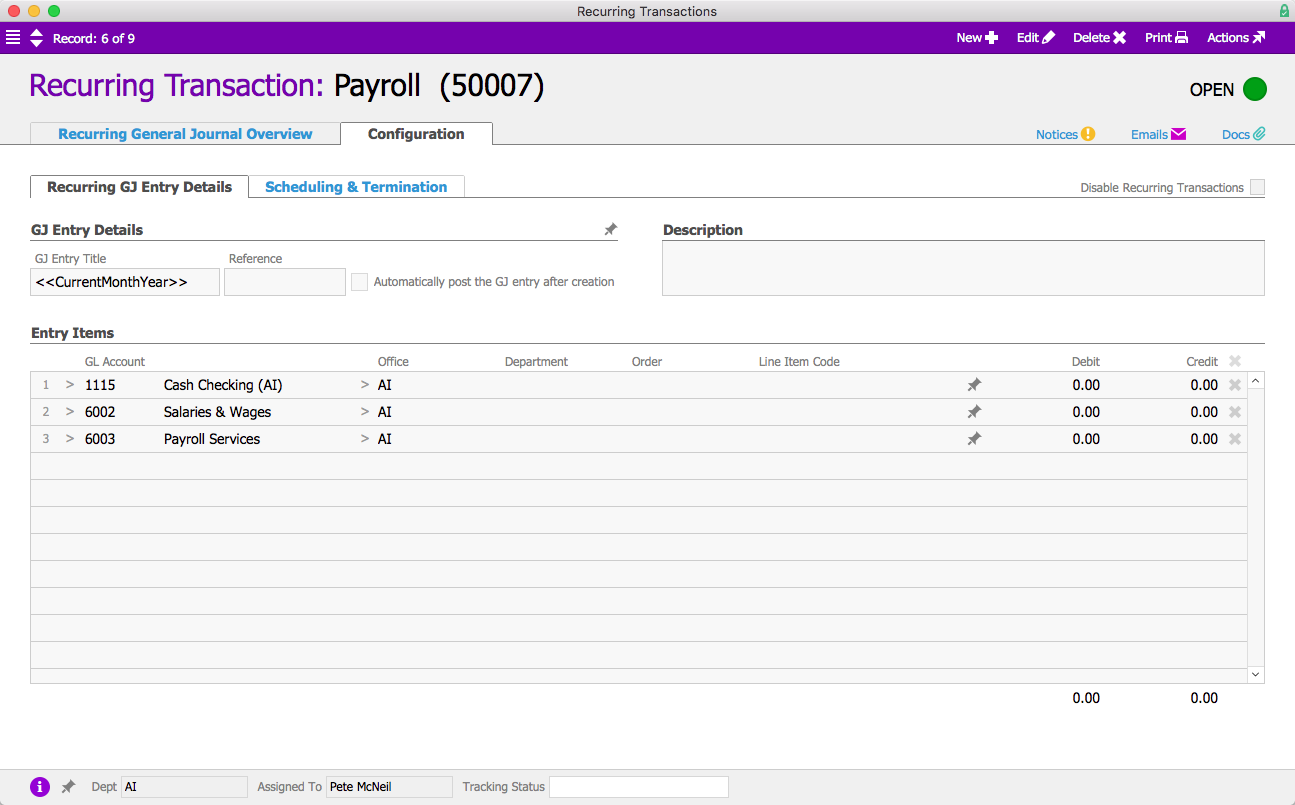
Pete McNeil, aACME’s Director of Human Resources, processes payroll every two weeks. To manage this data in aACE, he creates a new general journal entry in the Recurring Transactions module.

Because every pay period is slightly different, Pete does not configure the transaction to automatically post the GJ entry once it’s been generated. Instead, the recurring transaction will be used as a template and Pete will fill in the details each time payroll is processed. Because payroll will continue to run indefinitely, he doesn’t set an end date; aACE will continue generating GJ entries every two weeks until someone manually disables the transaction.

Recurring GJ Entry

Invoices

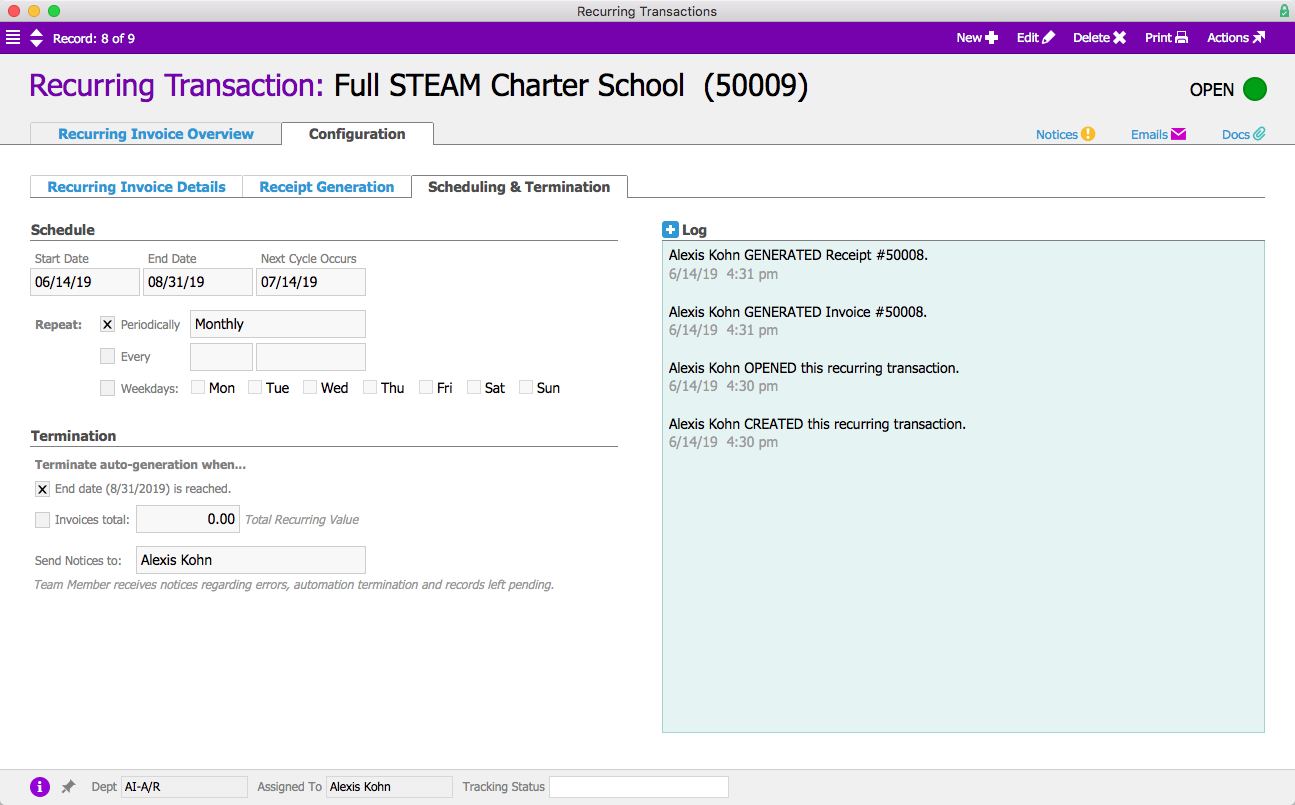
In addition to selling new and refurbished electronic whiteboards, aACME offers schools the option to rent these expensive products. The Full STEAM Academy Charter School rents three whiteboards for their summer term. To ensure that the revenue for each month’s payment is accounted for correctly, Alexis Kohn in the A/R department creates an invoice in the Recurring Transactions module.

Each month, aACE will generate a new invoice for the monthly rental fee and charge the credit card on file for Full STEAM. The transaction will automatically terminate at the end of the summer. Unlike a recurring receipt, which considered each payment as part of a single transaction, aACE will recognize revenue from the recurring invoices separately.

Recurring Invoice

Orders

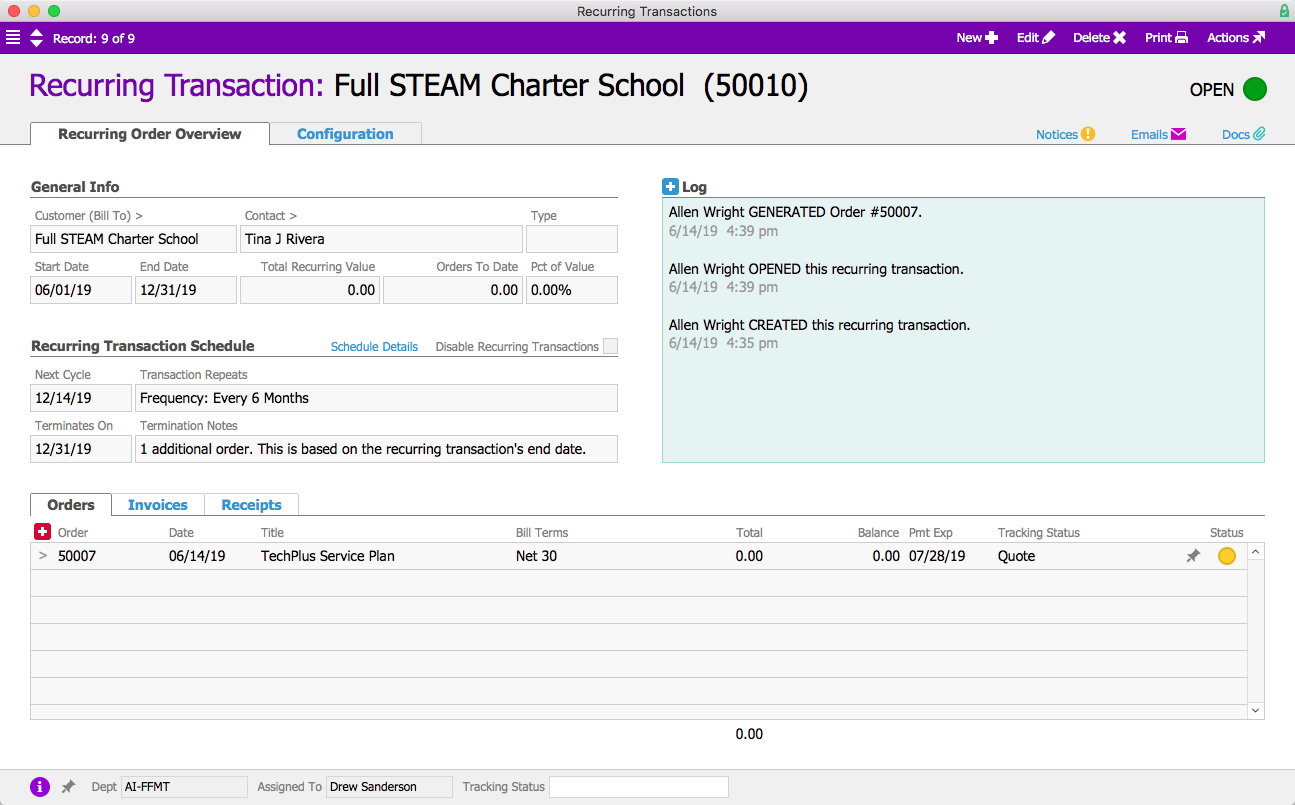
For customers who buy or lease electronic whiteboards or other tech, aACME offers a service plan for a technician to come onsite and make sure their products are in good working condition. Twice a year, aACE generates an order that automatically appears on the calendar for scheduling, and when the technician goes onsite they have a job ready to apply their time and any materials used on maintenance.

Recurring Order

Disbursements

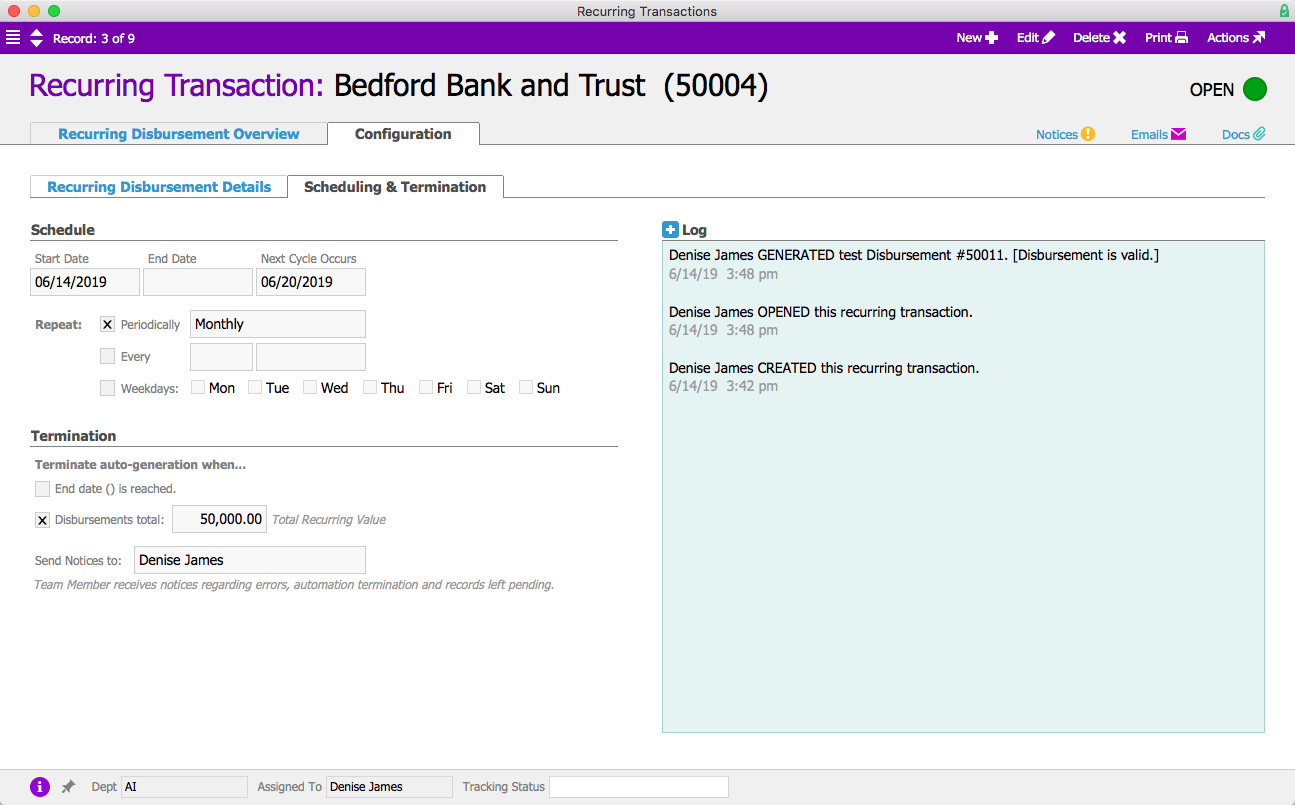
aACME has funds automatically withdrawn from their operating account each month to pay down a loan. To account for those payments, Denise James in the A/P department creates a recurring disbursement and tests the transaction to ensure that it generates an accurate disbursement record. On the 20th of each month – the date that the loan payments are due – aACE automatically generates and posts a disbursement for the exact amount of the loan payment.

Recurring Disbursement

Purchase Orders

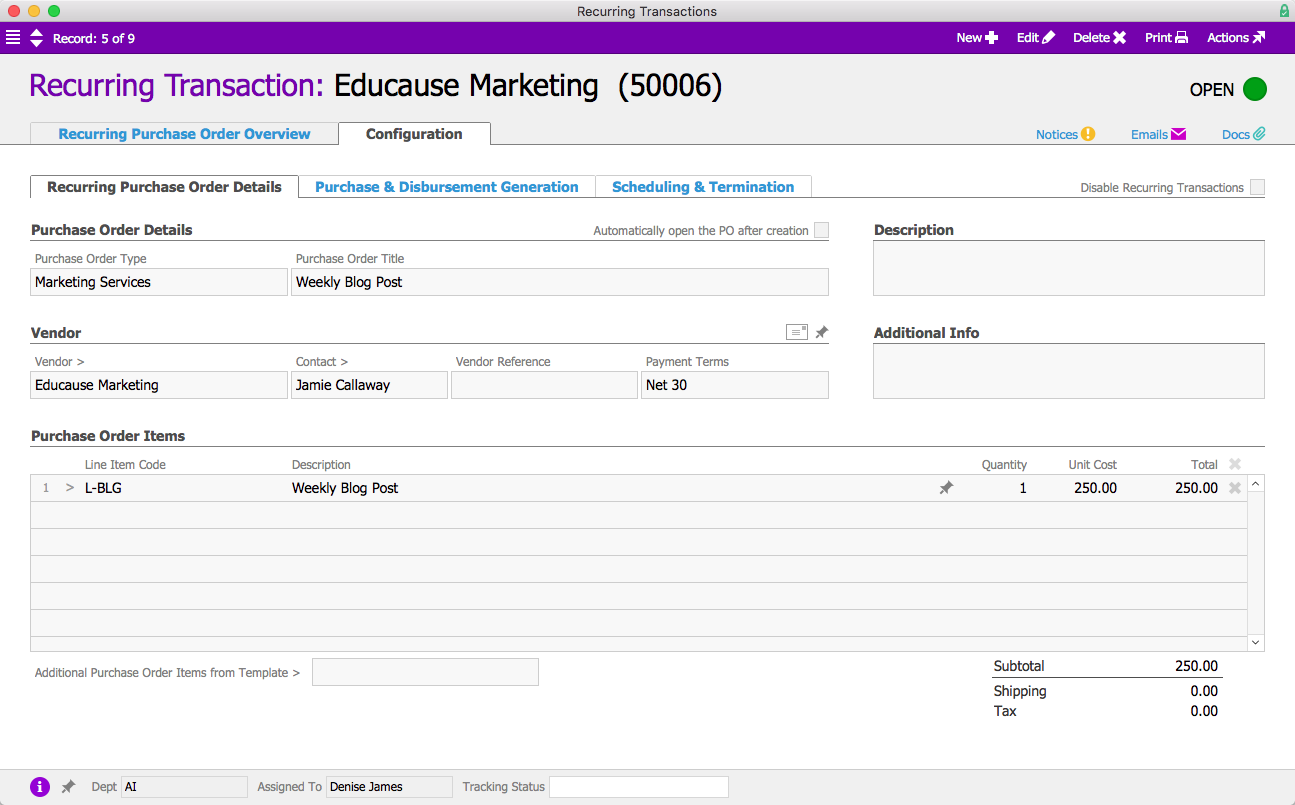
aACME provides resources for educators and school administrators on current best practices in education. To keep up with the demand for new content, they outsource their weekly blog posts to a handful of rotating writers. Denise James creates a recurring purchase order for these posts. Each week aACE automatically generates a PO for that week’s article, which will ultimately be invoiced and published upon delivery.

Recurring PO

These are just a few of the ways that aACME uses the Recurring Transactions in their day-to-day operations. To learn more about how aACE automation can help streamline your business, sign up for a webinar today.

"aACE software is easy to use, intuitive, logical, and easily customized. It is clear that the architecture of aACE has been very well thought out. We were able to automate some previously manual processes that is resulting in literally hundreds of saved labor hours each month." -Daniel Chapman , Founder & CEO, Redd Remedies
Learn More

Whether it’s paying the rent, billing for subscription services, or allowing customers to take out a payment plan, most businesses have at least a few transactions that are set to recur regularly. Wouldn’t it be great if you could enter these transactions once and trust your business management... Learn More

-->

Whether it’s paying the rent, billing for subscription services, or allowing customers to take out a payment plan, most businesses have at least a few transactions that are set to recur regularly. Wouldn’t it be great if you could enter these transactions once and trust your business management solution to do the rest?

With aACE, you can.

aACE’s automated Recurring Transactions module allows you to set and forget your regular transactions. To see this feature in action, let’s take a look at just a few examples of how our fictional company, aACME Education Solutions, uses it in their day-to-day operations.

Receipts

The Regina County Area School District places an order for 20 tablet computers for their students. Account Manager Mara Harvey receives a call from Lauren Padilla at the school district, asking if they could pay for the tablets in five installments. When aACE auto-generates the order’s invoice, Mara makes a note of the agreement in the Payment Comments field.

Invoice

When Alexis Kohn in the Accounts Receivable department sees this note, she creates a new customer payment receipt in the Recurring Transactions module. Lauren has agreed to pay each installment via a credit card that’s kept on file, so Alexis configures the transaction to automatically charge that card and post the resulting receipt each month until the invoice has been paid off. Lauren had asked for the payment plan to begin immediately, so Alexis manually runs the first cycle. aACE generates the first receipt and updates the transaction’s schedule so it will run automatically next month.

Recurring Receipt

Purchases

aACME Education Solutions has just signed a lease on a new office space, and Denise James in the Accounts Payable department needs to set up a recurring transaction for the monthly rent. To do that, she creates a new purchase in the Recurring Transactions module.

Using merge fields, she sets up the title of each purchase to reflect the then-current month and year. Then she configures the record to automatically generate a purchase and disbursement on the first of each month. The disbursement will be left pending, and a member of the A/P team will be notified when it is time to process it and cut the monthly rent check.

Recurring Purchase

General Journal Entries

Pete McNeil, aACME’s Director of Human Resources, processes payroll every two weeks. To manage this data in aACE, he creates a new general journal entry in the Recurring Transactions module.

Because every pay period is slightly different, Pete does not configure the transaction to automatically post the GJ entry once it’s been generated. Instead, the recurring transaction will be used as a template and Pete will fill in the details each time payroll is processed. Because payroll will continue to run indefinitely, he doesn’t set an end date; aACE will continue generating GJ entries every two weeks until someone manually disables the transaction.

Recurring GJ Entry

Invoices

In addition to selling new and refurbished electronic whiteboards, aACME offers schools the option to rent these expensive products. The Full STEAM Academy Charter School rents three whiteboards for their summer term. To ensure that the revenue for each month’s payment is accounted for correctly, Alexis Kohn in the A/R department creates an invoice in the Recurring Transactions module.

Each month, aACE will generate a new invoice for the monthly rental fee and charge the credit card on file for Full STEAM. The transaction will automatically terminate at the end of the summer. Unlike a recurring receipt, which considered each payment as part of a single transaction, aACE will recognize revenue from the recurring invoices separately.

Recurring Invoice

Orders

For customers who buy or lease electronic whiteboards or other tech, aACME offers a service plan for a technician to come onsite and make sure their products are in good working condition. Twice a year, aACE generates an order that automatically appears on the calendar for scheduling, and when the technician goes onsite they have a job ready to apply their time and any materials used on maintenance.

Recurring Order

Disbursements

aACME has funds automatically withdrawn from their operating account each month to pay down a loan. To account for those payments, Denise James in the A/P department creates a recurring disbursement and tests the transaction to ensure that it generates an accurate disbursement record. On the 20th of each month – the date that the loan payments are due – aACE automatically generates and posts a disbursement for the exact amount of the loan payment.

Recurring Disbursement

Purchase Orders

aACME provides resources for educators and school administrators on current best practices in education. To keep up with the demand for new content, they outsource their weekly blog posts to a handful of rotating writers. Denise James creates a recurring purchase order for these posts. Each week aACE automatically generates a PO for that week’s article, which will ultimately be invoiced and published upon delivery.

Recurring PO

These are just a few of the ways that aACME uses the Recurring Transactions in their day-to-day operations. To learn more about how aACE automation can help streamline your business, sign up for a webinar today.

"aACE software is easy to use, intuitive, logical, and easily customized. It is clear that the architecture of aACE has been very well thought out. We were able to automate some previously manual processes that is resulting in literally hundreds of saved labor hours each month." -Daniel Chapman , Founder & CEO, Redd Remedies
Learn More

Read more about Manage Multiple Business Entities in a Single aACE Solution – Here’s How

Manage Multiple Business Entities in a Single aACE Solution – Here’s How

aACE does that.

With aACE, you can track data from different locations, different offices, or even different brands in one comprehensive yet easy-to-use solution. Powerful segregation-of-duties tools allow you to control which parts of the system each user can access, while aACE’s reporting tools allow you to refine financial statements to different entities within the same solution. To see aACE’s multi-entity accounting features in action, let’s take a look at how our fictional company, aACME Education Solutions, manages multiple brands in aACE.

aACME Education Solutions sells technology, textbooks, and classroom resources for students, teachers, and school administrators. They have a regional outlet in the Midwest that sells clearance products at a discount under the aACME brand. They also conduct in-school educational programs under the Education Elite brand, based in Texas. aACME and Education Elite are two separate companies operating under the same ownership, but aACME can sell EE products and programs.

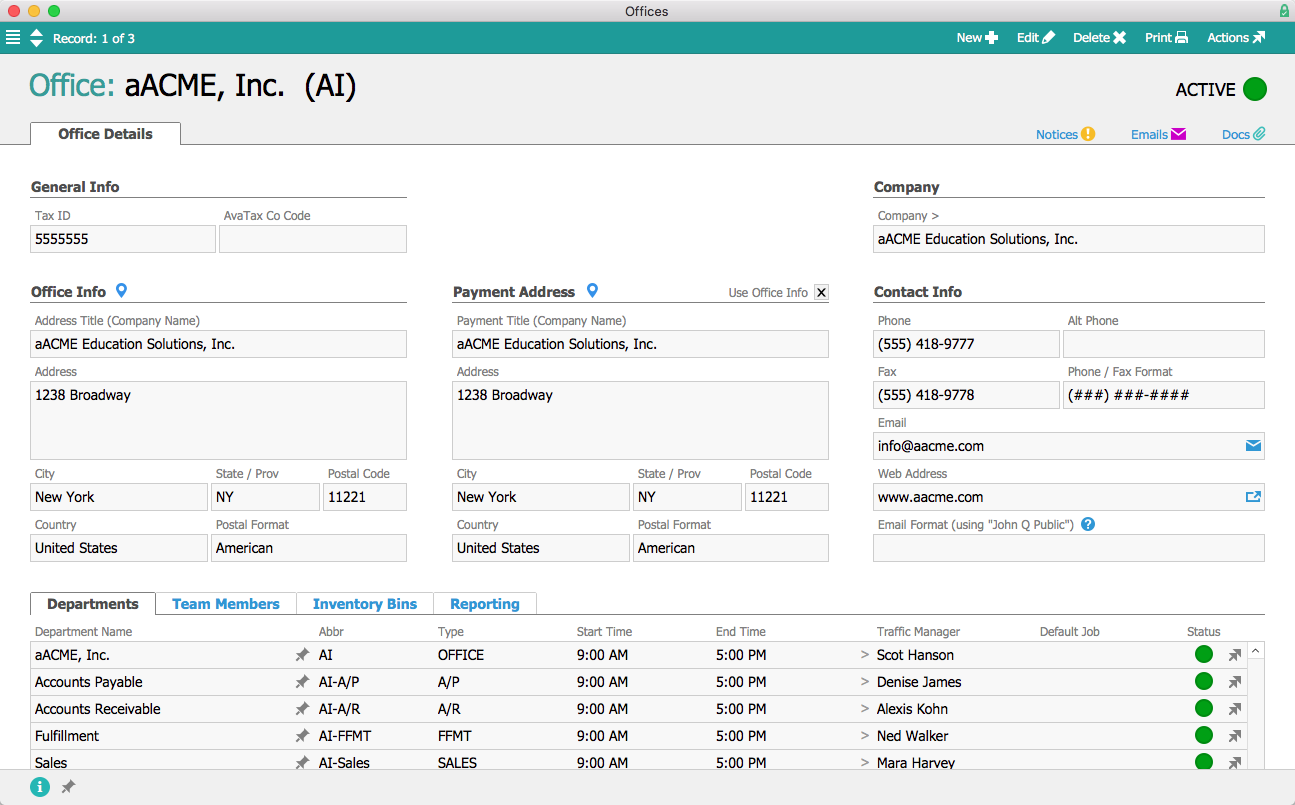
In aACME’s aACE solution there are three separate office records: aACME Inc., the Midwest Regional Outlet, and Education Elite. Each office has its own specific addresses, tax ID, departments, team members, inventory locations, and report branding.

Office Record

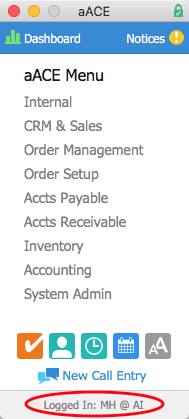
Users are assigned to a particular office. When they log in, their initials and the initials of their office are displayed at the bottom of the main menu. Mara Harvey, for example, is assigned to the aACME Inc. office, so when she logs in the menu displays “MH @ AI”.

Main Menu

Mara receives an order from the Highbridge Academy. They’re adding a new astronomy elective and need 30 student textbooks. To kick off the new course, they’d also like to bring Education Elite in to give a workshop on astronomy to the entire school.

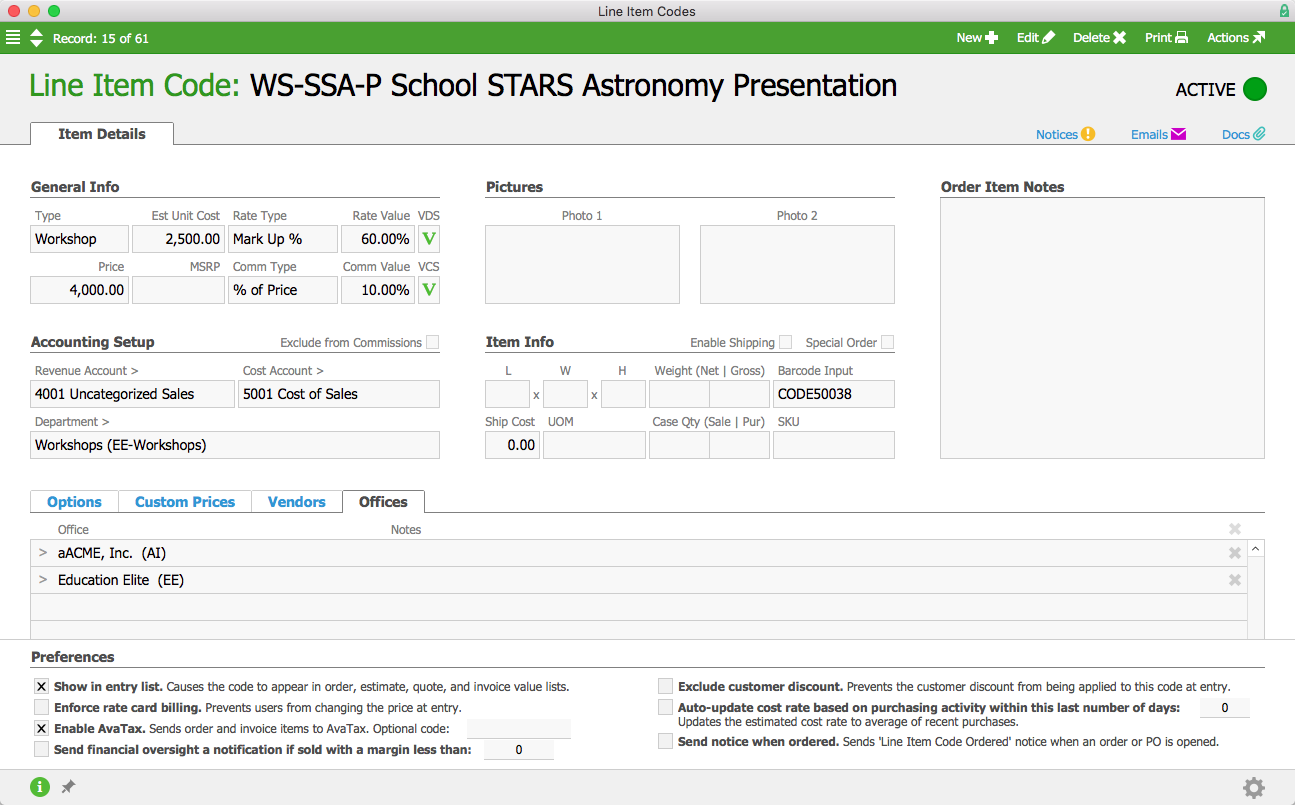
Because Education Elite’s workshops can be sold by employees at aACME’s headquarters, the workshop’s product record lists the aACME Inc. office in addition to the Education Elite office. To ensure that the revenue from the workshop is attributed to Education Elite regardless of which office sells it, the product record’s department is EE-Workshops. The clearance outlet does not sell the workshops, so the Midwest Regional Outlet is not listed in the product’s record. Employees at the outlet don’t see the workshops in their system and are not able to add them to orders.

Workshop Record

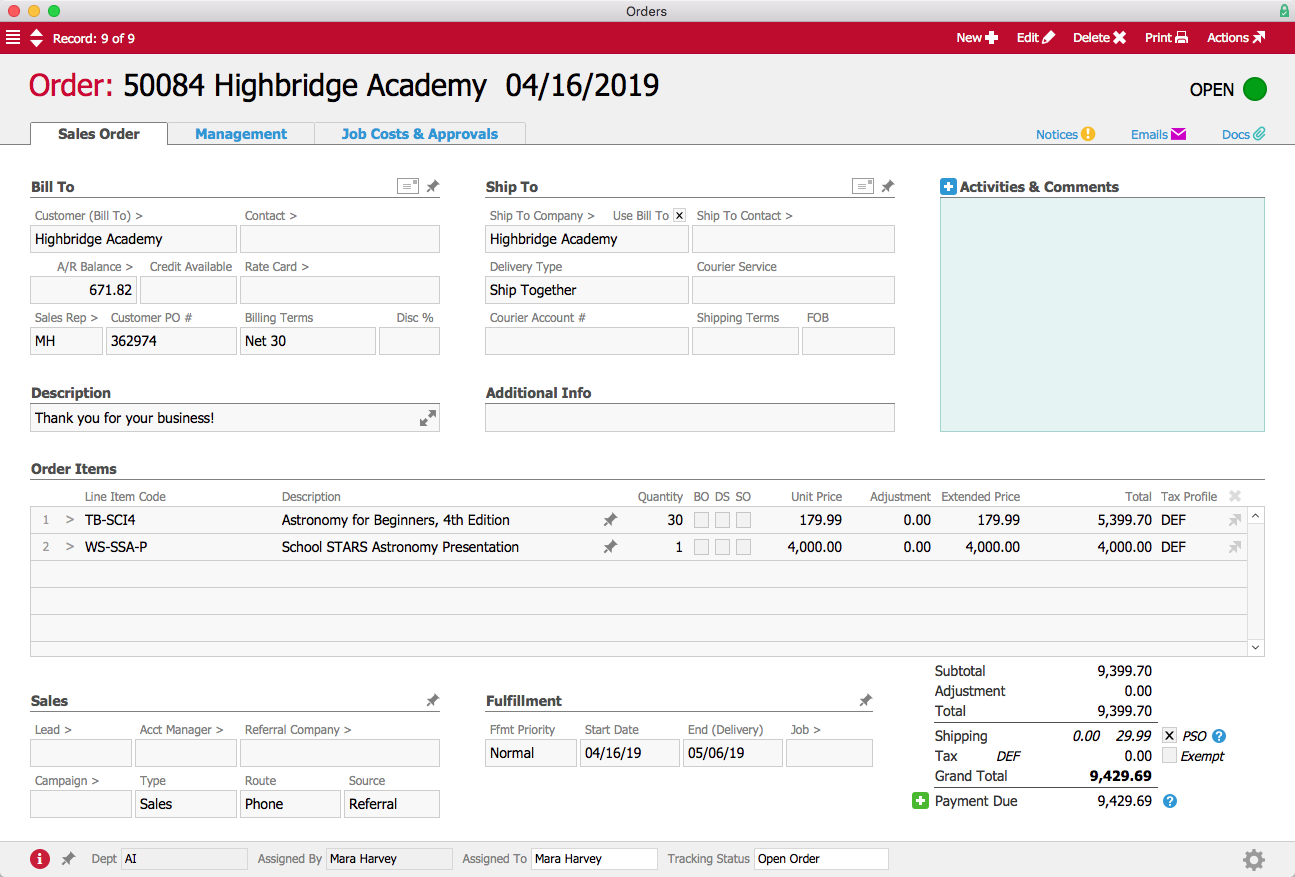
As an employee in the aACME Inc. office, Mara can see the astronomy workshop in her list of products. She adds it to the Highbridge Academy order along with the textbooks they requested.

Highbridge Order

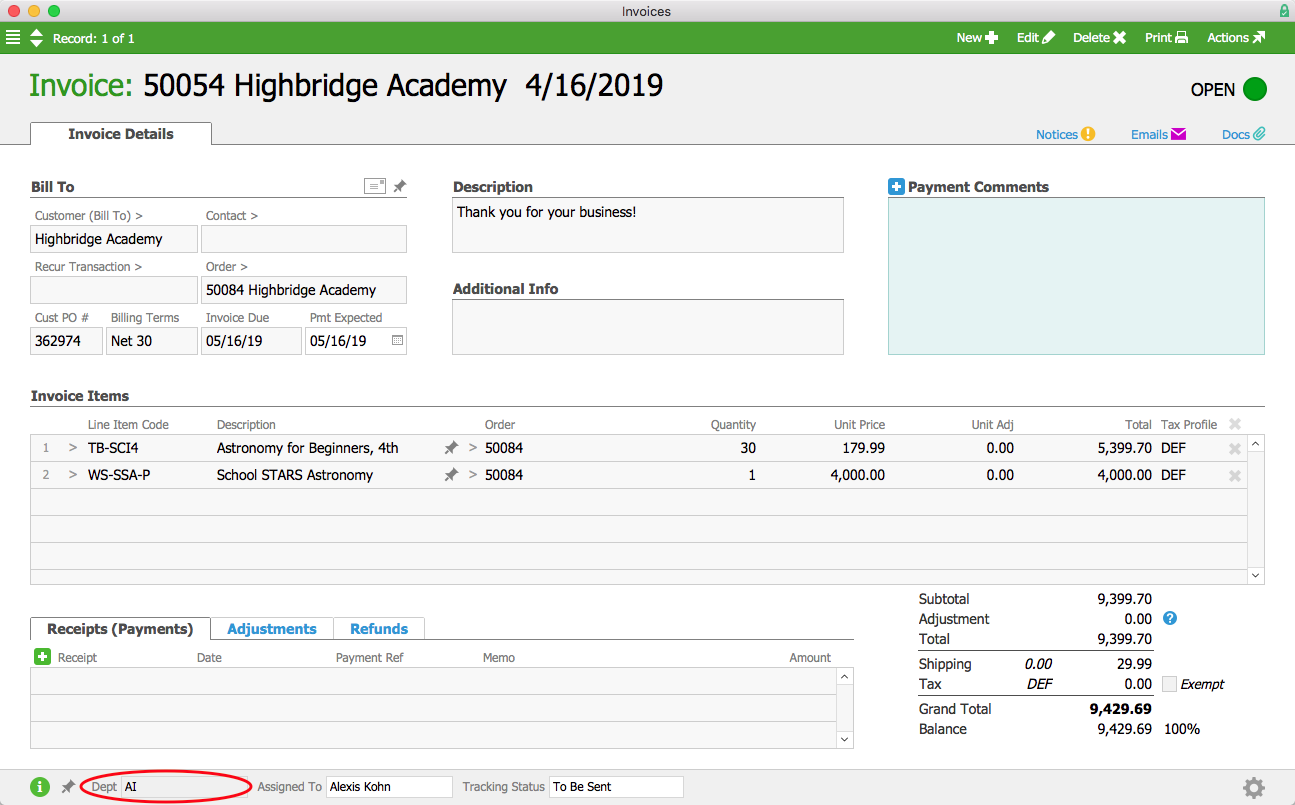
When aACE generates the invoice for this order, it will be assigned to aACME Inc. because that is where the order originated. This ensures that the customer will receive a single invoice for the entire order regardless of how many different offices they’ve ordered products from.

5 Highbridge Invoice-1

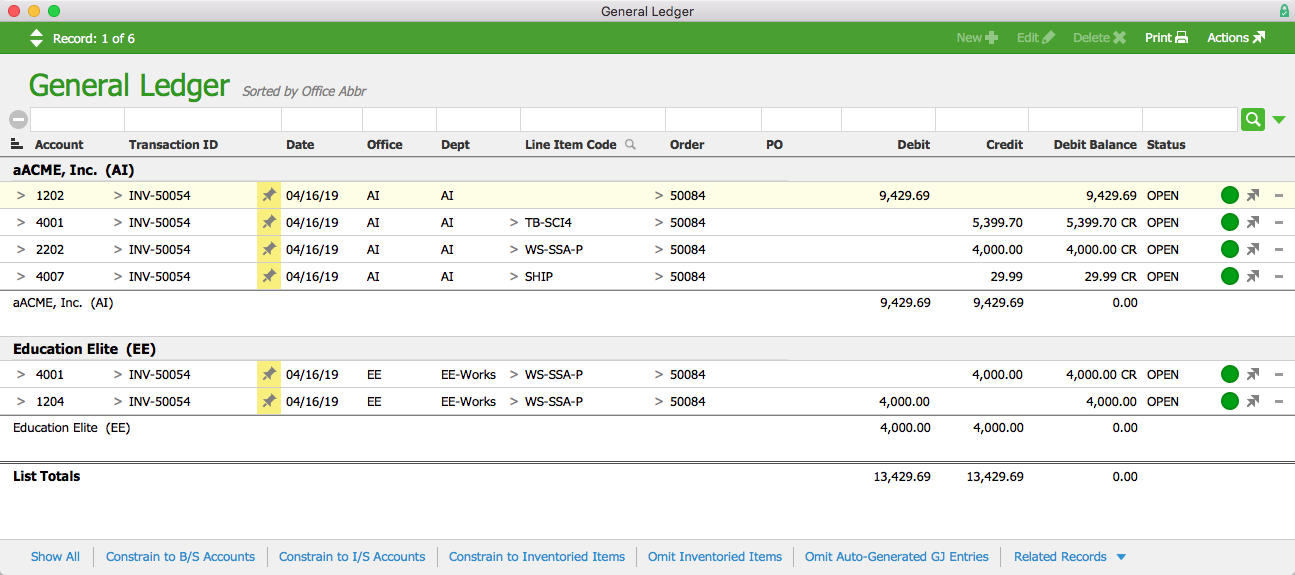
Because the workshop is assigned to Education Elite, the general ledger will attribute the revenue generated from the workshop to EE’s office. Below we can see the GL transactions associated with the invoice. The transactions have been sorted by office to show that the $4,000 revenue (Account #4001) from the workshop has been attributed to EE. There is also a receivables balance (Account #1204) for the $4,000 due from AI. We can see the corresponding payables balance (Account #2202) associated with AI’s office.

General Ledger

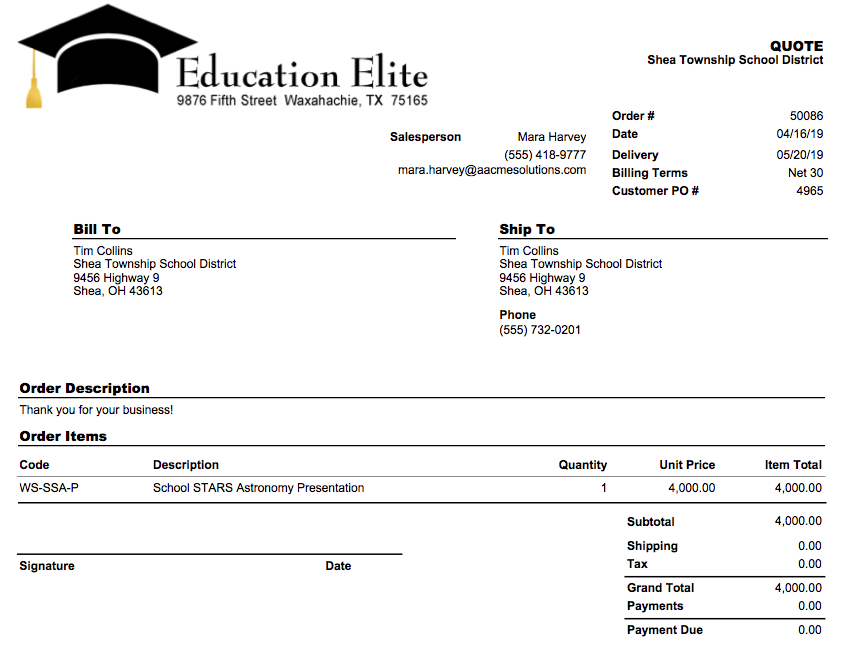
Later, Mara receives an order from the Shea Township School District. They would also like to run the astronomy workshop at their high school; because they have worked directly with Mara in the past, they placed the order through her instead of through Education Elite. When Mara processes the order, she changes the department associated with the order to Education Elite since she is only selling their products. This change means that the quote she sends to Shea Township will have EE’s branding instead of aACME’s.

Shea Twp Quote

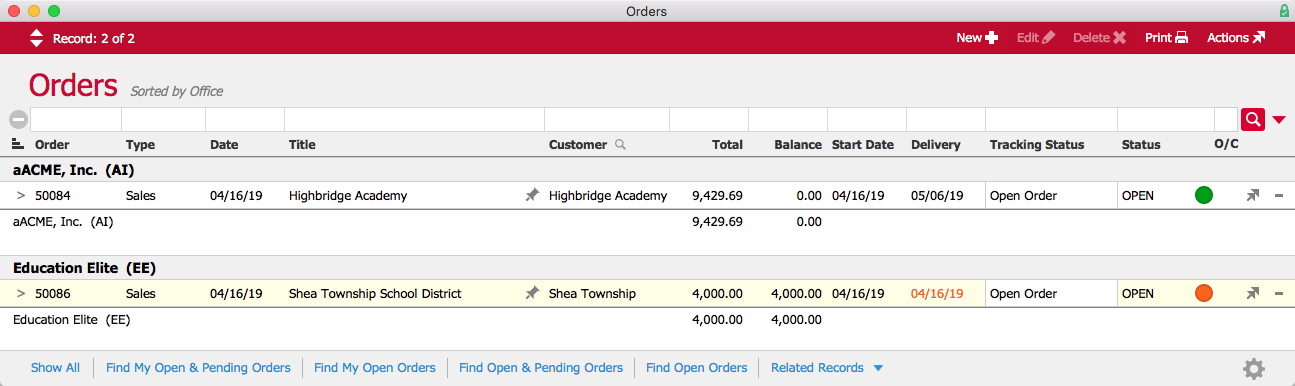
As an account manager, Mara has privileges in aACE that allow her to see orders from all three offices. In the Orders module list view, she can sort her list of orders by office to see which ones belong to aACME Inc., the Midwest Regional Outlet, or Education Elite.

Orders List View

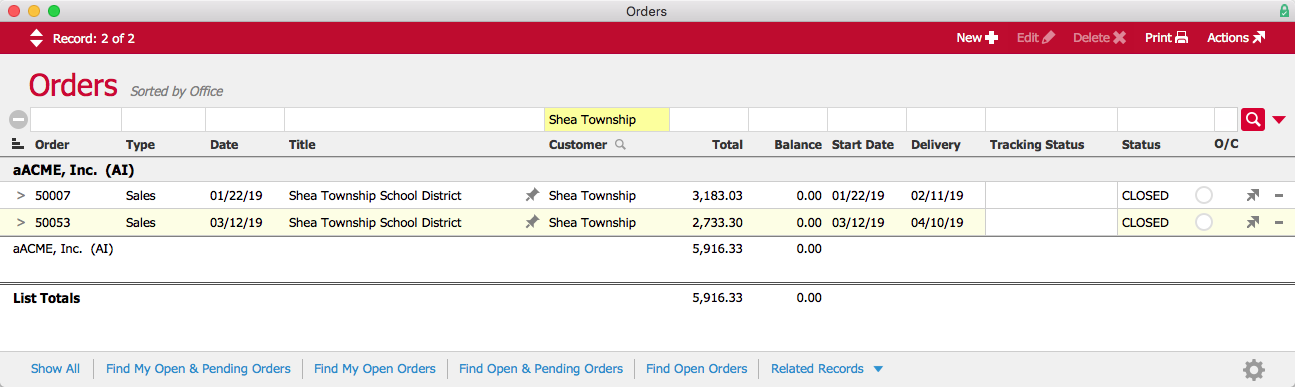
Not all users are able to view data from all of aACME’s offices. Jamie Gianelli, a sales representative for aACME Inc., is only able to view orders pertaining to her own office. If she searches for Shea Township, for example, she won’t see Order #50086 for the astronomy workshop because that order belongs to Education Elite.

Orders List View

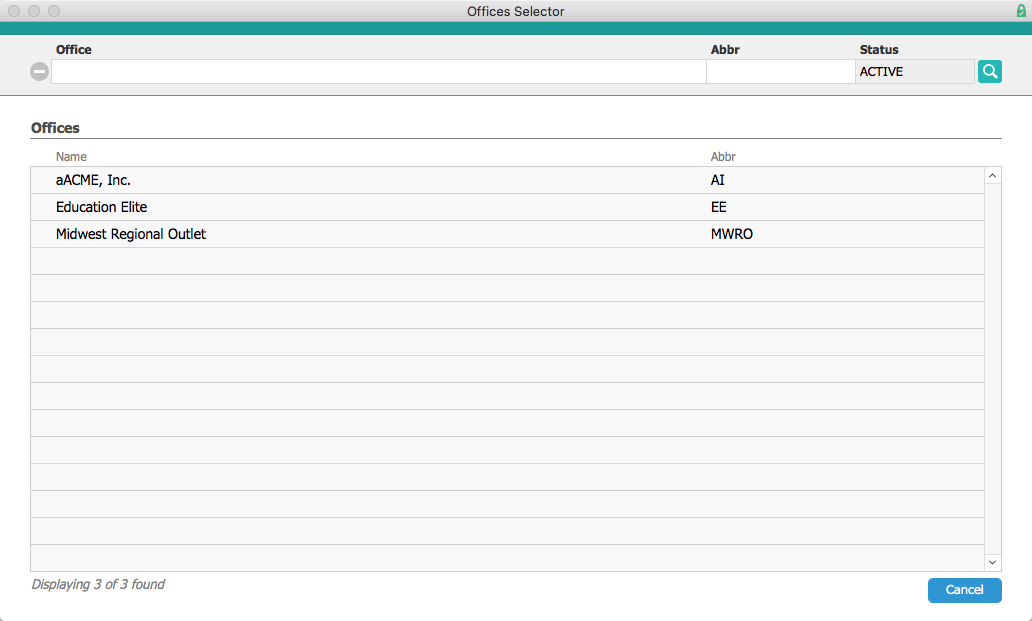
Stockroom manager Allen Wright typically works out of aACME Inc.’s main office in New York, but when the stockroom manager at the Midwest Regional Outlet is promoted out of the role, Allen is sent there to temporarily fill the vacancy. When Allen logs into aACE, he’s automatically logged into the aACME, Inc. office. But because he’s a manager, he has privileges in aACE that allow him to switch between offices. While he’s working in the outlet, he changes his office to the MWRO so that he has access to all of the correct data.

Office Selector

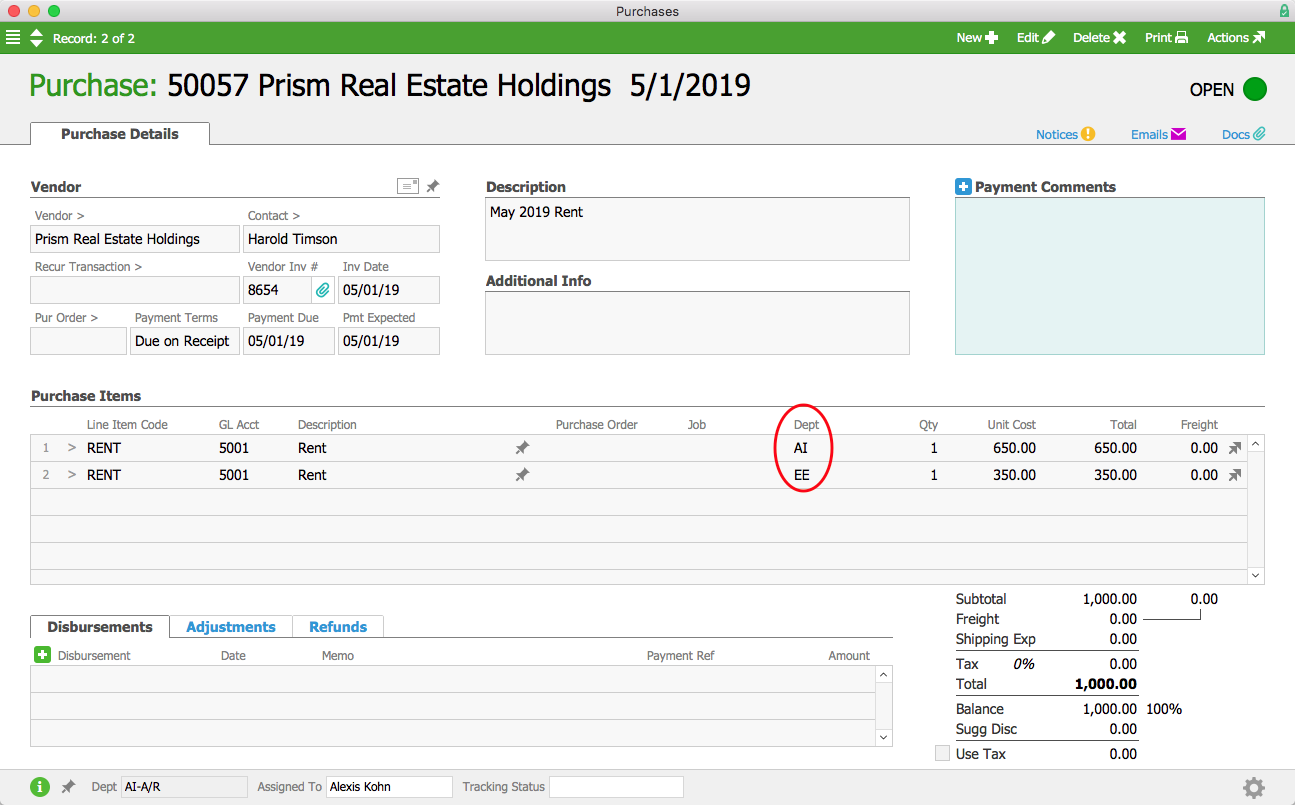
Now let’s look at how aACE handles accounting transactions among multiple entities. Education Elite is based in Texas, but they also occupy a satellite office within aACME Inc.’s Manhattan headquarters. The $1,000 monthly rent paid to aACME’s landlord, Prism Real Estate Holdings, is therefore split between the two companies. In aACME’s Accounts Payable department, Alexis Kohn enters the May rent in the Purchases module. She enters $650 for rent as the first line item, and chooses AI from the drop-down list of departments. In the second line item she enters the remaining $350 for rent and chooses EE from the list of departments.

Purchase

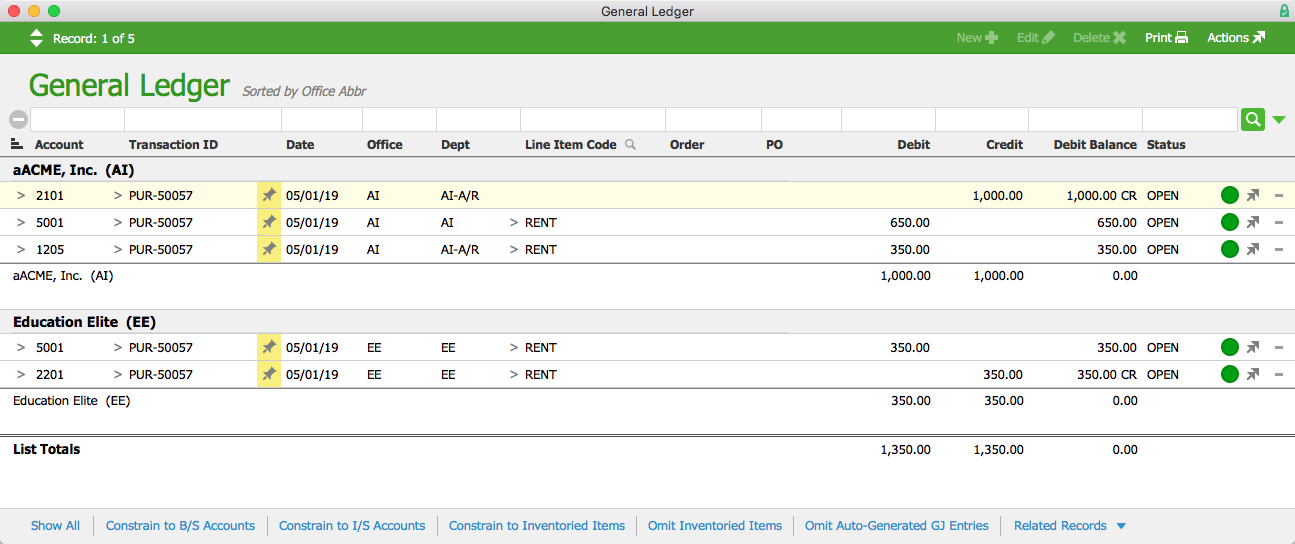
The full $1,000 is paid to the landlord in one purchase, with the correct totals attributed to each company in the general ledger. Below we can see the GL transactions associated with this purchase sorted by office. Because the purchase originated in the aACME Inc. office, the AP balance for the entire purchase is attributed to AI (Account #2101). The expense code for the rent, however, only lists the $650 that AI was responsible for under AI’s office (Account #5001). The remaining $350 is a receivable balance due from Education Elite (Account #1205). Likewise, the transactions associated with EE’s office show a $350 expense for rent (Account #5001) and a $350 payable balance due to AI (Account #2201).

GL Rent Entries

We’ve now seen several examples of workflows involving multiple entities in aACE, but what happens when an executive needs to see the bigger picture?

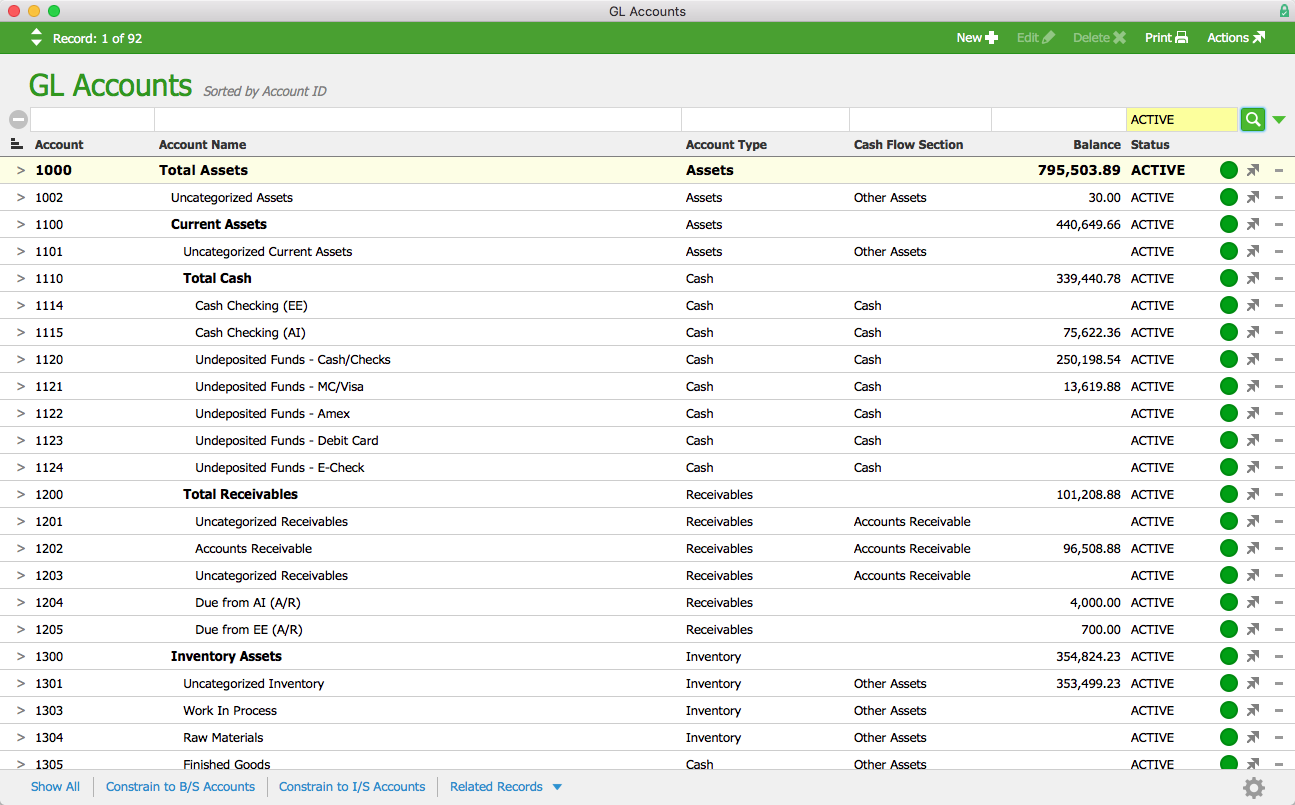
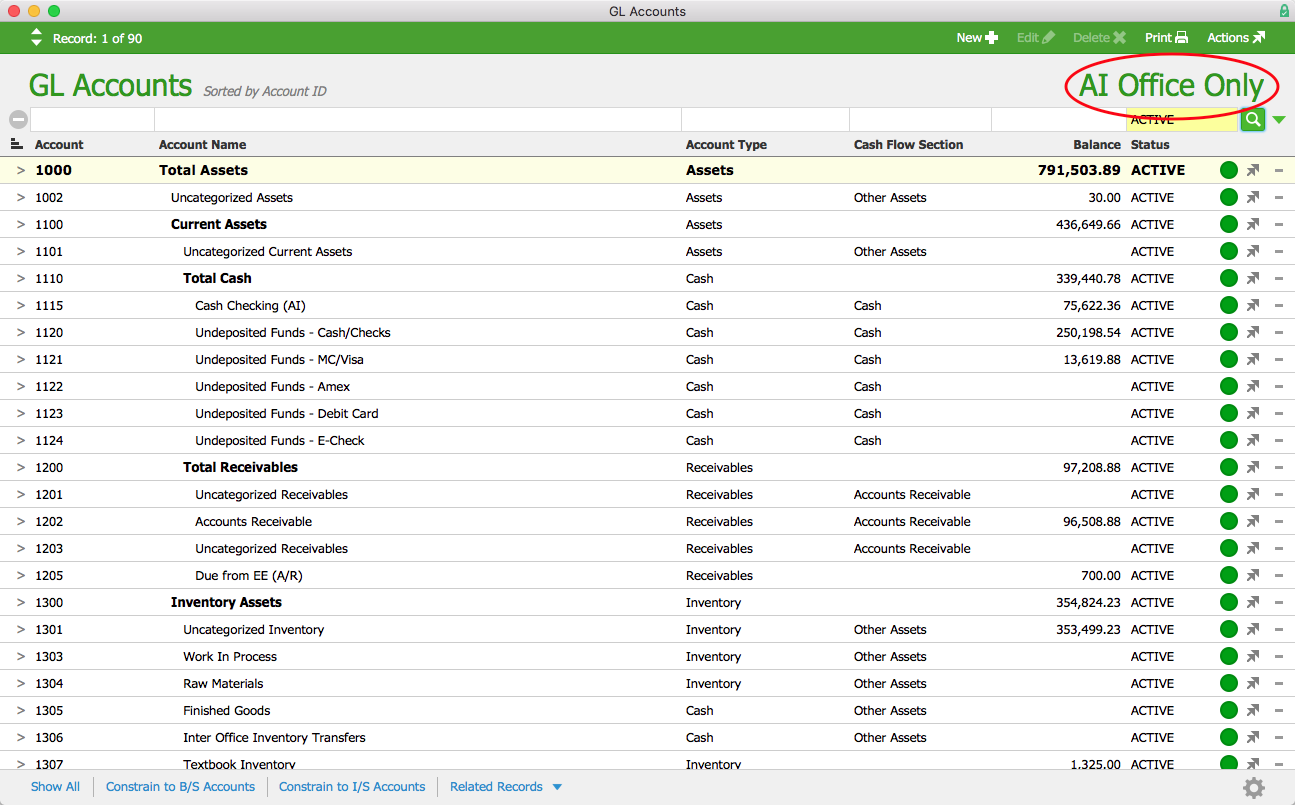
When aACME Inc. President Jacob Young logs into aACE and views the GL Accounts module, he can see accounts from each of aACME’s three offices in one consolidated chart of accounts.

GL Accounts

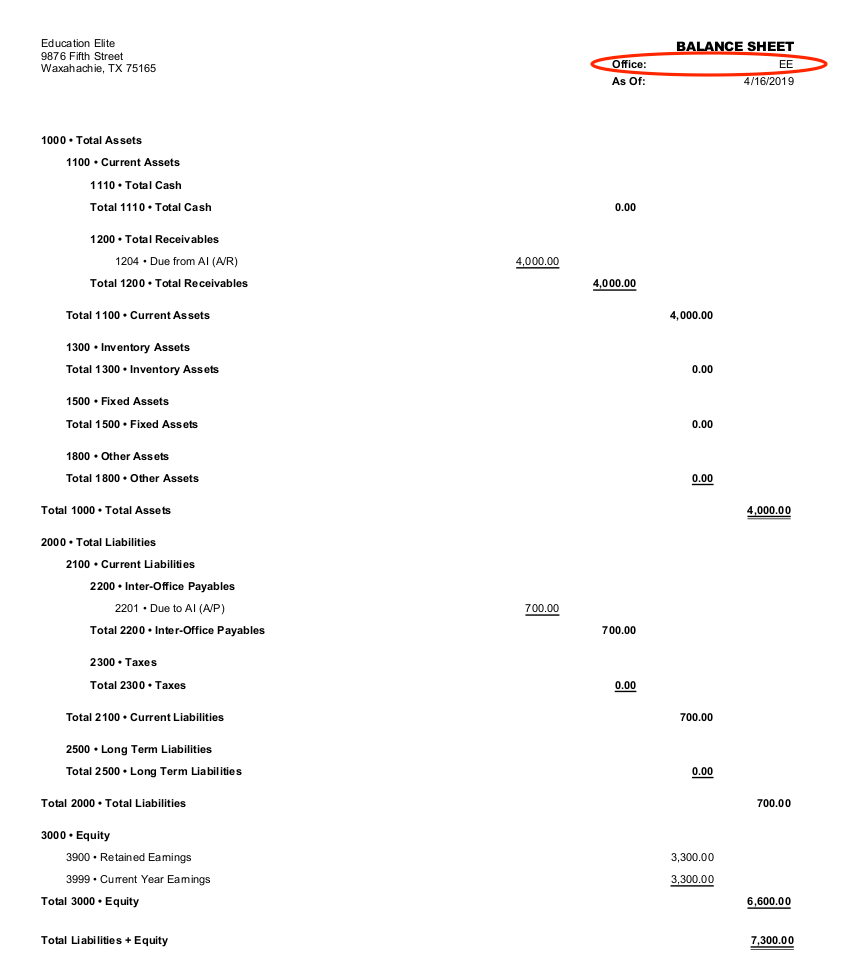
If he wants to constrain the data to a single entity — for instance, Education Elite — he can select Balance Sheet from the Print menu and choose Education Elite’s office.

EE Balance Sheet

For some purposes, it may be better to manages the three offices’ general ledgers separately. Jacob can do that by enabling a preference in aACE’s Data Entry settings. Now when he views the GL Accounts module, he’ll see only the accounts for the office he’s currently logged into.

aACME Inc GL Accounts

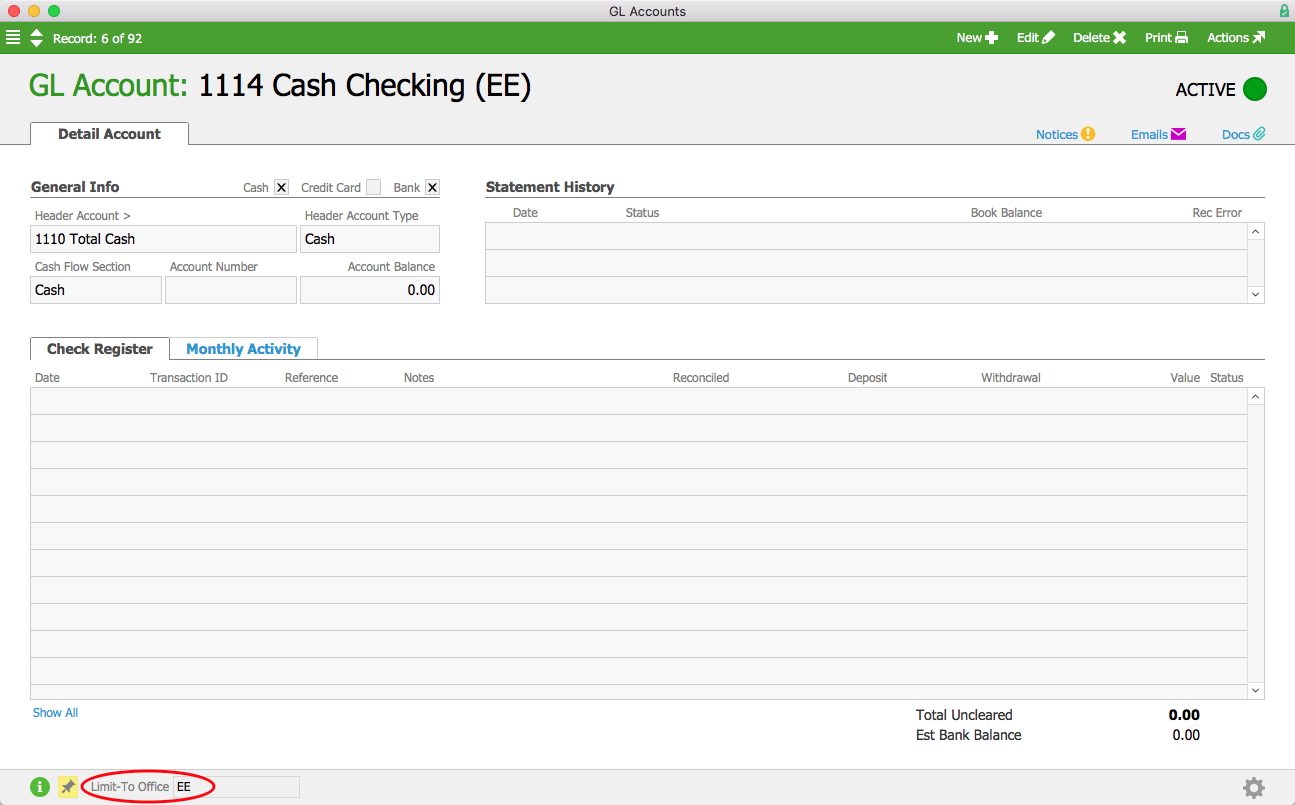
If Jacob wants to limit a particular GL account to the Education Elite office, he can simply select EE from the Limit-To Office drop down menu when creating a new GL account or editing an existing one. If the preference to prevent multi-office transactions is enabled, this GL account will not be visible to users who are not logged in to Education Elite’s office.

Cash Checking EE

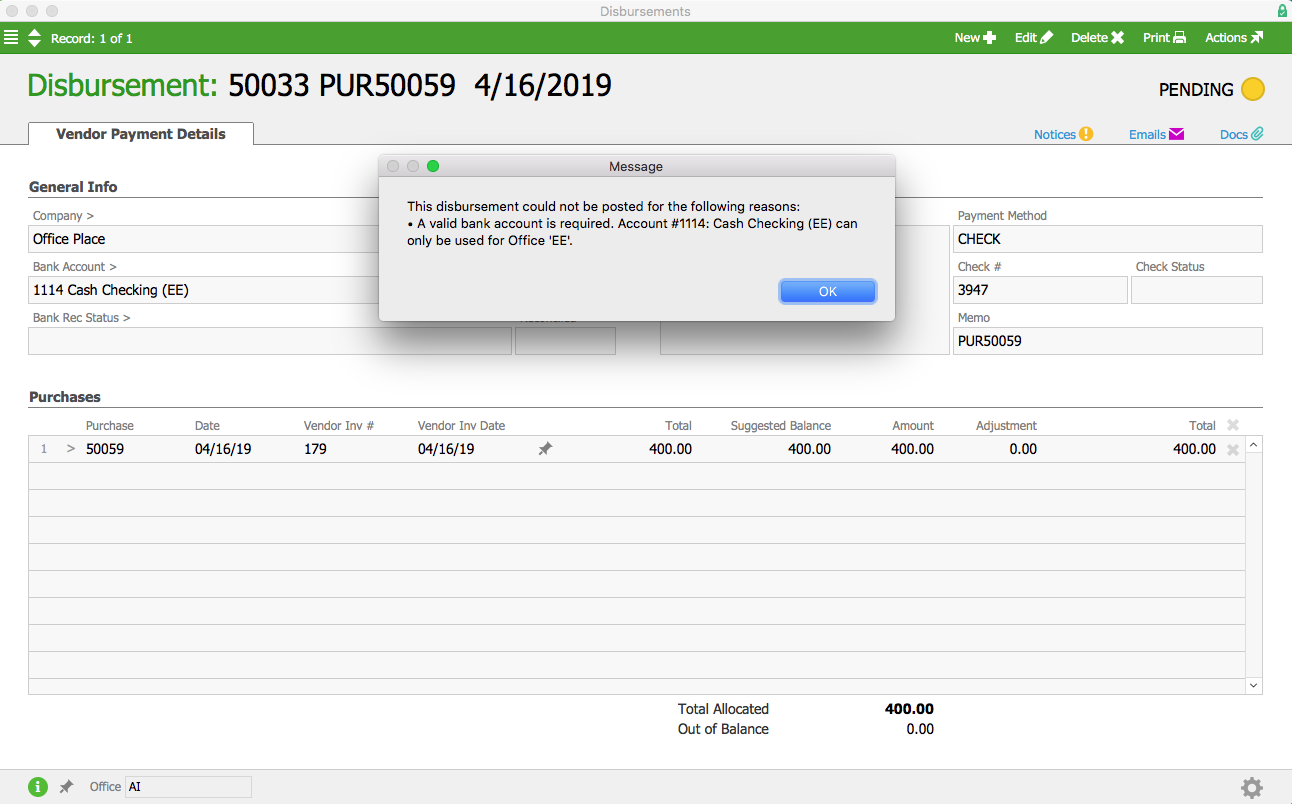
This means that when Denise James in the Accounts Payable department cuts a check for office supplies on behalf of aACME Inc. she will only be able to do so from the AI office’s checking account. If she tries to use an Education Elite account to cut a check assigned to aACME Inc., aACE will display an error message and prevent the disbursement from being posted.

Disbursement Error

These scenarios highlight some of the most useful features of aACE multi-entity accounting. Whether you’re managing multiple locations or multiple companies, aACE makes it easy to accurately track all of your data in a single, comprehensive solution. To learn more about how an actual business manages multiple entities in aACE, check out our success story on Special EFX. And to see aACE in action, register for a webinar today.

 "I cannot begin to tell you what a breath of fresh air this has been for us. Implementing aACE is the best thing we ever did. The solution evolves with us as our needs change." ~ Peter Osborne, CEO, Special EFX Ltd.

Learn More

Managing the financials for one office can be tricky enough. Add in multiple locations or even multiple separate businesses, and you may find yourself having to choose between separate accounting solutions that don’t talk to each other or a single solution that commingles data from each entity,... Learn More

-->

Managing the financials for one office can be tricky enough. Add in multiple locations or even multiple separate businesses, and you may find yourself having to choose between separate accounting solutions that don’t talk to each other or a single solution that commingles data from each entity, forcing you or your accountant to spend time manually separating out the information you need. Wouldn’t it be great if one solution could give you a clear picture of your entire financial situation?

aACE does that.

With aACE, you can track data from different locations, different offices, or even different brands in one comprehensive yet easy-to-use solution. Powerful segregation-of-duties tools allow you to control which parts of the system each user can access, while aACE’s reporting tools allow you to refine financial statements to different entities within the same solution. To see aACE’s multi-entity accounting features in action, let’s take a look at how our fictional company, aACME Education Solutions, manages multiple brands in aACE.

aACME Education Solutions sells technology, textbooks, and classroom resources for students, teachers, and school administrators. They have a regional outlet in the Midwest that sells clearance products at a discount under the aACME brand. They also conduct in-school educational programs under the Education Elite brand, based in Texas. aACME and Education Elite are two separate companies operating under the same ownership, but aACME can sell EE products and programs.

In aACME’s aACE solution there are three separate office records: aACME Inc., the Midwest Regional Outlet, and Education Elite. Each office has its own specific addresses, tax ID, departments, team members, inventory locations, and report branding.

Office Record

Users are assigned to a particular office. When they log in, their initials and the initials of their office are displayed at the bottom of the main menu. Mara Harvey, for example, is assigned to the aACME Inc. office, so when she logs in the menu displays “MH @ AI”.

Main Menu

Mara receives an order from the Highbridge Academy. They’re adding a new astronomy elective and need 30 student textbooks. To kick off the new course, they’d also like to bring Education Elite in to give a workshop on astronomy to the entire school.

Because Education Elite’s workshops can be sold by employees at aACME’s headquarters, the workshop’s product record lists the aACME Inc. office in addition to the Education Elite office. To ensure that the revenue from the workshop is attributed to Education Elite regardless of which office sells it, the product record’s department is EE-Workshops. The clearance outlet does not sell the workshops, so the Midwest Regional Outlet is not listed in the product’s record. Employees at the outlet don’t see the workshops in their system and are not able to add them to orders.

Workshop Record

As an employee in the aACME Inc. office, Mara can see the astronomy workshop in her list of products. She adds it to the Highbridge Academy order along with the textbooks they requested.

Highbridge Order

When aACE generates the invoice for this order, it will be assigned to aACME Inc. because that is where the order originated. This ensures that the customer will receive a single invoice for the entire order regardless of how many different offices they’ve ordered products from.

5 Highbridge Invoice-1

Because the workshop is assigned to Education Elite, the general ledger will attribute the revenue generated from the workshop to EE’s office. Below we can see the GL transactions associated with the invoice. The transactions have been sorted by office to show that the $4,000 revenue (Account #4001) from the workshop has been attributed to EE. There is also a receivables balance (Account #1204) for the $4,000 due from AI. We can see the corresponding payables balance (Account #2202) associated with AI’s office.

General Ledger

Later, Mara receives an order from the Shea Township School District. They would also like to run the astronomy workshop at their high school; because they have worked directly with Mara in the past, they placed the order through her instead of through Education Elite. When Mara processes the order, she changes the department associated with the order to Education Elite since she is only selling their products. This change means that the quote she sends to Shea Township will have EE’s branding instead of aACME’s.

Shea Twp Quote

As an account manager, Mara has privileges in aACE that allow her to see orders from all three offices. In the Orders module list view, she can sort her list of orders by office to see which ones belong to aACME Inc., the Midwest Regional Outlet, or Education Elite.

Orders List View

Not all users are able to view data from all of aACME’s offices. Jamie Gianelli, a sales representative for aACME Inc., is only able to view orders pertaining to her own office. If she searches for Shea Township, for example, she won’t see Order #50086 for the astronomy workshop because that order belongs to Education Elite.

Orders List View

Stockroom manager Allen Wright typically works out of aACME Inc.’s main office in New York, but when the stockroom manager at the Midwest Regional Outlet is promoted out of the role, Allen is sent there to temporarily fill the vacancy. When Allen logs into aACE, he’s automatically logged into the aACME, Inc. office. But because he’s a manager, he has privileges in aACE that allow him to switch between offices. While he’s working in the outlet, he changes his office to the MWRO so that he has access to all of the correct data.

Office Selector

Now let’s look at how aACE handles accounting transactions among multiple entities. Education Elite is based in Texas, but they also occupy a satellite office within aACME Inc.’s Manhattan headquarters. The $1,000 monthly rent paid to aACME’s landlord, Prism Real Estate Holdings, is therefore split between the two companies. In aACME’s Accounts Payable department, Alexis Kohn enters the May rent in the Purchases module. She enters $650 for rent as the first line item, and chooses AI from the drop-down list of departments. In the second line item she enters the remaining $350 for rent and chooses EE from the list of departments.

Purchase

The full $1,000 is paid to the landlord in one purchase, with the correct totals attributed to each company in the general ledger. Below we can see the GL transactions associated with this purchase sorted by office. Because the purchase originated in the aACME Inc. office, the AP balance for the entire purchase is attributed to AI (Account #2101). The expense code for the rent, however, only lists the $650 that AI was responsible for under AI’s office (Account #5001). The remaining $350 is a receivable balance due from Education Elite (Account #1205). Likewise, the transactions associated with EE’s office show a $350 expense for rent (Account #5001) and a $350 payable balance due to AI (Account #2201).

GL Rent Entries

We’ve now seen several examples of workflows involving multiple entities in aACE, but what happens when an executive needs to see the bigger picture?

When aACME Inc. President Jacob Young logs into aACE and views the GL Accounts module, he can see accounts from each of aACME’s three offices in one consolidated chart of accounts.

GL Accounts

If he wants to constrain the data to a single entity — for instance, Education Elite — he can select Balance Sheet from the Print menu and choose Education Elite’s office.

EE Balance Sheet

For some purposes, it may be better to manages the three offices’ general ledgers separately. Jacob can do that by enabling a preference in aACE’s Data Entry settings. Now when he views the GL Accounts module, he’ll see only the accounts for the office he’s currently logged into.

aACME Inc GL Accounts

If Jacob wants to limit a particular GL account to the Education Elite office, he can simply select EE from the Limit-To Office drop down menu when creating a new GL account or editing an existing one. If the preference to prevent multi-office transactions is enabled, this GL account will not be visible to users who are not logged in to Education Elite’s office.

Cash Checking EE

This means that when Denise James in the Accounts Payable department cuts a check for office supplies on behalf of aACME Inc. she will only be able to do so from the AI office’s checking account. If she tries to use an Education Elite account to cut a check assigned to aACME Inc., aACE will display an error message and prevent the disbursement from being posted.

Disbursement Error

These scenarios highlight some of the most useful features of aACE multi-entity accounting. Whether you’re managing multiple locations or multiple companies, aACE makes it easy to accurately track all of your data in a single, comprehensive solution. To learn more about how an actual business manages multiple entities in aACE, check out our success story on Special EFX. And to see aACE in action, register for a webinar today.

 "I cannot begin to tell you what a breath of fresh air this has been for us. Implementing aACE is the best thing we ever did. The solution evolves with us as our needs change." ~ Peter Osborne, CEO, Special EFX Ltd.

Learn More

Read more about Always Know Who Did What and When with aACE’s Advanced Logging Features

Always Know Who Did What and When with aACE’s Advanced Logging Features

A Day in the Life

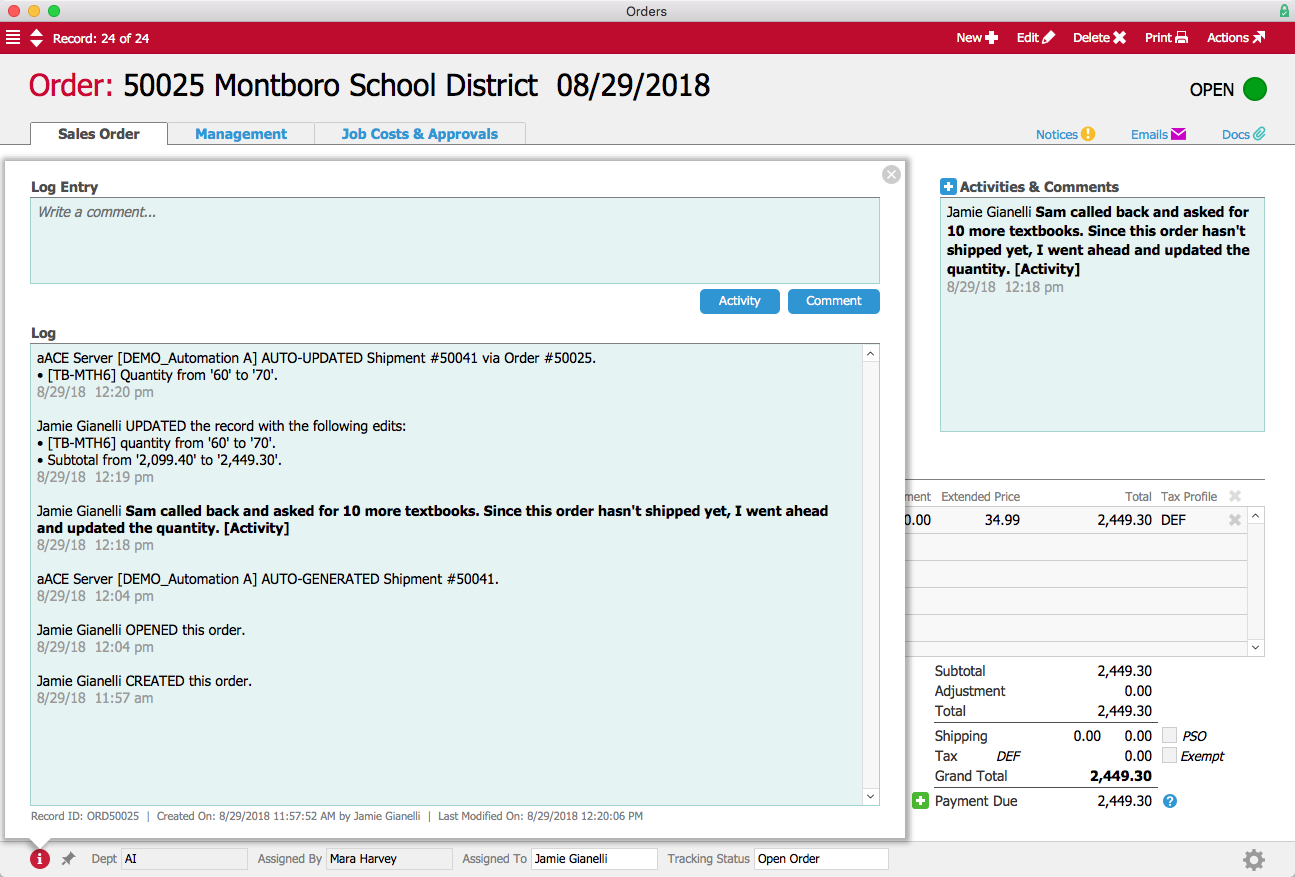
Sales rep Jamie Gianelli enters an order for 60 math textbooks placed by Sam Patel for the Montboro School District. When Sam calls back later to add an additional 10 textbooks, Jamie updates the order’s quantity and enters a note in the Activities field to document the reason for the change. The order record’s log captures both the change Jamie made and her comment explaining it, so it can easily be seen by anyone with access to the order.

Order Log


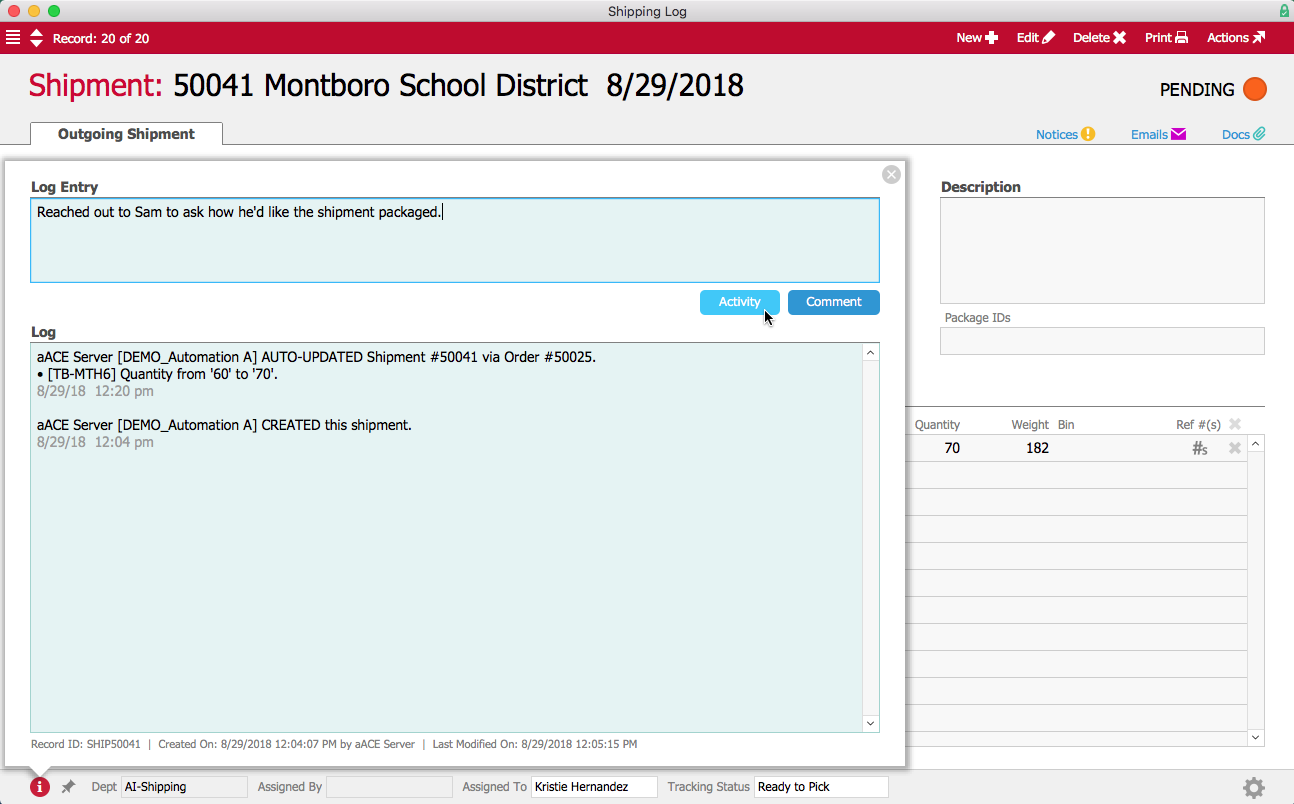
When Jamie updates the quantity of textbooks in the order record, aACE automatically updates the quantity in the associated shipment record. In the warehouse, Kristie Hernandez can see when the change was made and by whom in the shipment record’s log. If Kristie needs to contact Sam with a question, she can add that interaction in the log.

Shipment Log-1


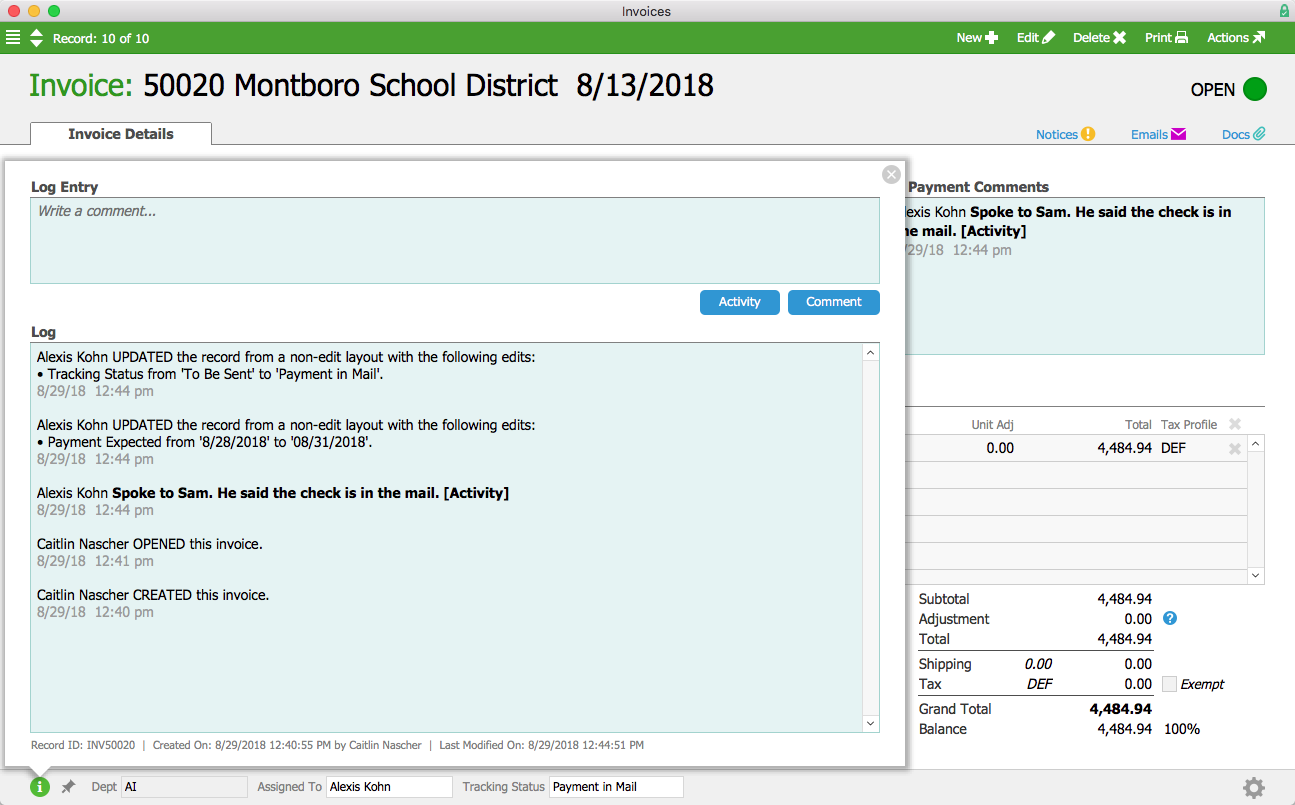
Over in the A/R department, Alexis Kohn looks through open invoices and spots one from the Montboro School District that’s past due. She gets in touch with Sam and learns that the check had been sent out that morning. Alexis changes the invoice’s tracking status to “Payment In Mail” with an expected payment date a few days ahead and a comment noting her conversation with Sam. These changes are captured in the log, so when her supervisor notices that the invoice is marked as current despite being past the due date, he can easily find the explanation.

Invoice Log


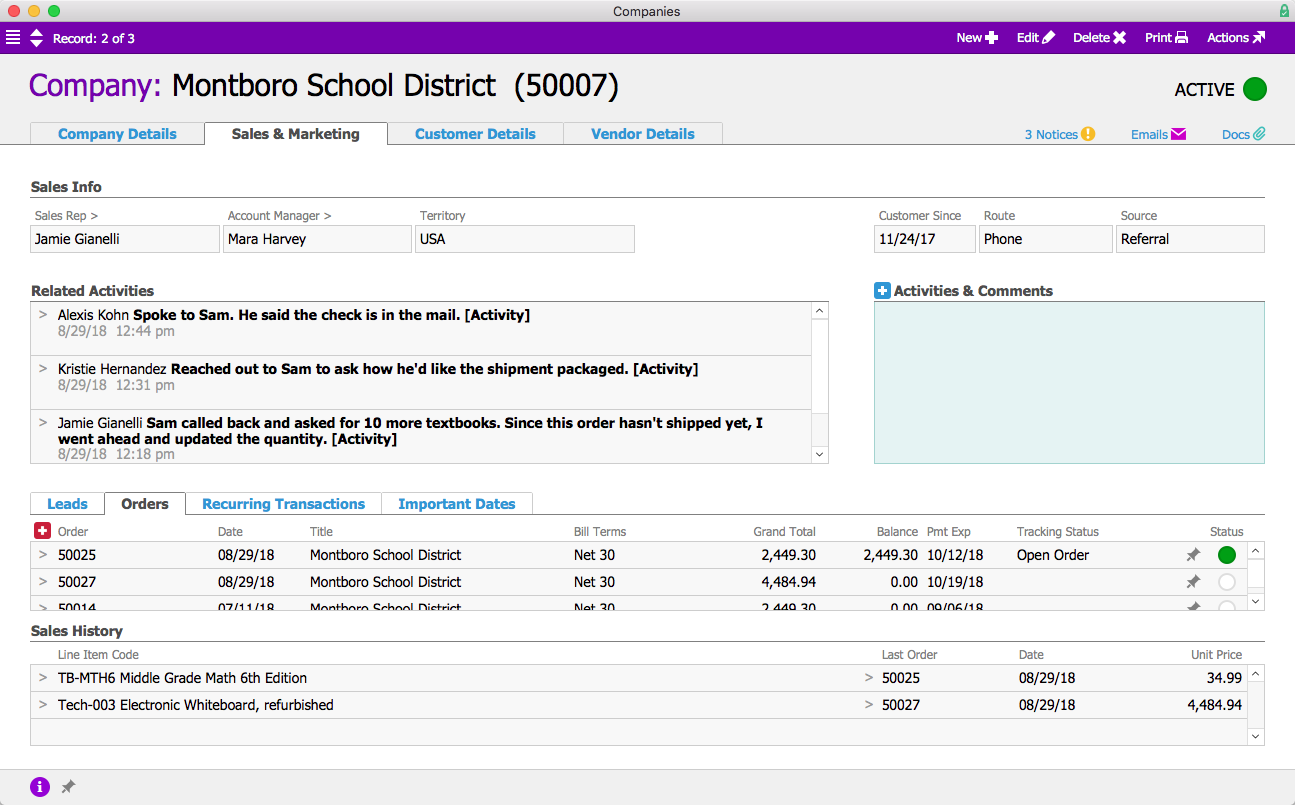
All of these activities have also been captured in the Montboro School District’s Company record, allowing Mara Harvey, the account manager, to keep track of interactions between Sam and various members of the aACME team. Each activity in the log links back to the record where it originated, allowing Mara to quickly view the source of an activity with one click.

Company Activities


But what if senior management needs to review everything a user has done in the system, not just their activity within one record? aACE’s System Logs module allows system administrators to view what a particular team member has been doing in the system across a given period of time, with links to the related records. This allows administrators to find records when users swear they completed a task but their managers aren’t sure it was done. It also gives HR managers the ability to review a user’s activity more broadly.

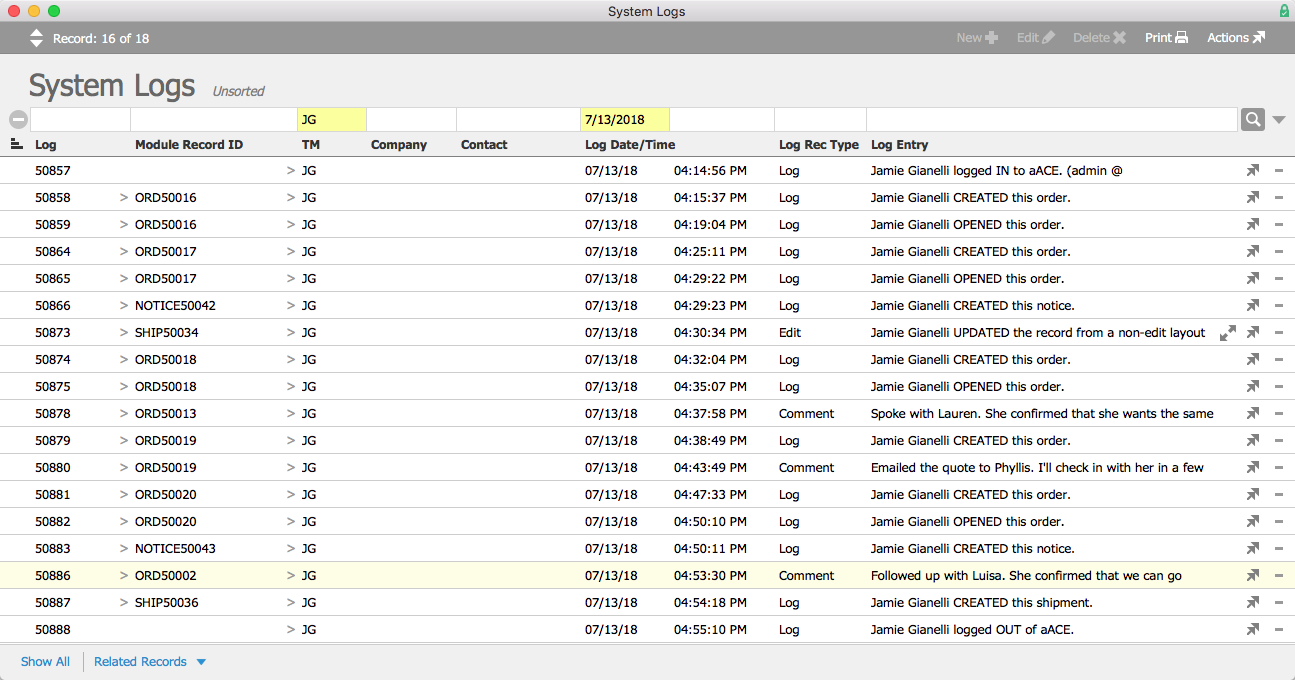
Let’s say Jamie's supervisor has a question about what she was doing on July 13th. Jamie says that she took several orders that day, and spoke to multiple clients. But her supervisor doesn’t recall that happening. They turn to their aACE system administrator to clear things up. With one quick search, they can view the logs Jamie generated that day, including links to the relevant records.

System Logs


Now that we’ve seen how aACE’s advanced logging works for our fictional company, take a look at our American Christmas success story to learn more about how this feature helped a real aACE client increase visibility throughout their business and cut their internal follow-up time by over 50%. Discover even more ways that aACE works for everyday businesses when you check out our other success stories below.

"One of my personal favorite features is the Data Log. With this feature, our team members can now see a complete account of the history of a transaction as it moves through our system. Not only does this provide us with visibility that we had never had before, but I'm pleased to say we have also greatly benefited from the increased accountability that comes with logging that all of our users have access to. And accountability, for us, has meant more consistent adoption of the processes that are important to the success of our organization." ~ Andrew J. Porter, ERP Manager, Gable
Learn More

aACE’s advanced logging features promote visibility and accountability by tracking key changes made to records, providing a clear audit trail, and ensuring you always know who did what and when. To learn more about these features, let’s look at how fictional company aACME Education Solutions... Learn More

-->

aACE’s advanced logging features promote visibility and accountability by tracking key changes made to records, providing a clear audit trail, and ensuring you always know who did what and when. To learn more about these features, let’s look at how fictional company aACME Education Solutions uses them in their day-to-day operations.

A Day in the Life

Sales rep Jamie Gianelli enters an order for 60 math textbooks placed by Sam Patel for the Montboro School District. When Sam calls back later to add an additional 10 textbooks, Jamie updates the order’s quantity and enters a note in the Activities field to document the reason for the change. The order record’s log captures both the change Jamie made and her comment explaining it, so it can easily be seen by anyone with access to the order.

Order Log


When Jamie updates the quantity of textbooks in the order record, aACE automatically updates the quantity in the associated shipment record. In the warehouse, Kristie Hernandez can see when the change was made and by whom in the shipment record’s log. If Kristie needs to contact Sam with a question, she can add that interaction in the log.

Shipment Log-1


Over in the A/R department, Alexis Kohn looks through open invoices and spots one from the Montboro School District that’s past due. She gets in touch with Sam and learns that the check had been sent out that morning. Alexis changes the invoice’s tracking status to “Payment In Mail” with an expected payment date a few days ahead and a comment noting her conversation with Sam. These changes are captured in the log, so when her supervisor notices that the invoice is marked as current despite being past the due date, he can easily find the explanation.

Invoice Log


All of these activities have also been captured in the Montboro School District’s Company record, allowing Mara Harvey, the account manager, to keep track of interactions between Sam and various members of the aACME team. Each activity in the log links back to the record where it originated, allowing Mara to quickly view the source of an activity with one click.

Company Activities


But what if senior management needs to review everything a user has done in the system, not just their activity within one record? aACE’s System Logs module allows system administrators to view what a particular team member has been doing in the system across a given period of time, with links to the related records. This allows administrators to find records when users swear they completed a task but their managers aren’t sure it was done. It also gives HR managers the ability to review a user’s activity more broadly.

Let’s say Jamie's supervisor has a question about what she was doing on July 13th. Jamie says that she took several orders that day, and spoke to multiple clients. But her supervisor doesn’t recall that happening. They turn to their aACE system administrator to clear things up. With one quick search, they can view the logs Jamie generated that day, including links to the relevant records.

System Logs


Now that we’ve seen how aACE’s advanced logging works for our fictional company, take a look at our American Christmas success story to learn more about how this feature helped a real aACE client increase visibility throughout their business and cut their internal follow-up time by over 50%. Discover even more ways that aACE works for everyday businesses when you check out our other success stories below.

"One of my personal favorite features is the Data Log. With this feature, our team members can now see a complete account of the history of a transaction as it moves through our system. Not only does this provide us with visibility that we had never had before, but I'm pleased to say we have also greatly benefited from the increased accountability that comes with logging that all of our users have access to. And accountability, for us, has meant more consistent adoption of the processes that are important to the success of our organization." ~ Andrew J. Porter, ERP Manager, Gable
Learn More

Scroll to Top